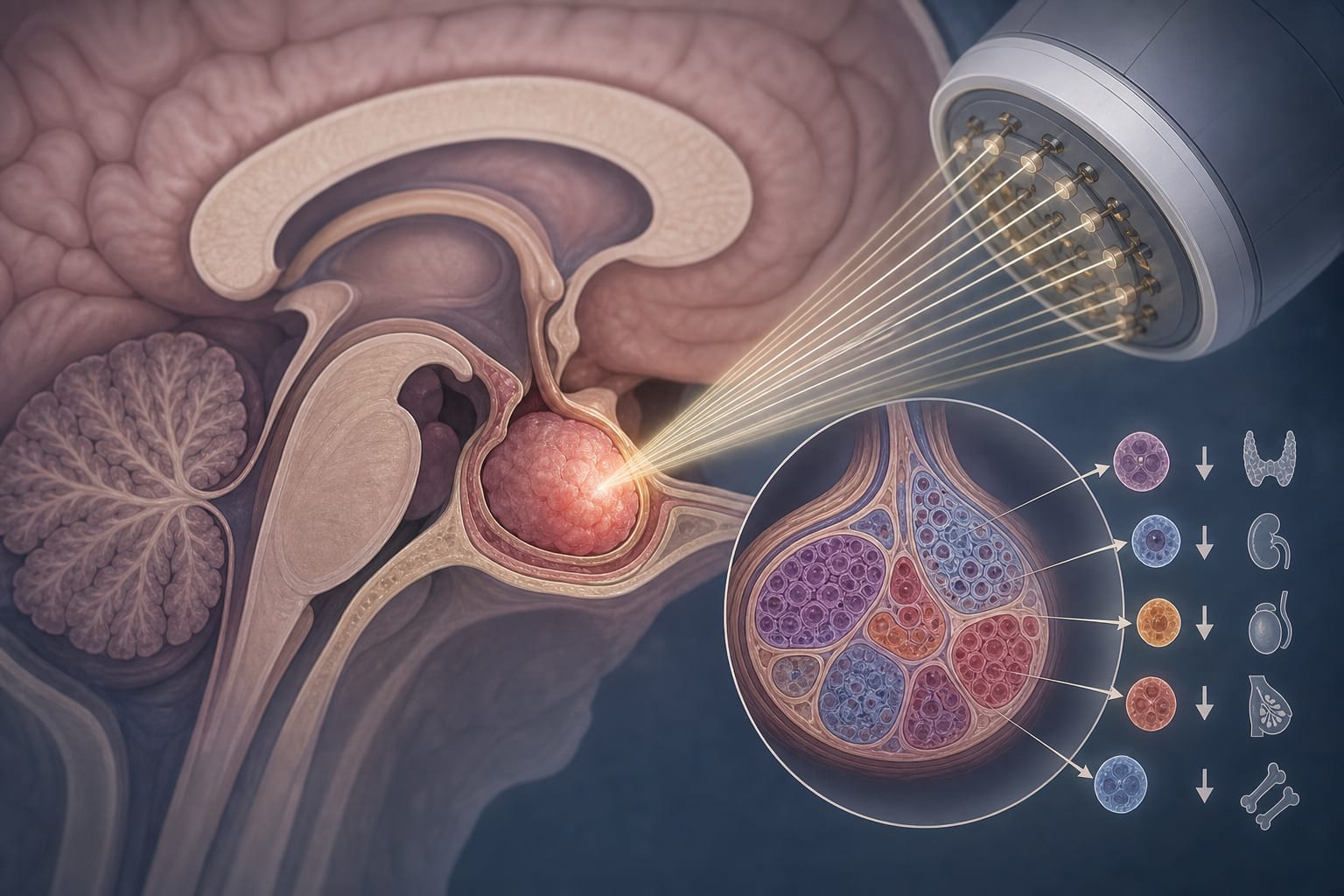
Clinical Scorecard: Post-Stereotactic Radiosurgery Pituitary Hormone Dysfunction in Patients with Pituitary Adenomas: Understanding Mechanisms and Treatment Approaches
At a Glance
Category
Detail
Condition
Pituitary hormone dysfunction following stereotactic radiosurgery (SRS) for pituitary adenomas.
Key Mechanisms
Hormonal dysfunction may result from damage caused by the tumor or its treatment, including SRS.
Target Population
Patients with pituitary adenomas treated with SRS, including those with functioning and nonfunctioning tumors.
Care Setting
Multidisciplinary pituitary care involving endocrinology, neurosurgery, and radiation oncology.
Key Highlights
SRS is used for tumor control and hormonal normalization in PAs - needs source.
Guideline-Based Recommendations
Diagnosis
Assess pituitary function before SRS, including evaluation for hormone hypersecretion and deficiencies.
After treatment, evaluate for new or worsening pituitary hormone deficiencies and distinguish these from pre-existing dysfunction.
Management
Surgical resection is preferred for symptomatic NFPAs and FPAs - needs source.
Monitoring & Follow-up
Continue long-term endocrine follow-up after SRS, as pituitary hormone deficiencies may develop after treatment.
Monitor pituitary hormone function periodically and assess tumor status with appropriate imaging follow-up.
Provide hormone replacement when deficiencies are identified, with ongoing reassessment of treatment needs.
Risks
New or progressive hypopituitarism is a potential late complication of SRS.
The risk and pattern of hormone dysfunction may vary with tumor characteristics, prior treatment, and radiation exposure to the normal pituitary gland and surrounding structures.
Patient & Prescribing Data
Patients should be informed that pituitary hormone dysfunction can occur or progress after SRS and may require long-term monitoring and hormone replacement.
Clinical Best Practices
Document baseline pituitary hormone function before SRS and use it to guide post-treatment assessment.
Coordinate follow-up among endocrinology, neurosurgery, and radiation oncology.
Consider surgical debulking prior to SRS for better outcomes - needs source.