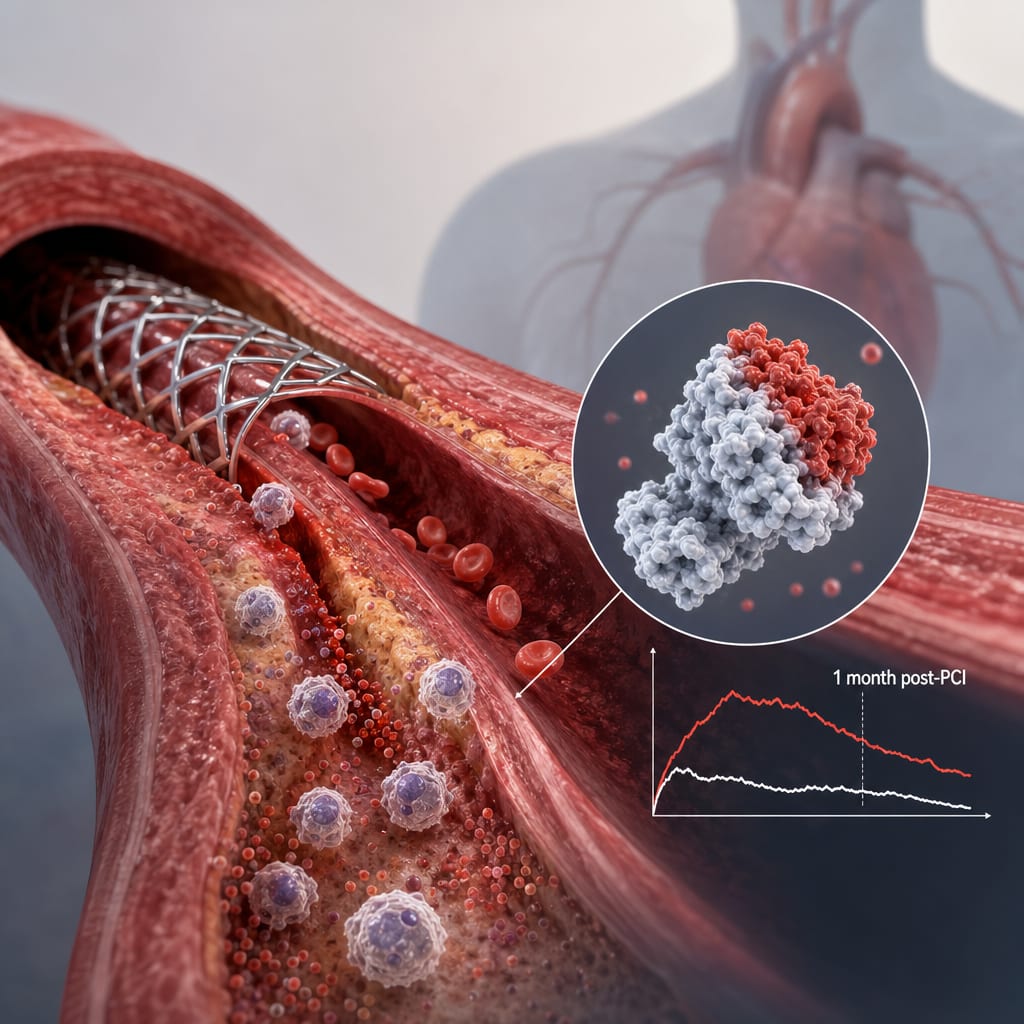
Persistent residual inflammatory risk at 1 month after contemporary PCI: rationale for routine hsCRP reassessment and dual-target therapy
-
By
-
Xinwang Gong
-
Chang Zhou
-
Yutao Wu
-
May 1, 2026
-
Clinical Scorecard: Ongoing Residual Inflammatory Risk One Month Post-Contemporary PCI: Justification for Regular hsCRP Monitoring and Dual-Target Treatment
At a Glance
| Category | Detail |
|---|
| Condition | Residual Inflammatory Risk (RIR) post-PCI |
| Key Mechanisms | NLRP3 inflammasome activation, IL-1β/IL-6 signaling, macrophage-mediated plaque inflammation |
| Target Population | Patients undergoing contemporary percutaneous coronary intervention (PCI) |
| Care Setting | Cardiology clinics and hospitals performing PCI |
Key Highlights
- 43% of patients show sustained hsCRP elevation ≥2 mg/L at 1 month post-PCI.
- Persistent RIR is an independent predictor of 12-month MACE and all-cause mortality.
- Optimal secondary prevention requires both LDL-C <70 mg/dL and hsCRP <2 mg/L.
- Routine hsCRP monitoring at 1 month may identify patients needing targeted anti-inflammatory treatment.
- Current guidelines do not mandate systematic hsCRP reassessment post-PCI.
Guideline-Based Recommendations
Diagnosis
- Assess hsCRP levels at 1 month post-PCI to evaluate residual inflammatory risk.
Management
- Consider low-dose colchicine or IL-6 pathway inhibitors for patients with persistent RIR.
Monitoring & Follow-up
- Regularly monitor hsCRP levels to identify patients at risk for recurrent cardiovascular events.
Risks
- Elevated hsCRP at 1 month is associated with increased risk of MACE and all-cause mortality.
Patient & Prescribing Data
Patients with elevated hsCRP post-PCI despite optimal LDL-C management.
Targeted anti-inflammatory therapies may reduce cardiovascular events in patients with persistent RIR.
Clinical Best Practices
- Implement routine hsCRP monitoring at 1 month post-PCI.
- Adopt a dual-target strategy for secondary prevention focusing on both LDL-C and hsCRP levels.
References