Efficacy and safety of transoral incisionless fundoplication in non-obese and obese adults: a population-based cohort study from the United States - Scorecard - MDSpire
Conexiant’s news site is now MDSpire News. Learn more
Advertisement
Effectiveness and safety of transoral incisionless fundoplication in adults with varying body weights: findings from a U.S. population-based cohort study
Clinical Scorecard: Effectiveness and safety of transoral incisionless fundoplication in adults with varying body weights: findings from a U.S. population-based cohort study
At a Glance
Category
Detail
Condition
Gastroesophageal reflux disease (GERD)
Key Mechanisms
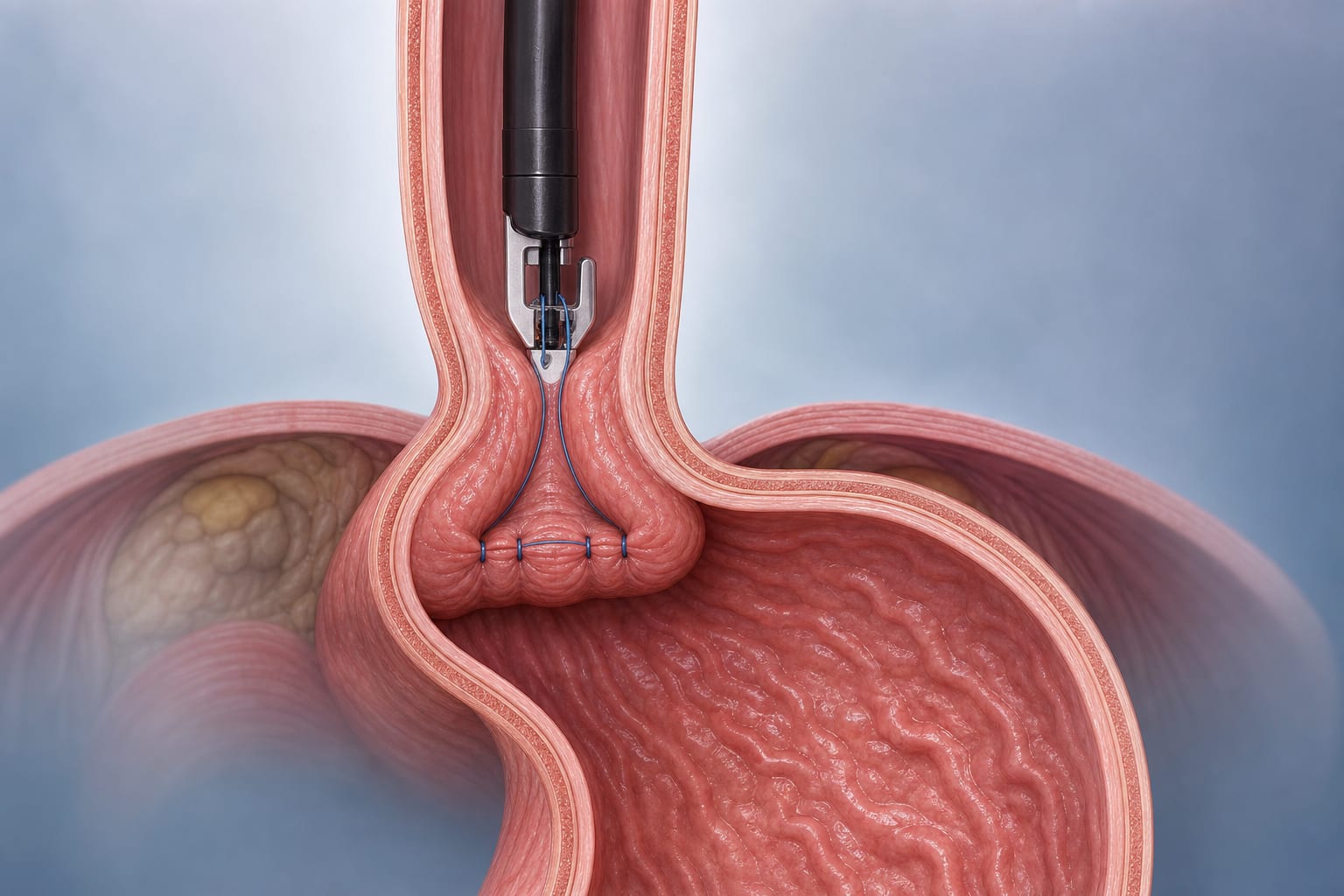
Transoral incisionless fundoplication (TIF) repairs the anti-reflux barrier via flap valve reconstruction, restoring the angle of His, and augmenting the high-pressure zone at the lower esophageal sphincter.
Target Population
Adults aged ≥ 18 years with chronic symptomatic GERD
Care Setting
U.S. population-based cohort study using electronic medical records
Key Highlights
TIF is effective for patients with axial hernia < 2 cm or hiatus diameters < 3 cm.
TIF has comparable efficacy to surgical fundoplication in appropriately selected patients.
BMI ≥ 35 kg/m2 is a relative contraindication for TIF.
Class 1 obesity (BMI 30–34.9 kg/m2) represents a significant cohort of GERD patients.
Combining TIF with cruroplasty shows comparable short-term efficacy and excellent safety.
Guideline-Based Recommendations
Diagnosis
Diagnosis of GERD should be confirmed using validated ICD-10 codes.
Management
Consider TIF for patients with axial hernia < 2 cm or hiatus diameters < 3 cm.
Monitoring & Follow-up
Monitor for postoperative new PPI recidivism and incidence of post-TIF esophagitis.
Risks
Higher fundoplication failure rates with increasing BMI and potential for perioperative complications.
Patient & Prescribing Data
Adults with GERD stratified by BMI: non-obese (BMI < 30 kg/m2) and class I obesity (BMI 30–34.9 kg/m2).
TIF may be effective in class I obesity, but BMI ≥ 35 kg/m2 is a contraindication.
Clinical Best Practices
Perform one-to-one propensity score matching to minimize confounding.
Assess covariate balance post-matching to ensure comparability between BMI cohorts.
Related Resources & Content
Obesity Surgery, 2025 -- Surgical Options for Managing GERD in Individuals with Moderate Obesity: Comparing Fundoplication and Roux-en-Y Gastric Bypass
Journal of Gastrointestinal Surgery, 2021 -- Laparoscopic Fundoplication Demonstrates Efficacy in Treating Gastroesophageal Reflux in Patients with Impaired Esophageal Motility
Obesity Surgery, 2025 -- Safety Profiles of Roux-en-Y Gastric Bypass and Sleeve Gastrectomy in Patients with Prior Fundoplication: An Analysis of 499 Cases from MBSAQIP
ASGE guideline on the diagnosis and management of GERD: summary and recommendations
Obesity Surgery — Factors Influencing the Effectiveness of Endoscopic Sleeve Gastroplasty
ASGE | American Society for Gastrointestinal Endoscopy guideline on the diagnosis and management of GERD: summary and recommendations
Transoral Incisionless Fundoplication Effective in Eliminating GERD Symptoms in Partial Responders to Proton Pump Inhibitor Therapy at 6 Months: The TEMPO Randomized Clinical Trial - PMC
Does Transoral Incisionless Fundoplication (TIF. 2.0) Improve Atypical GERD Symptoms? A Systematic Review and Meta-Analysis - PMC
by Fouad Jaber, Saltenat Moghaddam Adames, Mohamed Jaber, Kinan Obiedat, Kalpesh Patel, Teminioluwa A. Ajayi, Roy Tomas DaVee, Fares W. Ayoub, Nirav Thosani, Wasseem Skef