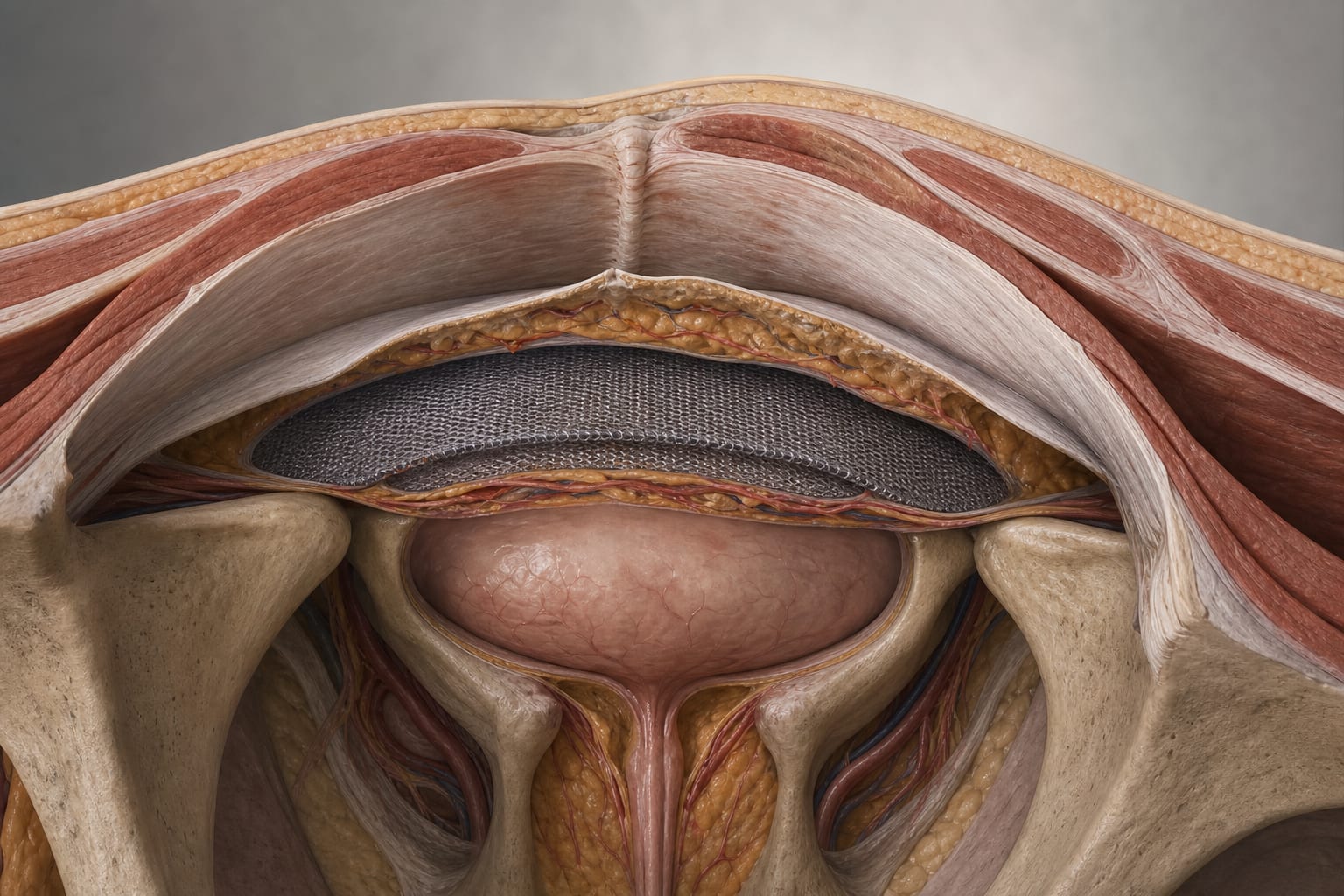
Urinary implications of retropubic dissection during abdominal wall reconstruction: Early results from a clinical quality assurance initiative - Scorecard - MDSpire
Clinical Scorecard: Impact of Retropubic Dissection on Urinary Function in Abdominal Wall Reconstruction: Initial Findings from a Clinical Quality Improvement Study
At a Glance
Category
Detail
Condition
Urinary Incontinence (UI)
Key Mechanisms
Retropubic dissection and mesh placement in abdominal wall reconstruction may exacerbate UI.
Target Population
Predominantly female patients aged > 60 years undergoing ventral hernia repair with transversus abdominis release.
Care Setting
High-volume abdominal wall reconstruction practice at a quaternary care academic medical center.
Key Highlights
High prevalence of urinary incontinence post-abdomino-pelvic operations.
Retropubic dissection associated with risk of urinary incontinence.
Quality assurance initiative to assess UI prevalence using UDI-6 survey.
Survey captures patient-reported outcomes related to urinary symptoms.
Focus on understanding urinary consequences of surgical interventions.
Guideline-Based Recommendations
Diagnosis
Use UDI-6 survey to assess urinary distress and symptoms.
Management
Consider risk–benefit counseling for patients undergoing TAR.
Monitoring & Follow-up
Monitor urinary function pre- and postoperatively using validated tools.
Risks
Awareness of potential urinary incontinence following retropubic dissection.
Patient & Prescribing Data
Patients undergoing ventral hernia repair via open transversus abdominis release.
Inclusion criteria focused on candidacy for TAR; exclusion for certain urological conditions.
Clinical Best Practices
Incorporate UDI-6 into routine clinical care for assessing UI.
Ensure thorough preoperative assessment of urinary function.
Utilize deidentified data for quality assurance initiatives.
by William C. Bennett, Emerson Lora, Mahamed O. Mohamed, Alvaro C. Carvalho, Noah X. Tocci, Erika M. Schmidt, Joseph Edwards, Ashley M. Mila-Hoff, Kimberly S. Miles, Sandip Vasavada, Clayton C. Petro, Ajita S. Prabhu
“High-dose intravenous vitamin C administered early after injury did not reduce organ dysfunction or [mortality] and should not be a treatment in severe burns.”