Selective vagus–recurrent laryngeal nerve anastomosis guided by intraoperative neuromonitoring: evidence of lateral motor fiber clustering in the vagus nerve - Scorecard - MDSpire
Advertisement
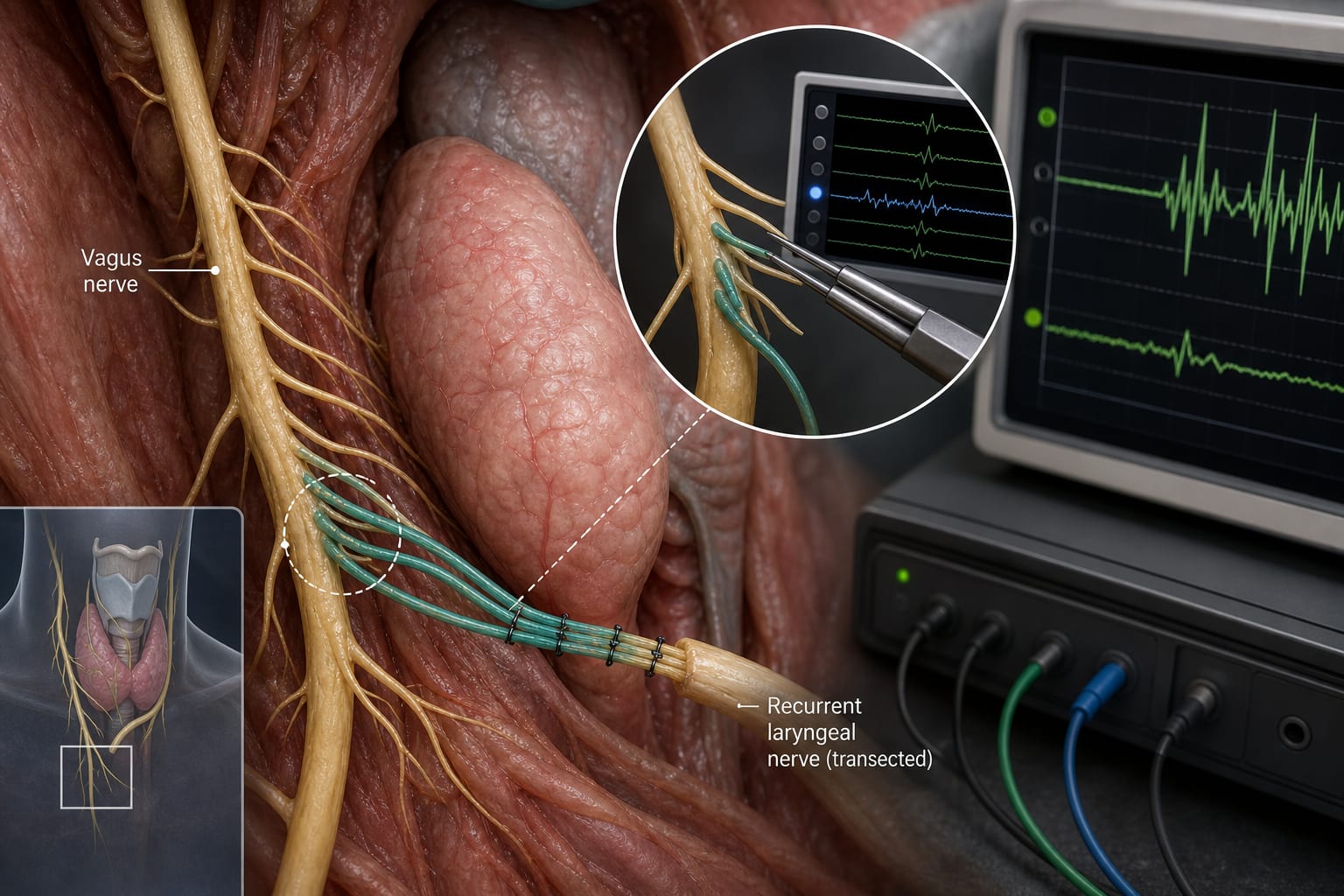
Selective vagus–recurrent laryngeal nerve anastomosis guided by intraoperative neuromonitoring: evidence of lateral motor fiber clustering in the vagus nerve
Clinical Scorecard: Intraoperative Neuromonitoring-Guided Selective Anastomosis of the Vagus and Recurrent Laryngeal Nerve: Insights into Lateral Motor Fiber Grouping in the Vagus Nerve
At a Glance
Category
Detail
Condition
Recurrent Laryngeal Nerve Transection
Key Mechanisms
Intraoperative neuromonitoring (IONM) to map vagus nerve motor fibers for selective anastomosis.
Target Population
Patients undergoing thyroid surgery with recurrent laryngeal nerve transection.
Care Setting
Experimental surgical model in a porcine model.
Key Highlights
Low-current IONM maps a consistent posterolateral cluster of laryngeal motor fibers in the cervical vagus nerve.
Selective vagus–RLN anastomosis using this cluster achieves immediate EMG recovery comparable to direct anastomosis.
The technique preserves most vagal trunk fibers and may be a function-preserving alternative when tension precludes direct RLN repair.
Guideline-Based Recommendations
Diagnosis
Identify recurrent laryngeal nerve transection during thyroid surgery.
Management
Consider selective vagus-recurrent laryngeal nerve anastomosis (SVRA) when direct anastomosis is not feasible.
Monitoring & Follow-up
Utilize intraoperative neuromonitoring (IONM) to assess vagus nerve motor fibers.
Risks
Monitor for hemodynamic changes during vagus nerve manipulation.
Patient & Prescribing Data
Porcine model representing human laryngeal and cervical nerve anatomy.
SVRA technique allows for targeted reconstruction while preserving vagus nerve integrity.
Clinical Best Practices
Employ low-current IONM for mapping motor fibers during nerve anastomosis.
Ensure careful dissection to minimize trauma to vagus nerve trunk.