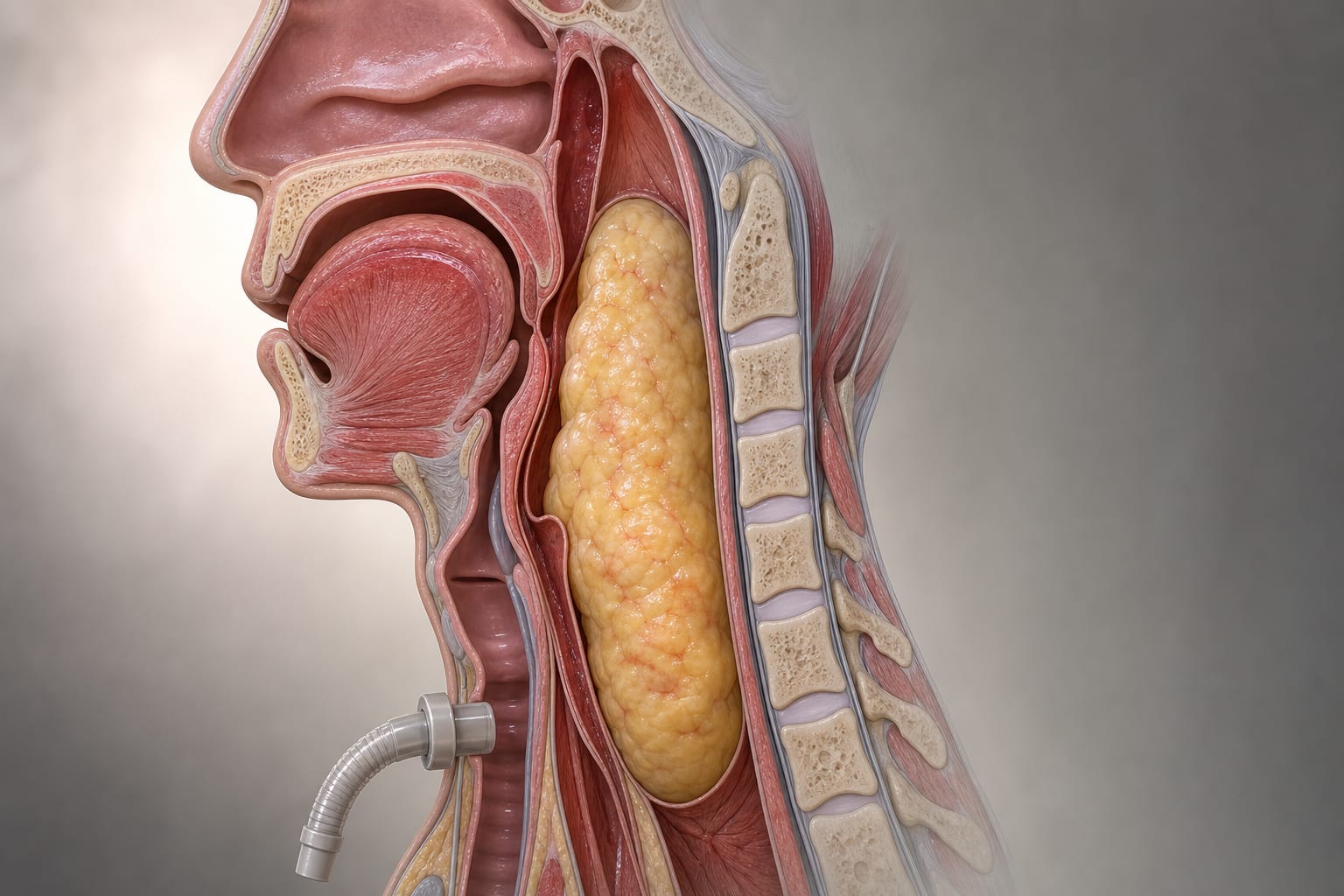
A giant retropharyngeal space lipoma: a case report and review of the literature
By
Takashi Koike
Ryo Takagi
Kosei Mori
Kengo Kanai
Yoshihiro Watanabe
Mitsuhiro Okano
Yoshihiro Noguchi
Yuichiro Hayashi
Mina Komuta
Yorihisa Imanishi
June 24, 2026
Clinical Scorecard: A Case Study of a Large Retropharyngeal Lipoma: Insights and Literature Review
At a Glance
Category Detail
Condition Retropharyngeal Lipoma (RPL) Key Mechanisms Benign mesenchymal tumor occurring in the retropharyngeal space, often asymptomatic until large. Target Population Males, particularly those presenting with dysphagia and respiratory symptoms. Care Setting Surgical intervention in a hospital setting.
Key Highlights
Giant RPLs can exceed 10 cm in diameter and may present with multiple symptoms. Computed tomography (CT) is effective for diagnosing RPL. Surgical excision is the primary treatment, often requiring a transcervical approach. Prophylactic tracheostomy may be necessary in cases of large RPL to prevent airway compromise. Nerve integrity monitoring (NIM) can assist in preserving the recurrent laryngeal nerve during surgery. Guideline-Based Recommendations
Diagnosis
Use CT for initial imaging to confirm the presence of a well-circumscribed, fat-density mass. MRI can provide detailed information about the relationship of the lesion with surrounding structures. Management
Surgical excision is recommended for symptomatic RPL, especially when large. Monitoring & Follow-up
Postoperative monitoring for airway compromise and symptom resolution is essential. Risks
Potential for airway compromise during surgery, necessitating careful preoperative planning. Patient & Prescribing Data
Adult males with retropharyngeal lipoma presenting with dysphagia and respiratory symptoms.
Surgical resection is effective in resolving symptoms, with careful consideration of airway management.
Clinical Best Practices
Assess the size and symptoms of RPL to determine the surgical approach. Consider prophylactic tracheostomy in cases of large RPL to mitigate airway risks. Utilize NIM during surgery to protect the recurrent laryngeal nerve. Related Resources & Content