Scleral Lens Simplicity: Utilizing Anterior Segment OCT for Scleral Lens Fitting
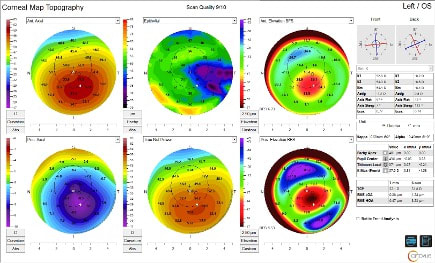
A 26-year-old with keratoconus saw major visual improvement with scleral lenses, highlighting the benefits of anterior segment OCT in lens fitting accuracy.
Clinical Scorecard: Scleral Lens Simplicity: Utilizing Anterior Segment OCT for Scleral Lens Fitting
At a Glance
Category Detail
Condition Keratoconus Key Mechanisms Utilization of anterior segment OCT for scleral lens fitting accuracy. Target Population Patients with keratoconus requiring scleral lens fitting. Care Setting Specialty contact lens clinic.
Key Highlights
Anterior segment OCT improves scleral lens fitting accuracy. Scleral lens corrected visual acuity improved to 20/25 in both eyes. Diagnostic scleral lens fitting revealed significant visual improvement. Central clearance of scleral lens ideally around 200 µm. OCT assists in evaluating edge alignment and limbal clearance. Guideline-Based Recommendations
Diagnosis
Utilize topography and anterior segment examination to assess keratoconus. Management
Prescribe scleral lenses based on diagnostic fitting results. Monitoring & Follow-up
Follow-up examinations to assess lens fit and ocular health. Risks
Monitor for conjunctival prolapse and excessive limbal hyperemia. Patient & Prescribing Data
Individuals with progressive keratoconus requiring visual correction.
Scleral lenses provide significant visual improvement and comfort.
Clinical Best Practices
Use anterior segment OCT to enhance scleral lens fitting accuracy. Aim for central clearance of approximately 200 µm during fitting. Ensure proper edge alignment to prevent conjunctival issues. References