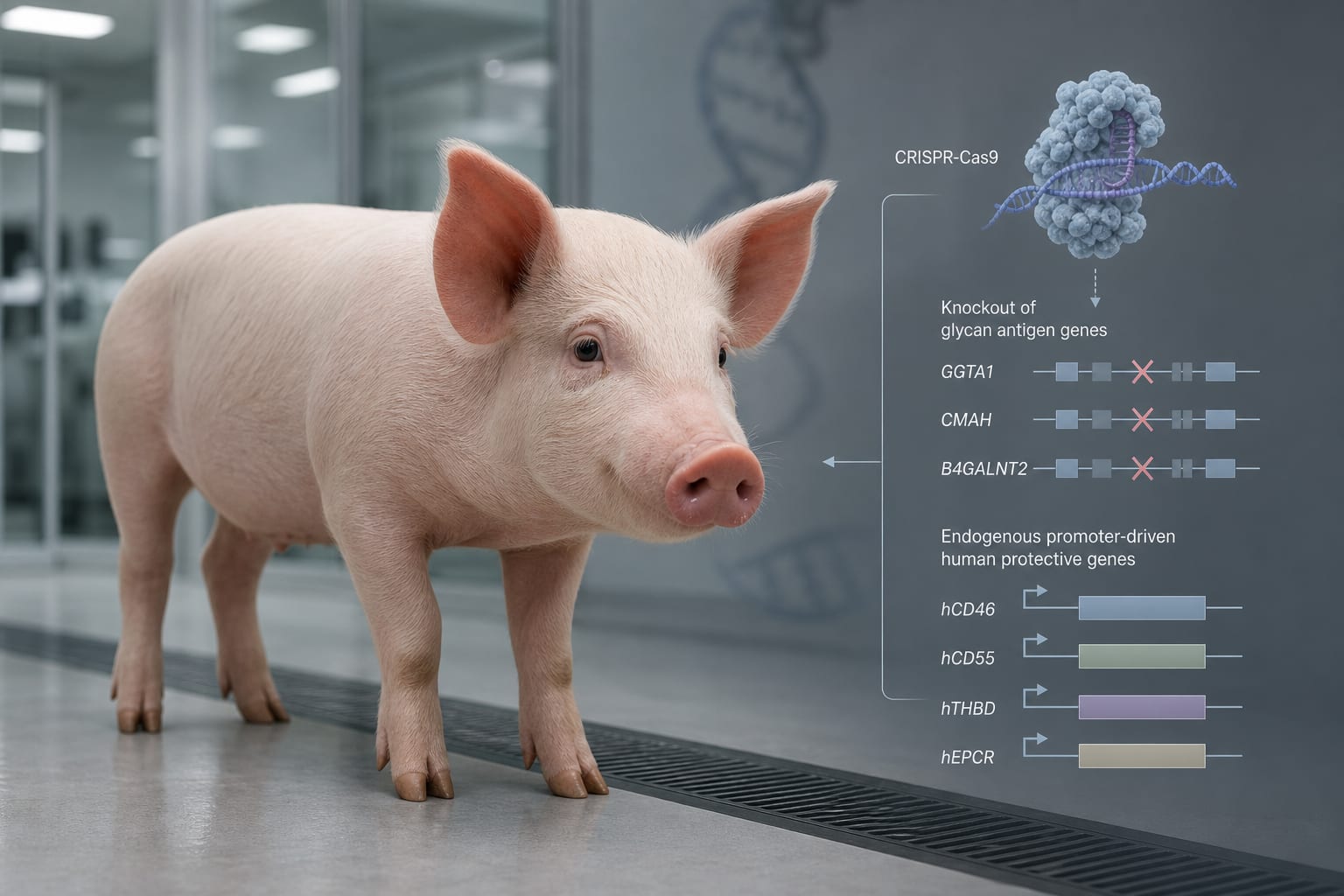
Development of a BM7G(TKO/hCD46/hCD55/hTHBD/hEPCR) donor pig with endogenous promoter-driven transgenes for xenotransplantation
-
By
-
Cong Xia
-
Meng Lian
-
Bingxiu Ma
-
Hongliang Yu
-
Renquan Zhang
-
Lijia Wen
-
Xueliang Wang
-
Yu Zhao
-
Zhen Ouyang
-
Yinghua Ye
-
Xiner Feng
-
Han Wu
-
Liangxue Lai
-
June 23, 2026
-
Clinical Scorecard: Creation of a BM7G(TKO/hCD46/hCD55/hTHBD/hEPCR) Genetically Modified Donor Pig Featuring Endogenous Promoter-Driven Transgenes for Enhanced Xenotransplantation
At a Glance
| Category | Detail |
|---|
| Condition | Xenotransplantation |
| Key Mechanisms | Knockout of glycan antigen genes and expression of immunoprotective proteins to improve xenograft survival. |
| Target Population | Patients requiring organ transplants. |
| Care Setting | Preclinical research in xenotransplantation. |
Key Highlights
- Three glycan antigens were completely absent in genetically modified pigs.
- Four human protective proteins were stably expressed in major organs.
- In-vitro assays showed reduced binding of human antibodies and inhibited complement-dependent cytotoxicity.
Guideline-Based Recommendations
Diagnosis
Management
Monitoring & Follow-up
Risks
Patient & Prescribing Data
Patients in need of organ transplants.
Genetically modified pigs may serve as a viable organ source to address donor shortages.
Clinical Best Practices
- Utilize CRISPR-Cas9 technology for gene knockout.
- Employ endogenous promoters for stable transgene expression.
- Conduct in-vitro functional assays to assess immunogenicity.
Related Resources & Content