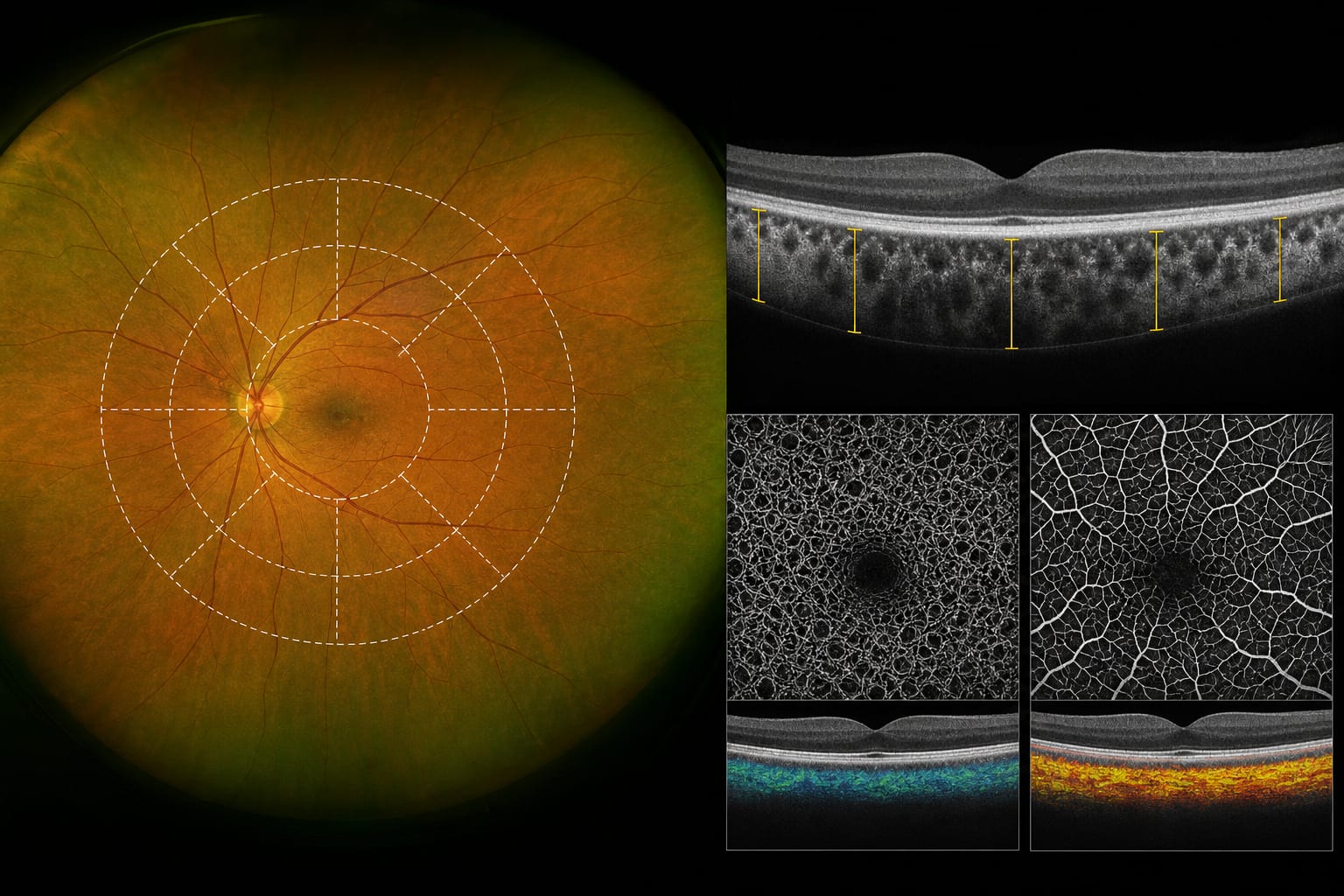
Assessment of Choroidal Alterations in Chinese Myopic Young Adults Using Ultra-Widefield Swept-Source OCT Angiography
-
By
-
Chao Wu
-
Tianwei Liu
-
Fengjiao Li
-
Wanzhen Jiao
-
Bojun Zhao
-
July 1, 2026
Clinical Scorecard: Assessment of Choroidal Alterations in Chinese Myopic Young Adults Using Ultra-Widefield Swept-Source OCT Angiography
At a Glance
| Category | Detail |
|---|
| Condition | Myopia |
| Key Mechanisms | Choroidal thickness (CT) and Sattler-Haller layer vessel density (SHVD) alterations associated with axial length (AL) and spherical equivalent (SE). |
| Target Population | Chinese young adults with varying refractive errors. |
| Care Setting | Ophthalmology clinics using ultra-widefield SS-OCTA. |
Key Highlights
- Significant reductions in CT and SHVD observed in high myopia (HM) across multiple subfields.
- CT correlated negatively with axial length (AL) and positively with spherical equivalent (SE).
- SHVD showed negative correlation with AL and positive correlation with SE.
- Central CT thickening and inferonasal thinning patterns preserved across myopia severities.
- UWF SS-OCTA enables comprehensive topographic analysis of choroidal alterations.
Guideline-Based Recommendations
Diagnosis
- Utilize UWF SS-OCTA for detailed assessment of choroidal alterations in myopic patients.
Management
- Monitor choroidal thickness and vessel density in patients with high myopia to assess risk of complications.
Monitoring & Follow-up
- Regular follow-up with imaging to track changes in choroidal parameters over time.
Risks
- High myopia is associated with increased risk of degenerative retinopathy and other sight-threatening complications.
Patient & Prescribing Data
Young adults with myopia, particularly in Asian populations.
Focus on monitoring choroidal structural changes as part of myopia management.
Clinical Best Practices
- Conduct comprehensive ophthalmic examinations including axial length measurement.
- Implement UWF SS-OCTA for enhanced visualization of choroidal structures.
- Educate patients about the risks associated with high myopia.
Related Resources & Content