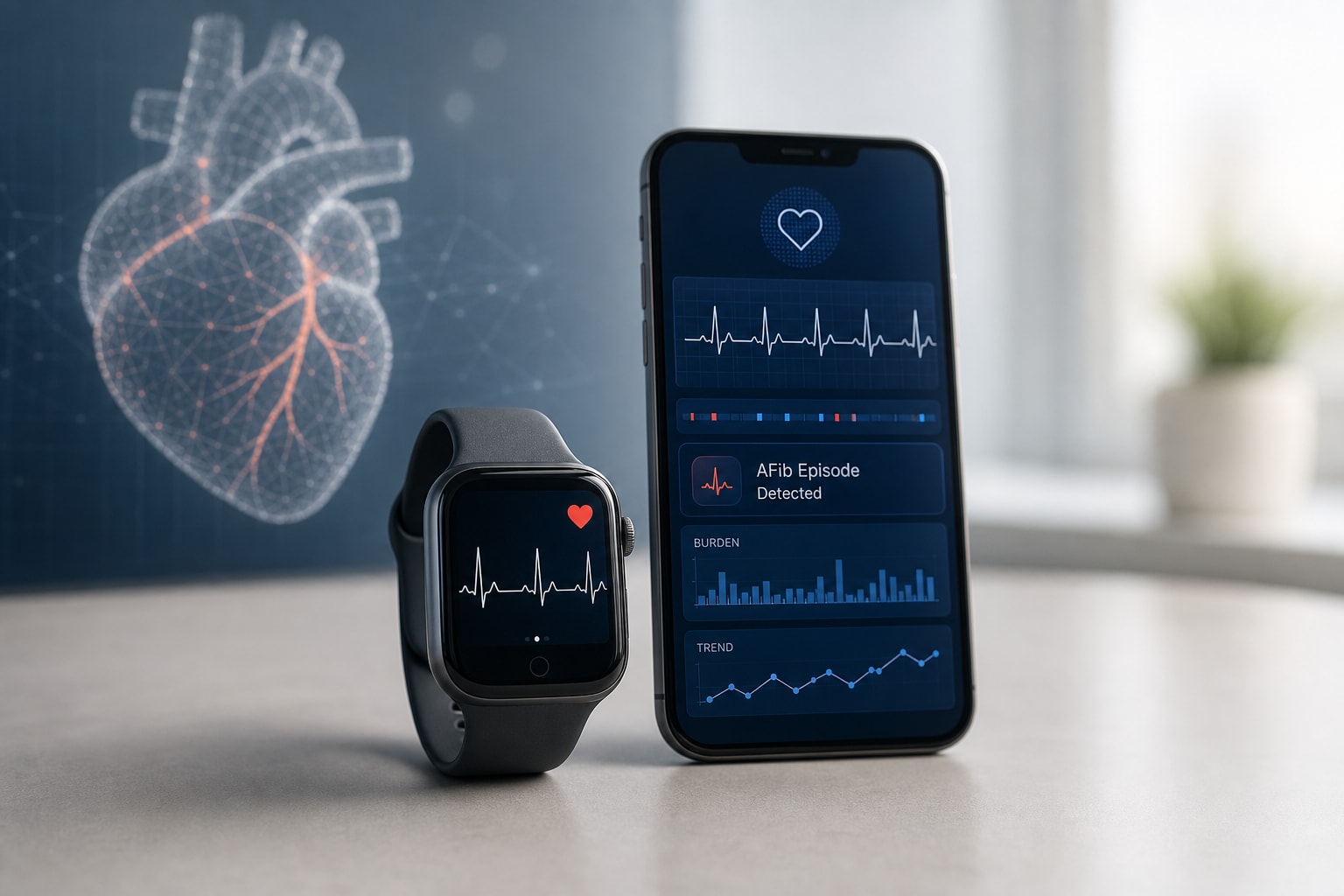
Utilization of Wearable Technology for Screening, Monitoring, and Managing Atrial Fibrillation
-
By
-
Wen Chen
-
Xinyi Lin
-
Ping Jia
-
Zhenwei Liu
-
July 21, 2026
Clinical Scorecard: Utilization of Wearable Technology for Screening, Monitoring, and Managing Atrial Fibrillation
At a Glance
| Category | Detail |
|---|
| Condition | Atrial Fibrillation |
| Key Mechanisms | Wearable devices using photoplethysmography (PPG) and electrocardiography (ECG) for continuous monitoring. |
| Target Population | Individuals with atrial fibrillation, including those with subclinical cases. |
| Care Setting | Community screening, postoperative monitoring, and long-term patient management. |
Key Highlights
- Atrial fibrillation is the most prevalent cardiac arrhythmia, affecting approximately 59.7 million individuals globally.
- Wearable technology enhances the detection of paroxysmal and asymptomatic atrial fibrillation.
- Integration of artificial intelligence in wearables facilitates remote monitoring and patient-clinician interactions.
- Subclinical atrial fibrillation detection raises questions about anticoagulation initiation thresholds.
- Standardized algorithms and validated hardware are essential for effective clinical implementation.
Guideline-Based Recommendations
Diagnosis
- Utilize ECG for definitive diagnosis based on morphological criteria.
Management
- Implement wearable technology for continuous monitoring and timely intervention.
Monitoring & Follow-up
- Employ wearables for postoperative rhythm monitoring and long-term management.
Risks
- Increased detection of subclinical atrial fibrillation may complicate treatment decisions.
Patient & Prescribing Data
Patients with atrial fibrillation, including those with subclinical forms.
Personalized antithrombotic therapy based on continuous AF burden assessment.
Clinical Best Practices
- Adopt multimodal wearable devices for comprehensive AF management.
- Ensure interoperability of electronic health records for effective data sharing.
- Focus on the continuous quantification of AF burden to guide therapy.
Related Resources & Content