Initial non-surgical versus upfront surgical management of ERCP-related perforations by Stapfer type: a systematic review and meta-analysis - Scorecard - MDSpire
Clinical Scorecard: Initial Conservative Versus Early Surgical Treatment of ERCP-Related Perforations by Stapfer Classification: A Systematic Review and Meta-Analysis
At a Glance
Category
Detail
Condition
ERCP-related perforation, classified by Stapfer type
Key Mechanisms
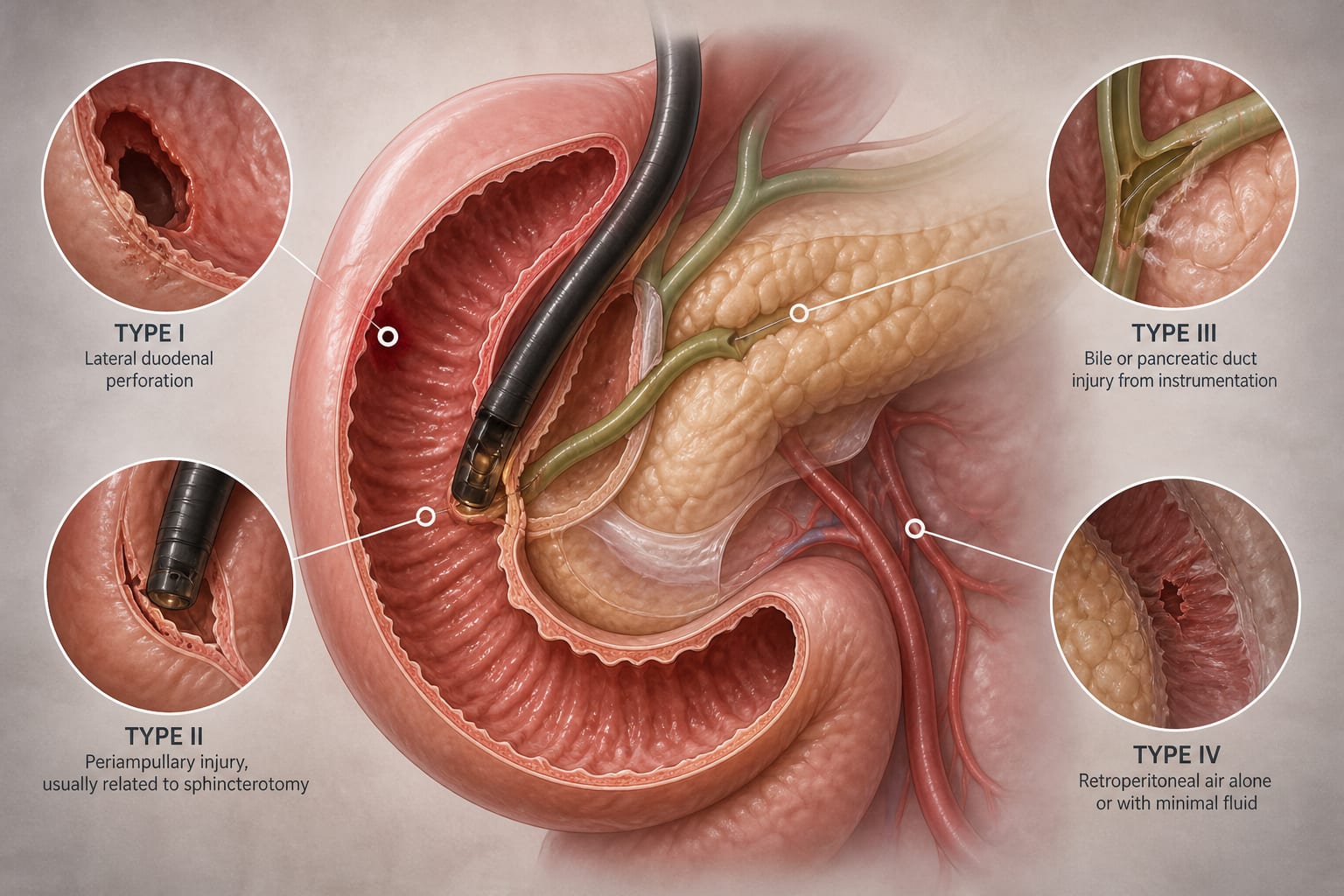
Type I: endoscope-induced free-wall duodenal perforation; Type II: usually sphincterotomy-associated periampullary injury; Type III: bile or pancreatic duct injury from guidewires or other instrumentation; Type IV: retroperitoneal air without an identifiable gross perforation.
Target Population
Adults with ERCP-related perforations in eligible studies of at least six cases.
Care Setting
Pancreaticobiliary practice, with management involving conservative care, endoscopic or image-guided interventions, and/or surgery.
Key Highlights
The review compares outcomes by the initial management strategy and stratifies analyses by Stapfer type.
Initial non-surgical management includes conservative medical therapy, endoscopic intervention, and/or image-guided drainage.
Patients who undergo operative rescue after initial non-surgical management remain in that initial group and count as strategy failures.
Initial non-surgical success is survival to hospital discharge without operative rescue; upfront surgical success is survival to discharge after the initial operation.
For Stapfer Types III–IV, surgical comparator data were too sparse to estimate relative effects meaningfully.
Guideline-Based Recommendations
Diagnosis
Classify ERCP-related perforations by Stapfer type or an anatomically equivalent description.
The source describes Type IV as retroperitoneal air without an identifiable gross perforation.
Management
Conservative care described in the source includes bowel rest, intravenous fluids, antibiotics, and clinical and radiological monitoring.
Endoscopic options described include TTSC, OTSC, plastic biliary or pancreatic stents, FCSEMS, and nasobiliary drainage.
Image-guided drainage may be used for retroperitoneal or intra-abdominal collections.
The review defines initial non-surgical management as conservative therapy, endoscopic intervention, and/or image-guided drainage; later operative rescue is classified as failure of that initial strategy.
Monitoring & Follow-up
The source describes intensive clinical and radiological monitoring as part of conservative care.
The review assessed initial-strategy success, mortality, hospital length of stay, crossover or escalation, and reported prognostic factors or surgical triggers.
Risks
ERCP-related perforation may lead to leakage of enteric or biliopancreatic contents, retroperitoneal contamination, sepsis, multiorgan failure, and death.
The source notes greater concern when recognition is delayed or prompt, effective source control is not obtained.
Patient & Prescribing Data
Adults with ERCP-related perforations; eligible studies included at least six cases and reported management and clinical outcomes.
The source describes conservative, endoscopic, radiological, and surgical approaches. It does not provide medication doses or patient-level prescribing regimens.
Clinical Best Practices
Use the initial definitive strategy chosen after perforation identification to classify management outcomes.
Do not reclassify patients who undergo rescue surgery from the initial non-surgical group to the surgical group.
Do not count progression within non-surgical care, such as later stenting or percutaneous drainage, as failure unless operative rescue occurs.
Interpret comparative findings for Stapfer Types III–IV cautiously because surgical comparator data were too sparse for meaningful relative-effect estimates.