Machine learning integration of routine inflammatory biomarkers for predicting remote punctate ischemic lesions following intracerebral hemorrhage: a single-center retrospective study - Scorecard - MDSpire
Advertisement
Machine learning integration of routine inflammatory biomarkers for predicting remote punctate ischemic lesions following intracerebral hemorrhage: a single-center retrospective study
Clinical Scorecard: Utilizing Machine Learning with Standard Inflammatory Biomarkers to Forecast Remote Punctate Ischemic Lesions After Intracerebral Hemorrhage: A Retrospective Analysis from a Single Center
At a Glance
Category
Detail
Condition
Remote Punctate Ischemic Lesions after Intracerebral Hemorrhage
Key Mechanisms
Systemic inflammation and coagulation activation linked to post-ICH ischemia.
Target Population
Patients diagnosed with spontaneous intracerebral hemorrhage.
Care Setting
Retrospective cohort study in a single center.
Key Highlights
3-12% of ICH patients develop remote ischemic lesions, worsening functional outcomes.
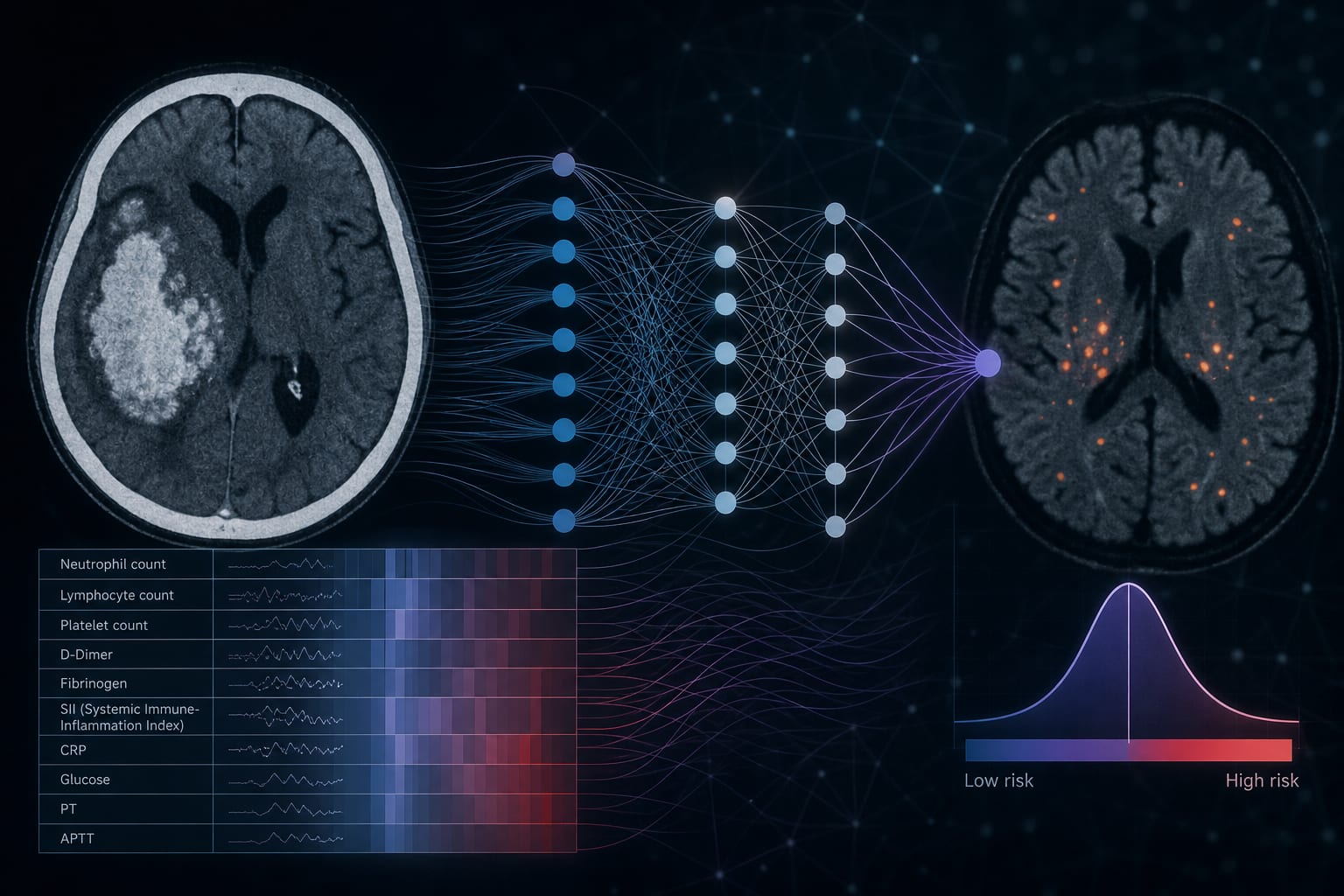
XGBoost model achieved the highest discrimination (AUC = 0.799) for predicting RPIL.
Key predictors identified include Age, History of Diabetes, SII, D-Dimer, Glucose, and Fibrinogen.
Nomogram developed for clinical risk stratification demonstrated excellent calibration.
Study emphasizes the role of immuno-thrombotic mechanisms in post-ICH complications.
Guideline-Based Recommendations
Diagnosis
Utilize neuroimaging to confirm incident RPIL within 14 days of ICH admission.
Management
Monitor inflammatory and coagulation markers in ICH patients.
Monitoring & Follow-up
Implement a clinical nomogram for personalized risk stratification.
Risks
Increased risk of functional decline associated with RPIL development.
Patient & Prescribing Data
Patients with spontaneous intracerebral hemorrhage.
Focus on managing systemic inflammation and coagulation to mitigate RPIL risk.
Clinical Best Practices
Incorporate machine learning models for improved prognostication in ICH.
Regularly assess routine laboratory biomarkers for early detection of complications.
The age-adjusted Parkinson disease death rate among US adults aged 65 years and older was 72.0 deaths per 100,000 standard population in 2024, lower than the 2021 rate, according to a National Center for Health Statistics Data Brief.