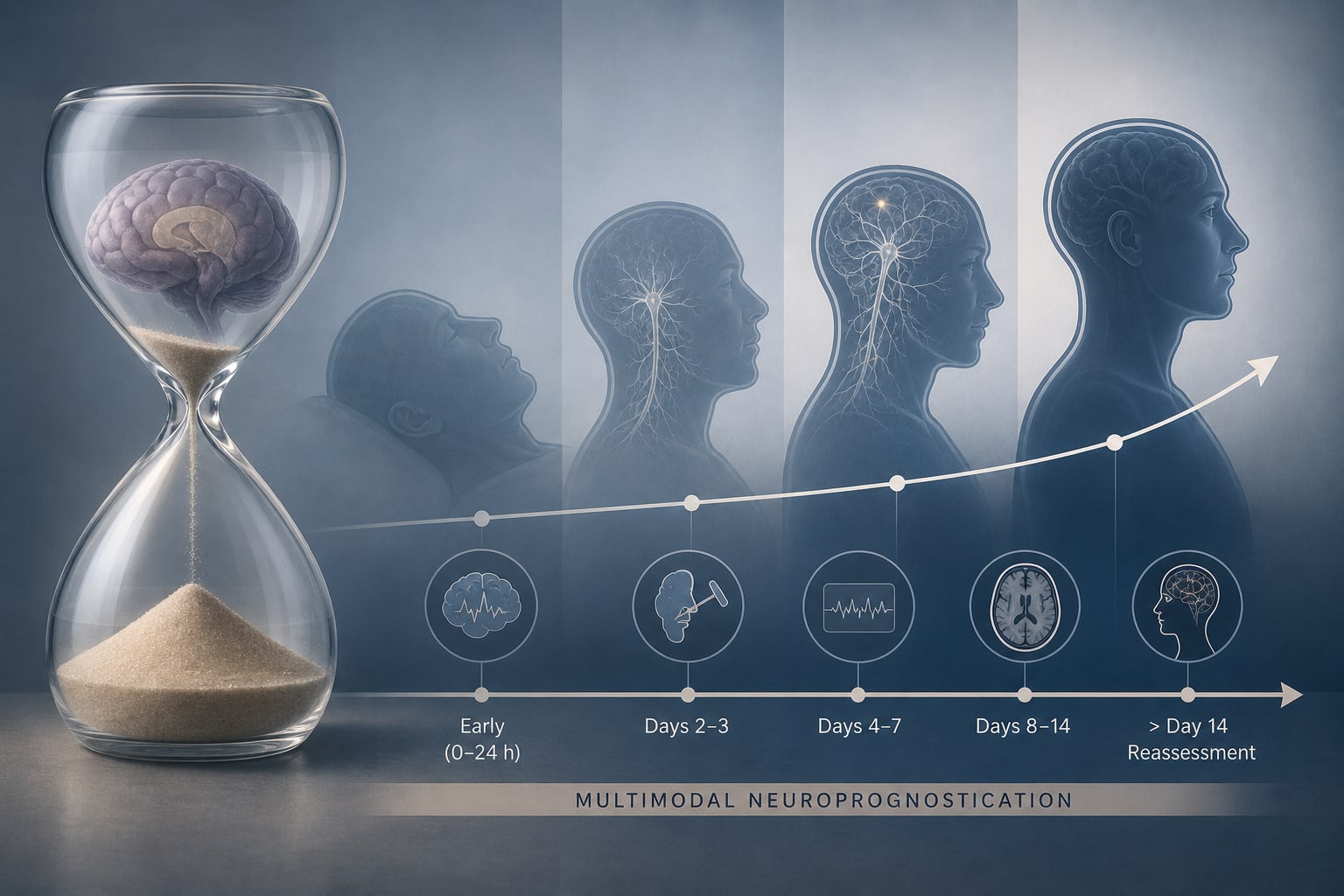
Clinical Scorecard: Reassessing Neuroprognostic Indicators Following Cardiac Arrest: Addressing Temporal Factors and the Challenge of Eliminating False Positives
At a Glance
Category
Detail
Condition
Cardiac Arrest
Key Mechanisms
Neuroprognostic markers, temporal evolution of markers
Target Population
Patients post-cardiac arrest not undergoing withdrawal of life-sustaining therapy
Care Setting
Critical Care
Key Highlights
Reassessment of neuroprognostic markers reduces false-positive classifications.
Temporal evolution of markers provides incremental prognostic information.
No false positives observed at day 14 among patients with at least two unfavorable markers.
Guideline-Based Recommendations
Diagnosis
Utilize multimodal prognostication during ongoing care.
Management
Consider temporal assessment of neuroprognostic markers.
Monitoring & Follow-up
Track marker trajectories over time to inform prognosis.
Risks
Be aware of potential false-positive rates in prognostic assessments.
Patient & Prescribing Data
Patients with cardiac arrest undergoing neuroprognostic evaluation.
Focus on the persistence of unfavorable markers for prognosis.
Clinical Best Practices
Implement time-anchored decision-making in neuroprognostication.
Assess the trajectory of neuroprognostic markers for better prognostic accuracy.
Report confidence intervals for false-positive rates to guide clinical decisions.