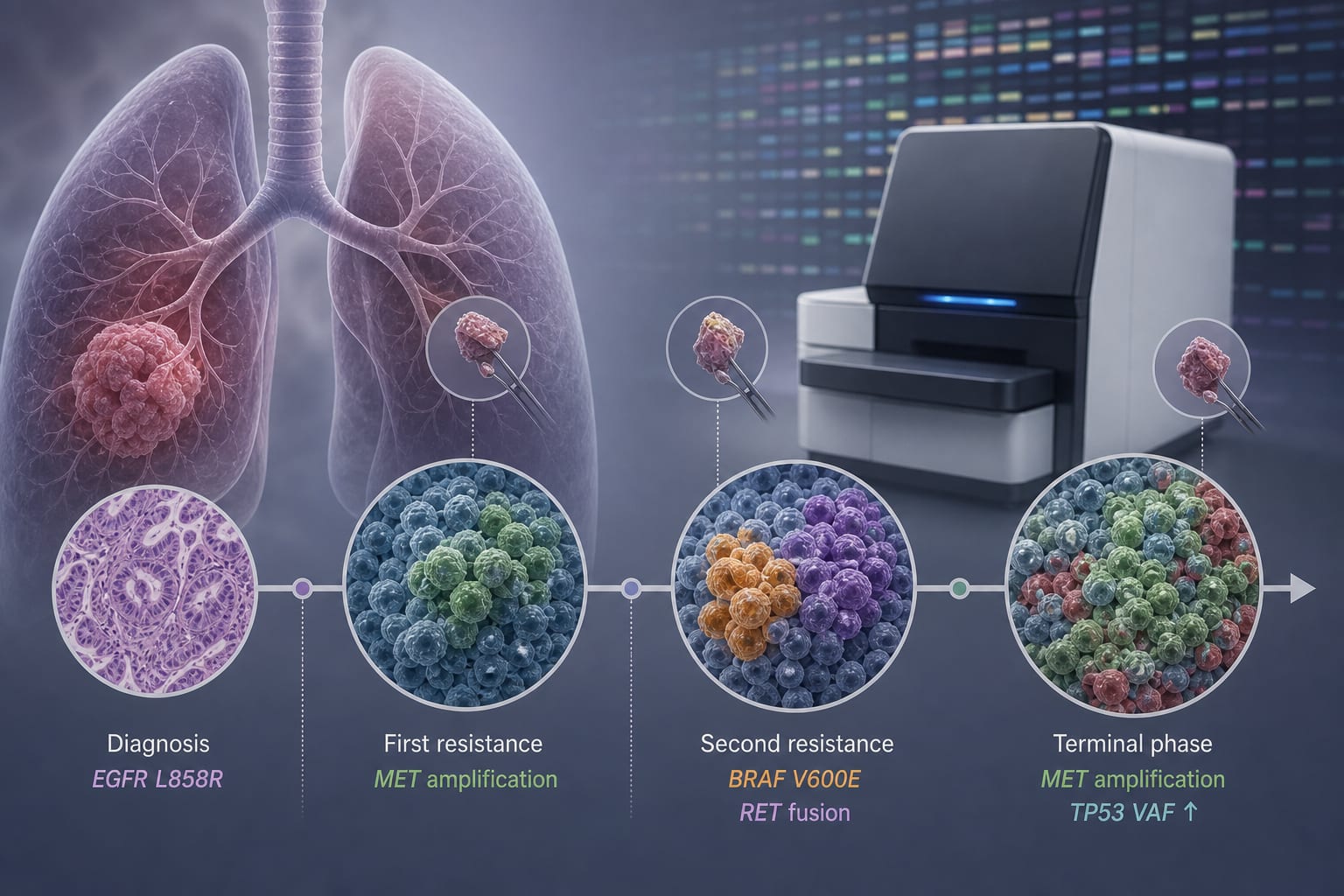
Evolving Clonal Resistance Mechanisms in EGFR-Mutant Lung Adenocarcinoma: Insights from a Case Study
-
By
-
Qingyun Zhang
-
Xiaoyan Yin
-
September 9, 2026
Clinical Scorecard: Evolving Clonal Resistance Mechanisms in EGFR-Mutant Lung Adenocarcinoma: Insights from a Case Study
At a Glance
| Category | Detail |
|---|
| Condition | EGFR-mutant non-small-cell lung cancer (NSCLC) |
| Key Mechanisms | Acquired resistance mechanisms including MET amplification, BRAF V600E mutation, and RET fusion. |
| Target Population | Patients with EGFR L858R mutation in lung adenocarcinoma. |
| Care Setting | Oncology clinical practice focusing on targeted therapy. |
Key Highlights
- EGFR L858R mutation is associated with favorable responses to EGFR-TKIs.
- Acquired resistance to third-generation EGFR-TKIs is nearly inevitable.
- Sequential development of resistance mechanisms can occur in individual patients.
- Dynamic next-generation sequencing (NGS) can track resistant clones in real time.
- Individualized treatment strategies may improve outcomes in resistant cases.
Guideline-Based Recommendations
Diagnosis
- Use next-generation sequencing (NGS) to identify EGFR mutations and resistance mechanisms.
Management
- Consider genotype-guided treatment modifications based on resistance evolution.
Monitoring & Follow-up
- Perform serial biopsies and NGS at each progression to characterize resistance.
Risks
- Acquired resistance mechanisms can lead to poor prognosis and treatment challenges.
Patient & Prescribing Data
62-year-old male with stage IIB poorly differentiated lung adenocarcinoma.
Aumolertinib followed by combination therapies showed variable effectiveness.
Clinical Best Practices
- Implement dynamic NGS to monitor clonal evolution in EGFR-mutant NSCLC.
- Adopt individualized treatment strategies based on resistance mechanisms.
Related Resources & Content