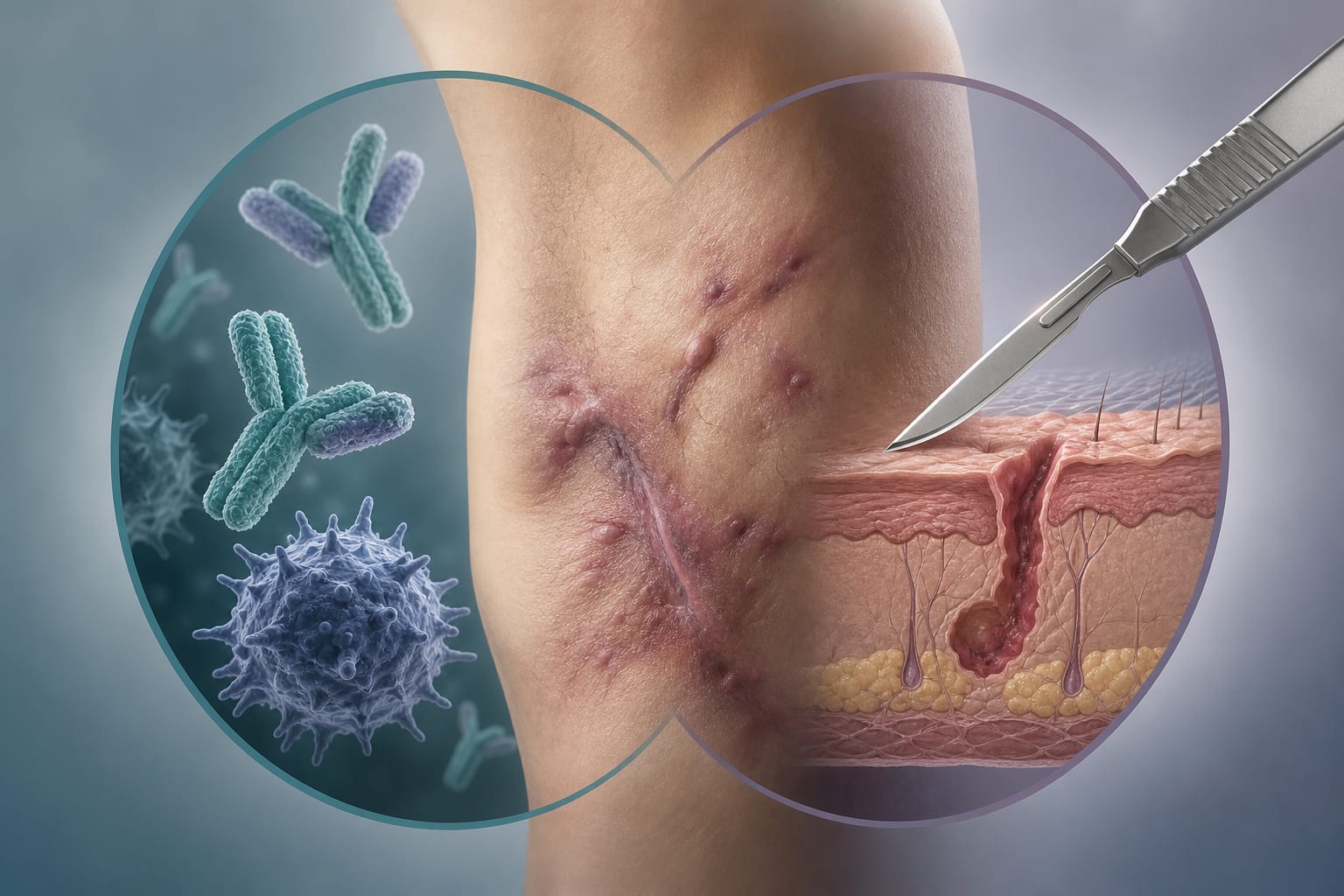
Is Hidradenitis Suppurativa Primarily an Autoinfection Rather Than Solely Autoinflammatory?
-
By
-
Maïa Delage
-
Olivier Join-Lambert
-
Snaigune Miskinyte
-
Alain Hovnanian
-
Aude Nassif
-
July 6, 2026
Clinical Scorecard: Is Hidradenitis Suppurativa Primarily an Autoinfection Rather Than Solely Autoinflammatory?
At a Glance
| Category | Detail |
|---|
| Condition | Hidradenitis Suppurativa |
| Key Mechanisms | Proposed as an autoinfectious disease with microbiological and immunological involvement. |
| Target Population | Patients with hidradenitis suppurativa, particularly those with varying disease severity. |
| Care Setting | Clinical practice and research settings focusing on dermatological conditions. |
Key Highlights
- Hidradenitis suppurativa is proposed to be an autoinfectious disease rather than purely autoinflammatory.
- Microbiological evidence shows abnormal bacterial presence in HS lesions correlating with disease severity.
- Therapeutic efficacy of targeted antibiotics in HS supports the infection hypothesis.
- Hypergammaglobulinemia is frequently observed in HS patients and correlates with disease severity.
- Common bacterial flora in HS lesions resembles that found in other inflammatory diseases.
Guideline-Based Recommendations
Diagnosis
- Consider microbiological analysis of HS lesions to identify bacterial flora.
Management
- Utilize targeted antibiotics for treatment of HS lesions based on identified bacterial flora.
Monitoring & Follow-up
- Monitor disease severity and immune response markers such as hypergammaglobulinemia.
Risks
- Inadequate culture techniques may lead to underestimation of bacterial presence in HS lesions.
Patient & Prescribing Data
Individuals diagnosed with hidradenitis suppurativa.
Targeted antibiotic therapy may be effective based on the polymicrobial nature of HS lesions.
Clinical Best Practices
- Employ prolonged culture techniques for accurate microbiological assessment of HS lesions.
- Consider the role of the host's immune response in the management of HS.
Related Resources & Content