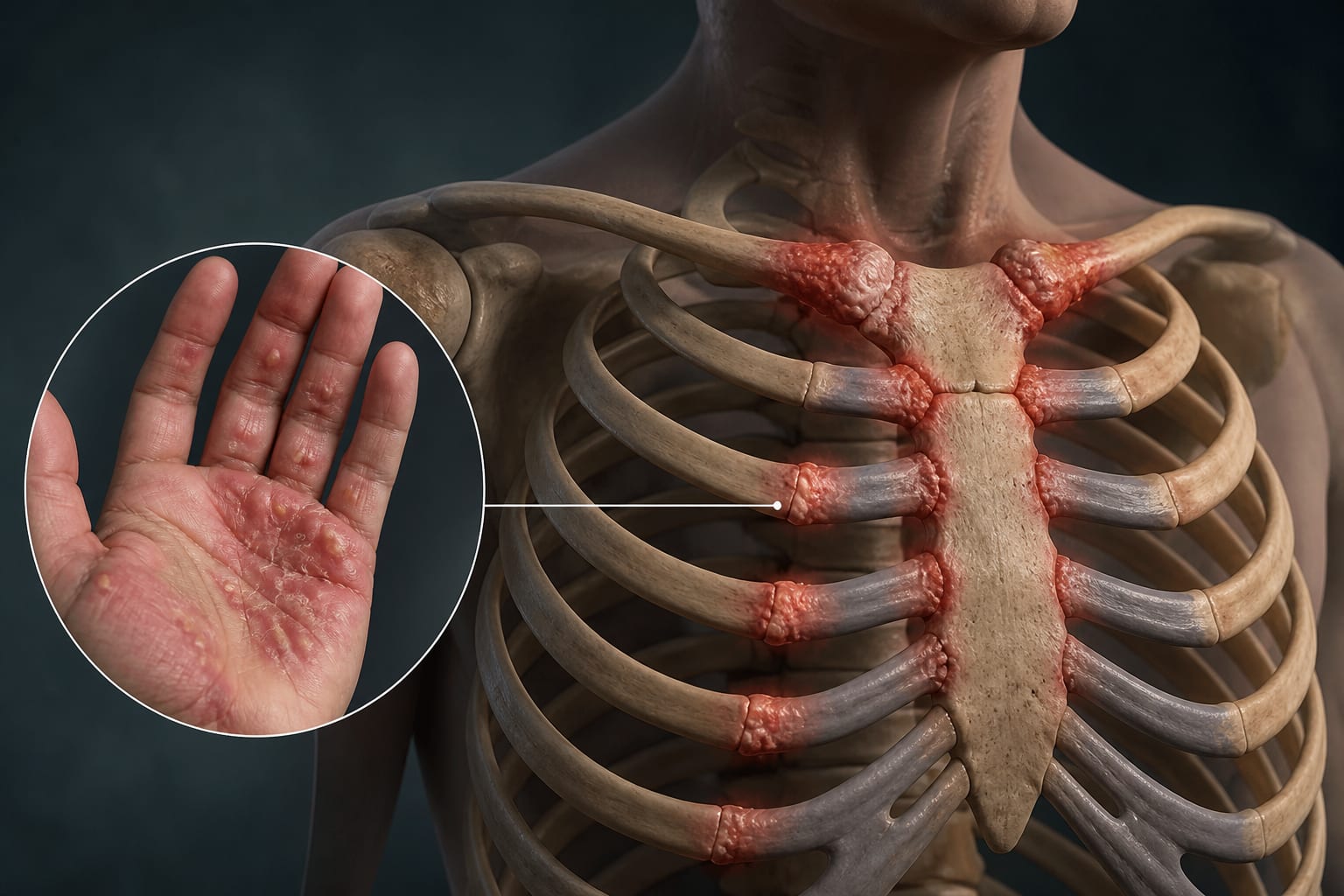
Palmoplantar skin lesions and chest pain in a patient with Crohn’s disease
-
By
-
Ouwais Alkhateb
-
Racha Ftouni
-
Ossama Abbas
-
Fadi H Mourad
-
November 1, 2026
Clinical Scorecard: Palmoplantar skin lesions and chest pain in a patient with Crohn’s disease
At a Glance
| Category | Detail |
|---|---|
| Condition | Clinical topic addressed by the source article: Palmoplantar skin lesions and chest pain in a patient with Crohn’s disease |
| Key Mechanisms | Mechanisms or clinical associations described in the source article. |
| Target Population | Patients or participants described in the source article. |
| Care Setting | In this case, gastroenterology, dermatology and rheumatology specialists collaborated in a multidisciplinary team. |
Key Highlights
- A patient with Crohn’s disease in clinical remission developed palmoplantar pustules, acneiform lesions and acute chest pain during infliximab treatment.
- Chest MRI showed manubriosternal bone marrow oedema with mild adjacent soft-tissue inflammation.
- Clinical and radiological findings supported SAPHO syndrome; infectious causes were excluded by appropriate investigations and medical history.
- NSAIDs, methotrexate and topical corticosteroids resolved chest pain and partially improved skin lesions.
- Infliximab was continued because of financial limitations and concern about a Crohn’s flare; intermittent topical corticosteroids were used for skin lesions.
Guideline-Based Recommendations
Diagnosis
- In this case, SAPHO syndrome was supported by axial osteitis, preceding palmoplantar pustulosis and subsequent acneiform eruptions; investigations and medical history excluded infectious causes.
Management
- The multidisciplinary team used NSAIDs, methotrexate and topical corticosteroids; chest pain resolved and skin lesions partially improved.
- Switching to ustekinumab was considered. Infliximab was continued because of financial limitations and the patient’s concern about a Crohn’s flare.
Monitoring & Follow-up
- The report states that chest pain did not recur while infliximab was continued.
Risks
- The authors considered anti-TNF-induced SAPHO syndrome more probable than paradoxical psoriasis alone in this case.
- The patient was concerned that stopping infliximab might precipitate a Crohn’s flare.
Patient & Prescribing Data
A 28-year-old man with an 8-year history of ileal Crohn’s disease, in clinical remission on infliximab 5 mg/kg every 8 weeks and azathioprine.
After his sixth infliximab infusion, he developed palmoplantar pustules, acneiform eruptions and chest pain. NSAIDs, methotrexate and topical corticosteroids resolved chest pain and partially improved skin lesions. Infliximab was continued, with intermittent topical corticosteroids for cutaneous lesions.
Clinical Best Practices
- The patient underwent ECG, serum troponin testing and stress echocardiography, with no abnormal findings; chest MRI showed manubriosternal bone marrow oedema and mild adjacent soft-tissue inflammation.
- The authors considered SAPHO syndrome more probable than paradoxical psoriasis alone because psoriasis did not account entirely for the osteoarticular manifestations.
- The team considered switching to ustekinumab, but continued infliximab in light of financial limitations and the patient’s concern about a Crohn’s flare.
Related Resources & Content
Based on findings from:
Skin lesions and chest pain in a patient with Crohn’s disease
Ouwais Alkhateb, Racha Ftouni, Ossama Abbas, Fadi H Mourad. Gut, 2026.
https://gut.bmj.com/content/75/11/2094
This content is an AI-generated, fully rewritten summary based on a published scholarly article. It does not reproduce the original text and is not a substitute for the original publication. Readers are encouraged to consult the source for full context, data, and methodology.