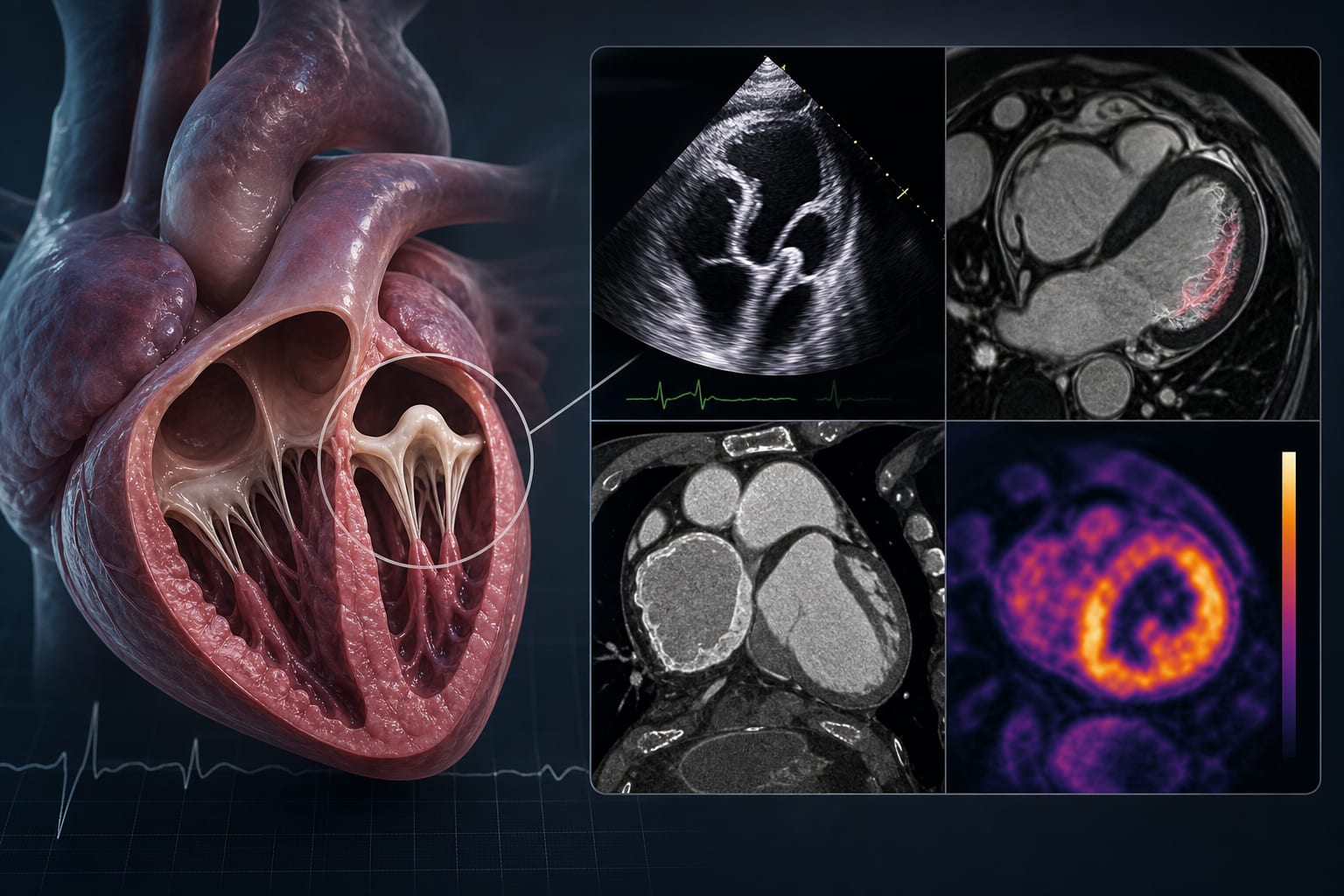
Clinical Scorecard: The Dark Papillary Muscle Sign: A New Prognostic Indicator in Cardiac Magnetic Resonance Imaging
At a Glance
Category
Detail
Condition
Papillary muscle abnormalities in patients with ventricular arrhythmias and preserved left ventricular function
Key Mechanisms
Systolic hypointensity (Dark-Paps) of papillary muscles on early post-contrast cine CMR indicating tissue abnormalities; association with mitral valve prolapse and mitral annular disjunction
Target Population
Patients with frequent premature ventricular complexes (PVC) or non-sustained ventricular tachycardia (NSVT) with preserved LV systolic function and no prior cardiac disease
Care Setting
Cardiac magnetic resonance imaging in specialized cardiology centers
Key Highlights
Papillary muscles play a critical role in mitral valve function and left ventricular mechanics.
Dark-Paps sign is identified as systolic hypointensity of both papillary muscles on early post-contrast cine CMR images.
Dark-Paps is associated with mitral valve prolapse and may have prognostic implications in patients with ventricular arrhythmias.
Guideline-Based Recommendations
Diagnosis
Use early post-contrast cine steady-state free precession (SSFP) CMR imaging to assess papillary muscle morphology and signal intensity.
Evaluate papillary muscles for systolic hypointensity relative to the interventricular septum to identify Dark-Paps.
Assess mitral valve anatomy for prolapse and mitral annular disjunction using long-axis and para-axial CMR views.
Management
Consider the presence of Dark-Paps and associated mitral valve abnormalities in risk stratification of patients with ventricular arrhythmias.
Optimize ECG gating with short-term antiarrhythmic therapy before CMR in patients with frequent PVCs or ventricular bigeminism to improve image quality.
Monitoring & Follow-up
Monitor patients with Dark-Paps for potential progression of ventricular arrhythmias and mitral valve dysfunction.
Follow-up imaging may be warranted to assess changes in papillary muscle morphology and function.
Risks
Patients with papillary muscle abnormalities and Dark-Paps may have increased risk of ventricular arrhythmias.
Mitral annular disjunction associated with papillary muscle abnormalities may predispose to myocardial fibrosis and arrhythmic events.
Patient & Prescribing Data
Patients with frequent PVCs or NSVT undergoing CMR evaluation
Short-term oral antiarrhythmic agents administered prior to CMR can optimize ECG triggering and image acquisition quality.
Clinical Best Practices
Perform comprehensive CMR including early post-contrast cine SSFP and late gadolinium enhancement sequences for detailed papillary muscle and mitral valve assessment.
Measure radial angles, maximal diameter, and signal intensity of anterolateral and posteromedial papillary muscles systematically.
Use a multidisciplinary approach integrating imaging findings with clinical arrhythmia data for prognostic evaluation.
by Giovanni Donato Aquaro, Carmelo De Gori, Giulia Grilli, Roberto Licordari, Andrea Barison, Giancarlo Todiere, Umberto Ianni, Matteo Parollo, Crysanthos Grigoratos, Luca Restivo, Antonio De Luca, Lorenzo Faggioni, Dania Cioni, Gianfranco Sinagra, Gianluca Di Bella, Emanuele Neri