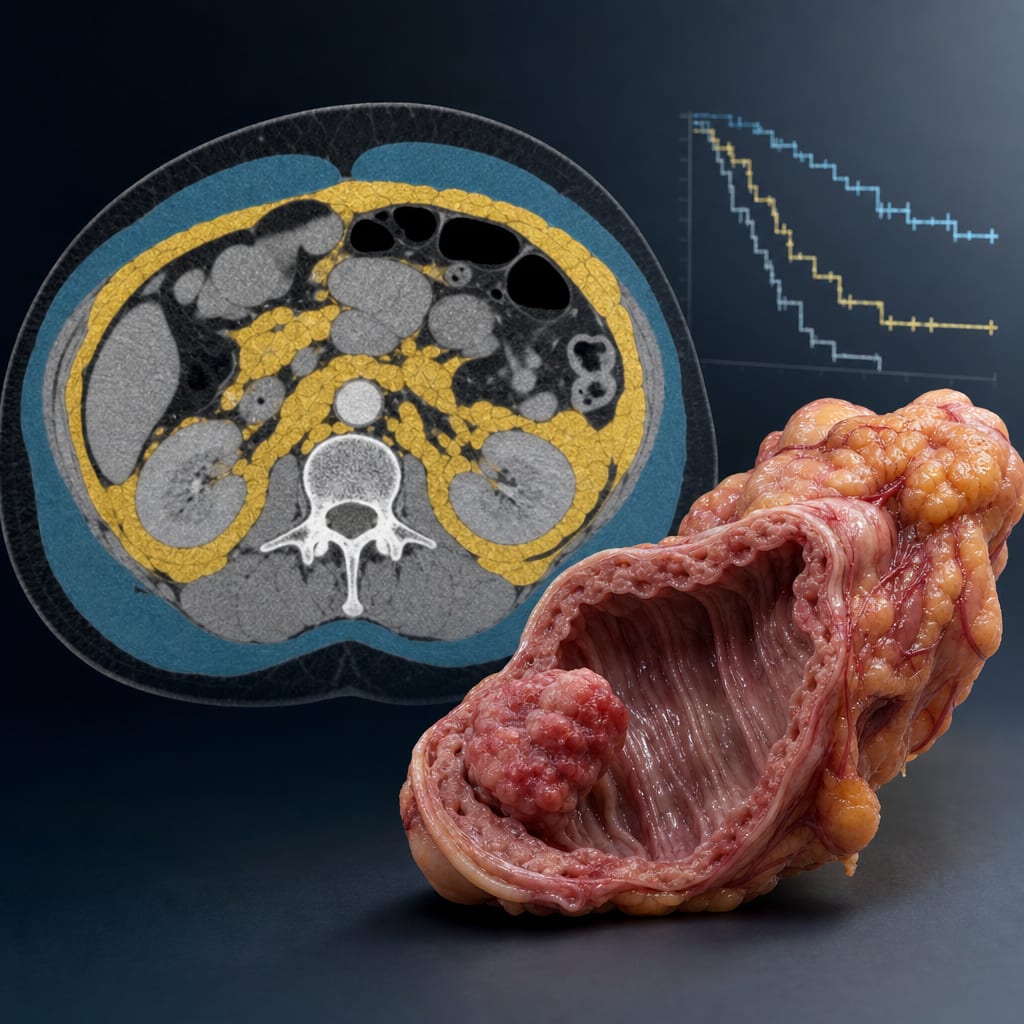
Clinical Scorecard: Comparative Outcomes of Minimally Invasive and Open Segmental Transverse Colectomy: Insights from a Multicenter Collaborative Study
At a Glance
Category
Detail
Condition
Mid transverse colon cancer requiring segmental colectomy
Key Mechanisms
Surgical resection of mid transverse colon with lymphadenectomy along middle colic artery; restoration of bowel continuity via anastomosis
Target Population
Patients with mid transverse colon cancer undergoing segmental colectomy
Care Setting
High-volume surgical centers with expert colorectal surgeons
Key Highlights
Minimally invasive surgery (laparoscopic/robotic) shows comparable oncological safety to open surgery for transverse colon cancer.
Minimally invasive approach is associated with improved short-term recovery outcomes such as faster return of bowel function and shorter hospital stay.
Intracorporeal versus extracorporeal anastomosis techniques were compared within minimally invasive surgeries to assess differences in outcomes.
Guideline-Based Recommendations
Diagnosis
Define mid transverse colon cancer intraoperatively as tumor located in mid transverse colon excluding 10 cm proximal and distal margins at hepatic and splenic flexures.
Management
Perform segmental transverse colectomy with ligation of middle colic artery at its origin and mobilization of both colonic flexures.
Choose surgical approach (open vs minimally invasive) based on surgeon expertise and patient factors; minimally invasive approach is feasible and safe in expert hands.
In minimally invasive surgery, anastomosis can be performed intracorporeally or extracorporeally depending on surgeon preference.
Monitoring & Follow-up
Monitor postoperative complications using Clavien–Dindo classification.
Perform daily blood tests including C-reactive protein to detect subclinical anastomotic leaks until discharge.
Assess for surgical wound infections, anastomotic leakage, prolonged ileus, and bleeding requiring transfusion.
Risks
Technical difficulty in lymph node dissection around middle colic artery and intestinal reconstruction may affect completeness of resection.
Potential for anastomotic leakage requiring clinical or radiological diagnosis and possible surgical revision.
Risk of postoperative bleeding and anemia.
Patient & Prescribing Data
388 patients with mid transverse colon cancer undergoing segmental colectomy between 2006 and 2016 in 28 high-volume Italian centers.
Minimally invasive surgery was performed in 42.3% of patients (laparoscopic 89%, robotic 11%). Intracorporeal anastomosis was performed in 22.6% of minimally invasive cases.
Clinical Best Practices
Ensure surgical procedures adhere to standardized criteria including ligation of middle colic artery at origin and mobilization of both flexures.
Utilize enhanced recovery after surgery (ERAS) protocols perioperatively to optimize patient recovery.
Select surgical approach based on surgeon expertise and patient characteristics to optimize outcomes.
Implement rigorous postoperative monitoring including daily inflammatory markers to detect complications early.