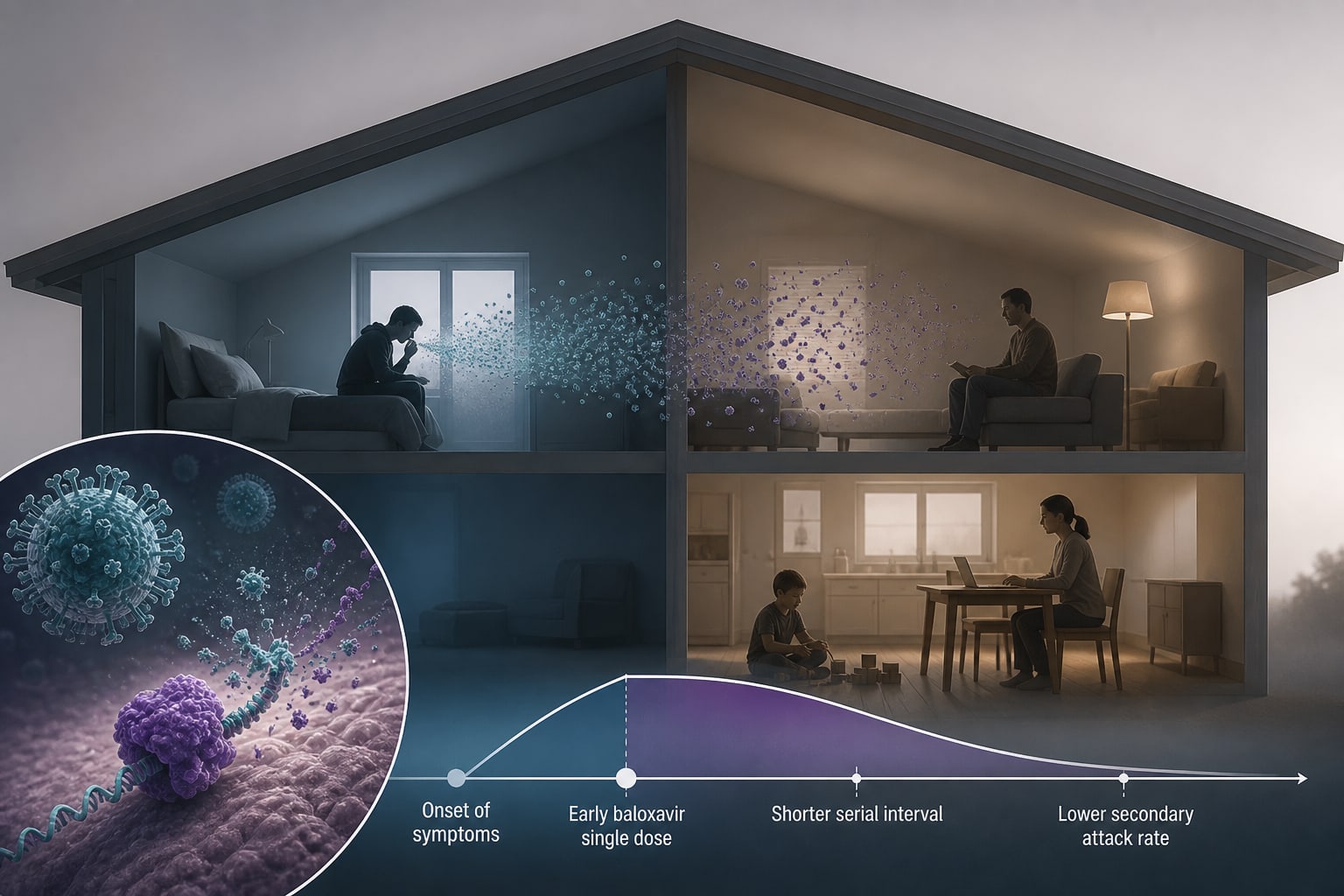
Impact of Timing on Baloxavir Treatment Regarding Serial Interval and Influenza Transmission in Households: A Likelihood-Based Study
-
By
-
Jihyeon Kim
-
Minju Ryu
-
Hiroshi Nishiura
-
Hyojung Lee
-
September 21, 2026
Clinical Scorecard: Impact of Timing on Baloxavir Treatment Regarding Serial Interval and Influenza Transmission in Households: A Likelihood-Based Study
At a Glance
Category | Detail |
|---|---|
Condition | Influenza |
Key Mechanisms | Baloxavir inhibits an early stage of viral replication. This study modeled how treatment timing might alter the serial interval distribution and estimated household secondary attack rate (SAR). |
Target Population | Japanese households reporting at least one symptomatic influenza case. |
Care Setting | An internet-based household survey and a model of influenza transmission. |
Key Highlights
The observed household SAR was 0.23 for baloxavir-treated index cases and 0.29 for untreated index cases; the difference was not statistically significant.
The model estimated a 31.54% reduction in serial interval density after baloxavir treatment.
Treatment within 24 hours of symptom onset was associated with a 25.34% reduction in the area under the modeled serial interval distribution. This is not a measured 25.34% reduction in household infections.
Modeled reductions were smaller when treatment started later.
The serial interval measures time between symptom onset in an index case and the earliest secondary case. It does not directly measure how long the index case remained infectious.
Guideline-Based Recommendations
The supplied paper does not provide a treatment guideline. The sections below distinguish its survey definitions and findings from clinical recommendations.
Diagnosis
For the survey, a case was classified as confirmed when a respondent reported an influenza diagnosis by rapid diagnostic test or reverse-transcription PCR. A suspected case required reported fever of at least 37.5°C plus cough or sore throat. These were study definitions, not new diagnostic recommendations.
Management
The model associated earlier baloxavir treatment with greater reductions in the serial interval distribution and lower estimated transmission risk. The study does not establish an optimal treatment time or direct clinicians to administer baloxavir within 24 hours.
Monitoring & Follow-up
Researchers used reported symptom-onset dates to calculate serial intervals and counted secondary cases among household contacts to calculate SAR. The paper does not recommend a patient-monitoring schedule.
Risks
Household contacts’ treatment and isolation practices were unavailable. The investigators also could not establish transmission chains beyond the index case and assumed that secondary infections originated from that case.
Patient & Prescribing Data
The serial interval analysis included 95 index cases: 73 treated with baloxavir and 22 untreated. Households without a definable serial interval were excluded from that analysis but remained eligible for SAR and odds ratio analyses. Treatment timing was reported through the household survey.
Clinical Best Practices
The findings may inform further research on antiviral timing and household transmission. The observed SAR difference was not statistically significant, and the modeled results depend on assumptions linking the serial interval distribution to transmission risk. This study alone does not establish a new prescribing practice.
Related Resources & Content
The following publication details appear in the supplied paper or its reference list:
Kim J, Ryu M, Nishiura H, Lee H. “Association of baloxavir treatment timing with serial interval and household transmission of influenza through a likelihood-based analysis.” International Journal of Infectious Diseases. 2026;172:109094.
Umemura T, Mutoh Y, Kawamura T, et al. “Efficacy of baloxavir marboxil on household transmission of influenza infection.” Journal of Pharmaceutical Health Care and Sciences. 2020;6:21.
Komeda T, Takazono T, Hosogaya N, et al. “Comparison of household transmission of influenza virus from index patients treated with baloxavir marboxil or neuraminidase inhibitors: a health insurance claims database study.” Clinical Infectious Diseases. 2021;72:e859–e867.
Ikematsu H, Baba T, Saito MM, et al. “Comparative effectiveness of baloxavir marboxil and oseltamivir treatment in reducing household transmission of influenza: a post hoc analysis of the BLOCKSTONE trial.” Influenza and Other Respiratory Viruses. 2024;18:e13302.
Monto AS, Kuhlbusch K, Bernasconi C, et al. “Efficacy of baloxavir treatment in preventing transmission of influenza.” New England Journal of Medicine. 2025;392:1582–1593.
Based on findings from:
Association of baloxavir treatment timing with serial interval and household transmission of influenza through a likelihood-based analysis
Jihyeon Kim, Minju Ryu, Hiroshi Nishiura, Hyojung Lee. International Journal Of Infectious Diseases, 2026.
https://www.sciencedirect.com/science/article/pii/S1201971226007290
This content is an AI-generated, fully rewritten summary based on a published scholarly article. It does not reproduce the original text and is not a substitute for the original publication. Readers are encouraged to consult the source for full context, data, and methodology.