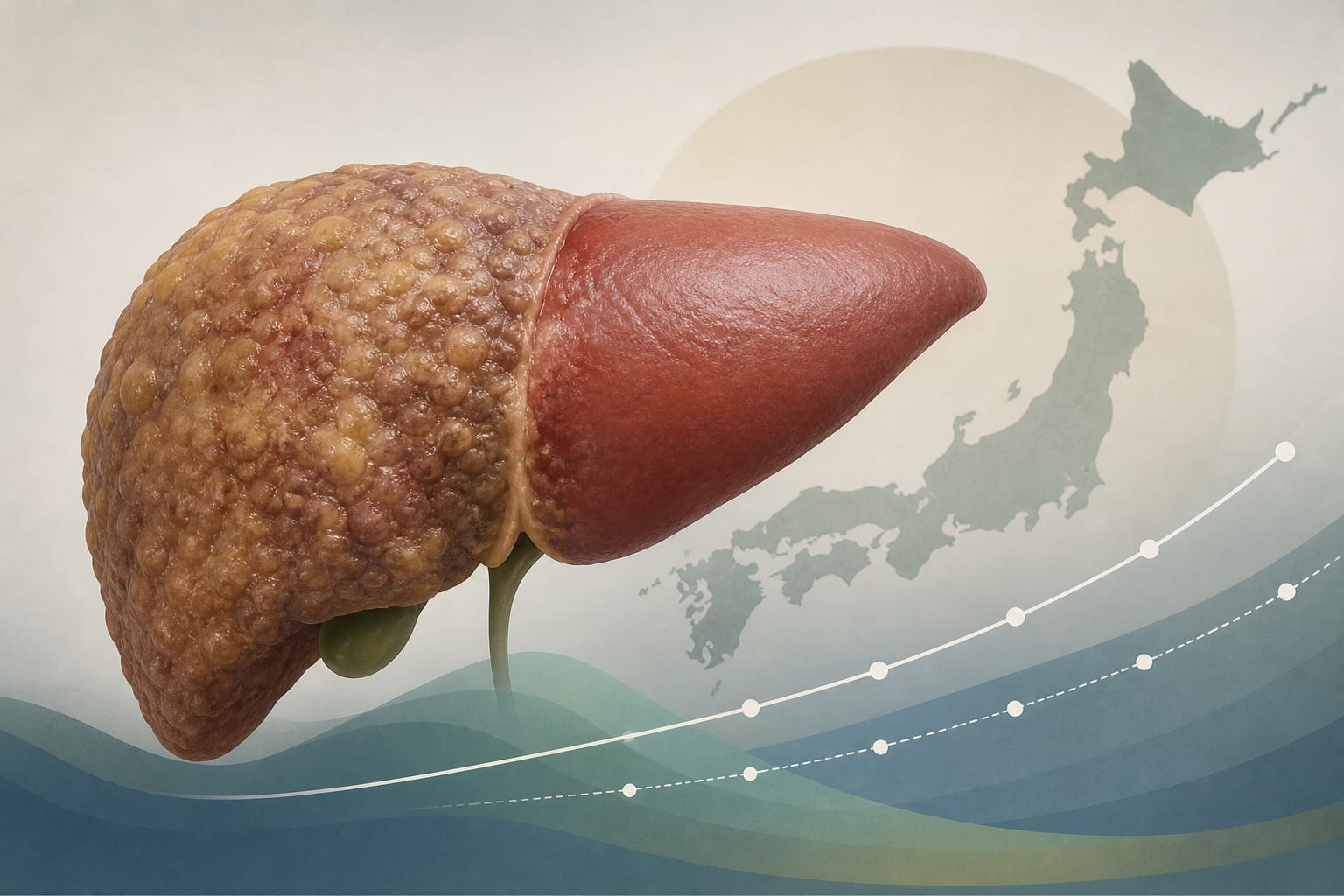
Semaglutide outcomes in Japanese patients with MASH align with results from the overall ESSENCE trial population
-
By
-
Hayato Nakagawa
-
October 27, 2026
Clinical Scorecard: Semaglutide outcomes in Japanese patients with MASH align with results from the overall ESSENCE trial population
At a Glance
Category | Detail |
|---|---|
Condition | Metabolic dysfunction-associated steatohepatitis (MASH) with moderate-to-advanced fibrosis (F2–F3), without cirrhosis. |
Key Mechanisms | Semaglutide may improve MASH through weight loss and broader metabolic effects. Experimental mouse findings suggest possible direct hepatoprotective effects, but these mechanisms have not been confirmed in humans. |
Target Population | Japanese adults with MASH and F2–F3 fibrosis enrolled in the ESSENCE trial subgroup. The 116 participants had a mean BMI of 29.8 kg/m²; 21.8% had BMI <25 kg/m², and 44.9% were aged ≥65 years. |
Care Setting | Clinical trial setting: participants received once-weekly semaglutide 2.4 mg or placebo, with outcomes assessed in a subgroup analysis of the phase 3 ESSENCE trial. |
Key Highlights
Among 116 Japanese participants, MASH resolution without fibrosis worsening occurred in 63.1% with semaglutide and 36.8% with placebo.
The Japanese subgroup’s MASH-resolution rates were similar to those in the overall ESSENCE population: 62.9% with semaglutide and 34.3% with placebo.
Semaglutide numerically favored MASH resolution in the BMI <27 kg/m² subgroup (57.1% vs 26.7%).
Percentage weight loss was comparable in Japanese and overall active-treatment participants (11.4% vs 10.5%), despite lower baseline body weight in the Japanese subgroup.
The subgroup was small; efficacy in non-obese patients with BMI <25 kg/m² and effects on liver-related events remain unestablished.
Guideline-Based Recommendations
Diagnosis
The ESSENCE subgroup analysis included Japanese adults with biopsy-confirmed MASH and moderate-to-advanced fibrosis (F2–F3), without cirrhosis.
Management
The article reports semaglutide approval in Japan for non-cirrhotic MASH with F2–F3 fibrosis. Japanese ESSENCE subgroup participants received once-weekly semaglutide 2.4 mg or placebo.
Monitoring & Follow-up
The article states that extended follow-up is needed to determine whether semaglutide lowers the risk of liver-related events.
Risks
The Japanese subgroup and BMI- and age-stratified analyses were small; the stratified analyses were exploratory.
The lowest BMI stratum assessed was <27 kg/m², so efficacy in non-obese individuals with BMI <25 kg/m² has not been established.
Fibrosis improvement was reported in 36.5% with semaglutide and 28.9% with placebo; the treatment difference was imprecise in the context of a relatively high placebo response and small sample size.
Patient & Prescribing Data
The first 800 randomized ESSENCE participants included 116 Japanese patients: 78 assigned to semaglutide and 38 to placebo. Japanese participants had a mean BMI of 29.8 kg/m²; 21.8% had BMI <25 kg/m², and 44.9% were aged ≥65 years.
With semaglutide, 63.1% achieved MASH resolution without fibrosis worsening and 36.5% had fibrosis improvement without worsening steatohepatitis; the corresponding placebo rate for fibrosis improvement was 28.9%. The safety profile was broadly consistent with the global trial. The article does not provide detailed adverse-event rates.
Clinical Best Practices
The article notes that the Japanese subgroup was small and BMI- and age-stratified analyses were exploratory.
The article states that efficacy in patients with BMI <25 kg/m² has not been established because the lowest assessed BMI category was <27 kg/m².
The reported outcomes include histologic and noninvasive assessments; the article states that longer follow-up is needed to assess liver-related events.
The article describes proposed direct hepatic mechanisms as experimental findings in mice that have not been confirmed in humans.
Related Resources & Content
Nakajima et al., Journal of Gastroenterology, 2026 — Semaglutide Administration in Japanese Individuals with Metabolic Dysfunction-Associated Steatohepatitis: Insights from the ESSENCE Trial Subgroup Analysis
Sanyal et al., New England Journal of Medicine, 2025 — Phase 3 Trial of Semaglutide in Metabolic Dysfunction–Associated Steatohepatitis
FDA, 2025 — Ongoing Non-malignant Hematological, Neurological, and Other Disorder Indications Accelerated Approvals
MDSpire News — Semaglutide Shows Potential in Liver Disease Trial
The New Gastroenterologist — Semaglutide Treatment Enhances Liver Histology in Patients with MASH
MDSpire News — Semaglutide Shows Dual Benefit in Knee OA
Semaglutide in Japanese participants with metabolic dysfunction-associated steatohepatitis: a subgroup analysis of the ESSENCE trial
Phase 3 Trial of Semaglutide in Metabolic Dysfunction–Associated Steatohepatitis
Ongoing Non-malignant Hematological, Neurological, and Other Disorder Indications Accelerated Approvals
Ongoing | Non-malignant Hematological, Neurological, and Other Disorder Indications Accelerated Approvals | FDA
Phase 3 Trial of Semaglutide in Metabolic Dysfunction–Associated Steatohepatitis | New England Journal of Medicine
Semaglutide in Japanese participants with metabolic dysfunction-associated steatohepatitis: a subgroup analysis of the ESSENCE trial.
Based on findings from:
Semaglutide for MASH in Japanese patients: findings consistent with the overall ESSENCE population
Hayato Nakagawa. Journal Of Gastroenterology, 2026.
https://link.springer.com/article/10.1007/s00535-026-02528-9
This content is an AI-generated, fully rewritten summary based on a published scholarly article. It does not reproduce the original text and is not a substitute for the original publication. Readers are encouraged to consult the source for full context, data, and methodology.