Factors Contributing to Patient Dissatisfaction Following the Use of Extended Depth-of-Focus and Trifocal Intraocular Lenses: A Retrospective Analysis - Scorecard - MDSpire

Factors Contributing to Patient Dissatisfaction Following the Use of Extended Depth-of-Focus and Trifocal Intraocular Lenses: A Retrospective Analysis

  • By

  • Kaifang Wang

  • Chuanjing Gao

  • Songsong Qiao

  • Xiaolu Wang

  • Xiaoming Wang

  • March 6, 2026

  • 0 min

Share

Clinical Scorecard: Factors Contributing to Patient Dissatisfaction Following the Use of Extended Depth-of-Focus and Trifocal Intraocular Lenses: A Retrospective Analysis

At a Glance

CategoryDetail
ConditionPostoperative dissatisfaction after presbyopia-correcting intraocular lens implantation
Key MechanismsResidual refractive errors, optical phenomena inherent to lens design, ocular surface disease, postoperative complications
Target PopulationPatients undergoing phacoemulsification with EDOF or trifocal intraocular lens implantation
Care SettingOphthalmology surgical and postoperative outpatient care

Key Highlights

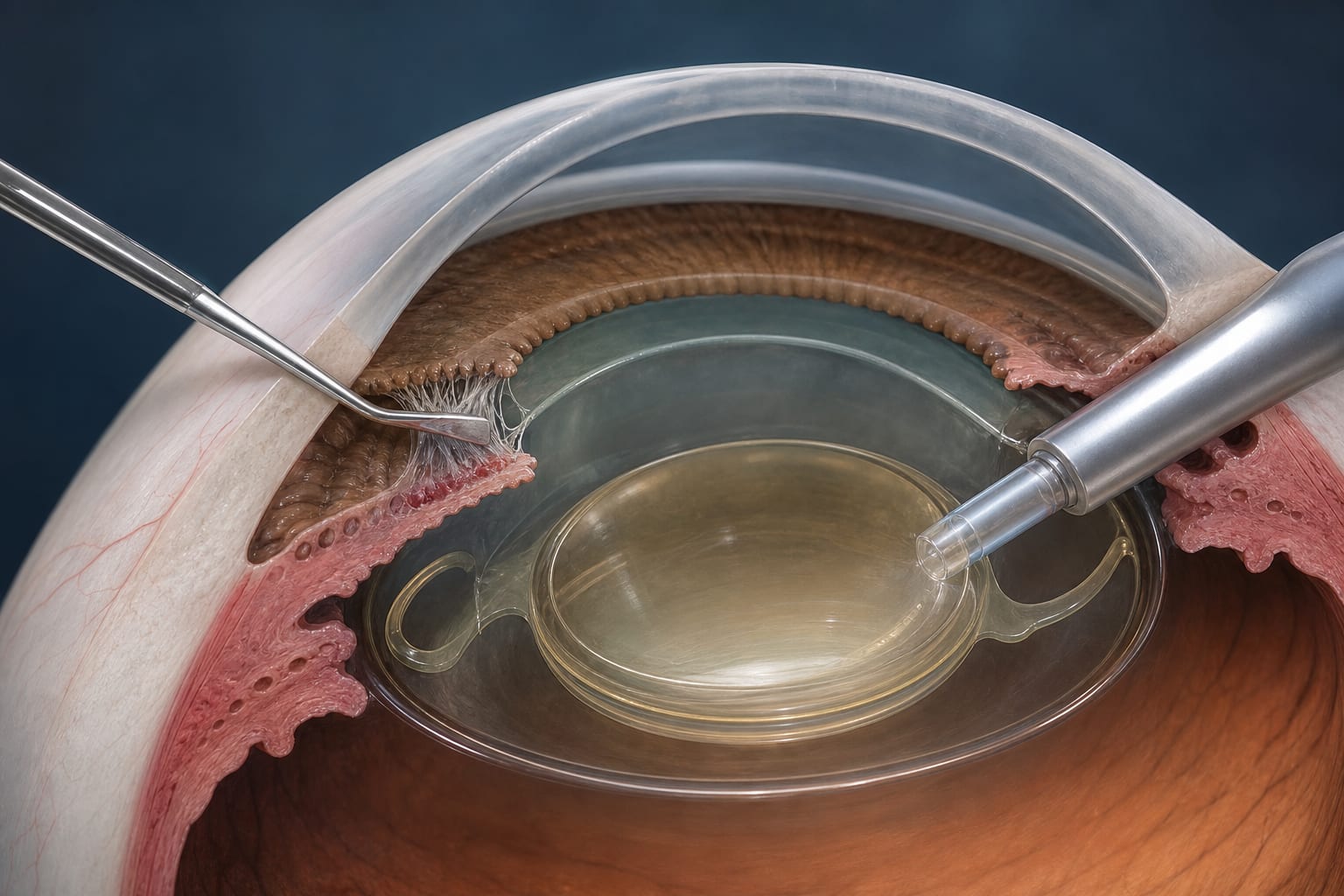
  • Trifocal IOLs redistribute light energy across three focal points to improve near and intermediate vision.
  • EDOF IOLs extend focal range by elongating depth of focus using wavefront-shaping or diffractive technologies.
  • Postoperative dissatisfaction may manifest as blurred vision, visual disturbances, or ocular discomfort despite satisfactory visual acuity.

Guideline-Based Recommendations

Diagnosis

  • Comprehensive preoperative ophthalmic examination including visual acuity, corneal properties, and ocular biometry.
  • Postoperative assessments at 3 days, 1 month, and 3 months including slit-lamp microscopy, refraction, and visual acuity testing.
  • Use of visual quality analyzers and ocular surface analysis for patients reporting subjective symptoms.
  • Classification of dissatisfaction causes based on objective findings when no organic lesions or refractive errors are present.

Management

  • Femtosecond laser-assisted phacoemulsification with appropriate IOL selection based on patient ocular parameters.
  • Postoperative medication regimen including levofloxacin, prednisolone acetate eye drops, and tobramycin-dexamethasone ointment.
  • Address residual refractive errors and ocular surface disease as potential contributors to dissatisfaction.

Monitoring & Follow-up

  • Regular postoperative follow-up visits with comprehensive ocular examinations and visual function assessments.
  • Monitoring for posterior capsular opacification, IOL position, and ocular surface health.
  • Use of advanced imaging and functional analyzers to detect subtle causes of dissatisfaction.

Risks

  • Residual refractive errors leading to blurred vision.
  • Optical phenomena related to multifocal or EDOF lens designs causing visual disturbances.
  • Ocular surface disease contributing to discomfort and reduced visual quality.
  • Postoperative complications affecting visual outcomes.

Patient & Prescribing Data

Patients receiving either AcrySof IQ Vivity (EDOF) or PanOptix TFNT00 (trifocal) IOLs after cataract surgery

Target refractive power set close to zero for trifocal IOLs; EDOF IOLs targeted at zero or slight myopic offset in non-primary eye to optimize binocular vision and patient satisfaction

Clinical Best Practices

  • Careful patient selection adhering to established clinical consensus guidelines for multifocal IOL implantation.
  • Preoperative identification of dominant eye and precise IOL power calculation using Barrett Universal II or Barrett True-K formulas.
  • Standardized surgical technique with femtosecond laser assistance performed by experienced surgeons.
  • Comprehensive postoperative follow-up with objective and subjective assessments to identify and manage dissatisfaction causes.
  • Utilization of ocular surface evaluation and visual quality metrics to guide targeted interventions.
References

Original Source(s)

Related Content