Applying Evidence-Based Care to Low-Risk Thyroid Cancer
-
By
-
Lia D. Delaney
-
Carolyn D. Seib
-
October 30, 2026
Clinical Scorecard: Applying Evidence-Based Care to Low-Risk Thyroid Cancer
At a Glance
| Category | Detail |
|---|---|
| Condition | Low-risk differentiated thyroid cancer |
| Key Mechanisms | The article addresses evidence-to-practice barriers in surgical de-escalation, including established surgical habits, professional identity, individualized decision-making, and variation in practice environments. |
| Target Population | Patients with low-risk differentiated thyroid cancer, including appropriately selected patients with tumors smaller than 4 cm and no nodal metastases or other high-risk features. |
| Care Setting | Surgical practices and the broader care pathway involving surgeons, referring physicians, and other care-team members. |
Key Highlights
- Guidelines increasingly endorse thyroid lobectomy for appropriately selected patients with low-risk differentiated thyroid cancer.
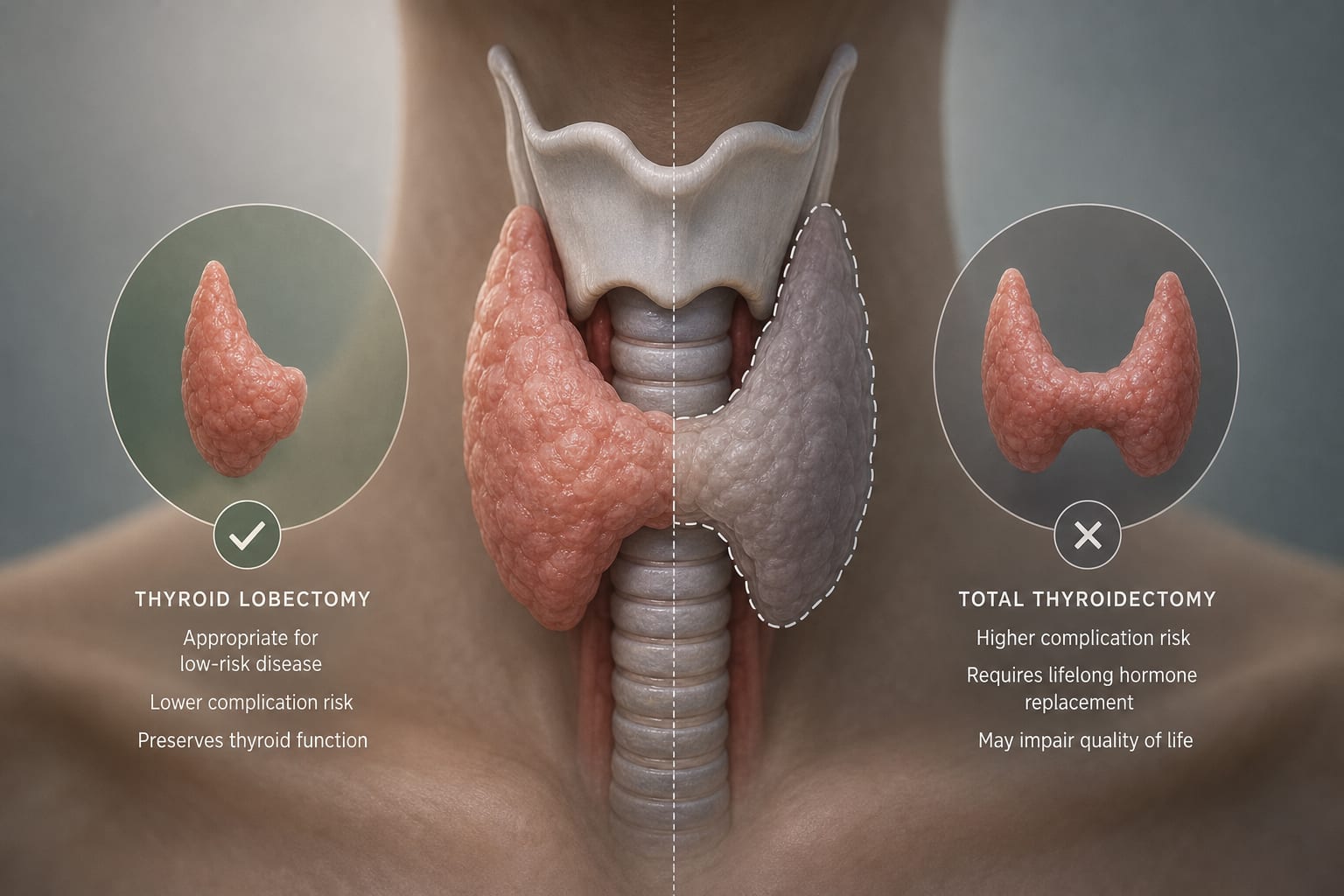
- For tumors smaller than 4 cm without nodal metastases or other high-risk features, evidence shows comparable oncologic outcomes with lobectomy and total thyroidectomy.
- Total thyroidectomy is associated with greater complication risk, lifelong thyroid hormone replacement, and poorer quality of life relative to lobectomy.
- In a focused ethnographic study, surgeons most frequently favored performance feedback, but no single intervention was identified as optimal.
- Care de-escalation includes decisions about surgery, postoperative radioactive iodine, and long-term surveillance.
Guideline-Based Recommendations
Diagnosis
- The article describes treatment selection for low-risk differentiated thyroid cancer but does not provide diagnostic recommendations.
Management
- Consider thyroid lobectomy for appropriately selected patients, including those with tumors smaller than 4 cm and no nodal metastases or other high-risk features.
- Total thyroidectomy remains an appropriate and safe option for some patients, depending on disease characteristics and patient preferences.
- Evidence supports surveillance without postoperative radioactive iodine ablation for most patients.
- Coordinate expectations for the initial procedure, adjuvant treatment, and long-term surveillance across the care team.
Monitoring & Follow-up
- The article identifies long-term surveillance as part of less-intensive management but does not specify a surveillance schedule.
Risks
- Compared with lobectomy, total thyroidectomy is associated with greater risk of complications, including transient or permanent hypoparathyroidism.
- Total thyroidectomy necessitates lifelong thyroid hormone replacement and is linked to poorer quality of life.
- The article notes that treatment variation is expected; the objective is to reduce variation not explained by relevant clinical or patient factors.
Patient & Prescribing Data
Patients with low-risk differentiated thyroid cancer; the article cites tumors smaller than 4 cm without nodal metastases or other high-risk features as a group for whom lobectomy may be appropriate.
Total thyroidectomy remains the treatment for approximately 60% to 80% of patients with low-risk thyroid cancer. The article supports individualized decisions about lobectomy, total thyroidectomy, postoperative radioactive iodine, and surveillance.
Clinical Best Practices
- Use relevant disease characteristics and patient preferences when selecting the extent of surgery.
- Consider performance feedback, such as comparison of surgeons’ total thyroidectomy rates with those of peers, as a possible practice-change strategy; the article does not identify a single optimal intervention.
- Develop decision-support tools collaboratively with surgeons and tailor them to local workflows, resources, and patient populations.
- Engage referring physicians and other care-team members in aligning expectations about surgery, adjuvant treatment, and surveillance.
Related Resources & Content
Based on findings from:
From Evidence to Practice in Low-Risk Thyroid Cancer
Lia D. Delaney, Carolyn D. Seib. Jama Network Open, 2026.
https://jamanetwork.com/journals/jamanetworkopen/fullarticle/2856036
This content is an AI-generated, fully rewritten summary based on a published scholarly article. It does not reproduce the original text and is not a substitute for the original publication. Readers are encouraged to consult the source for full context, data, and methodology.