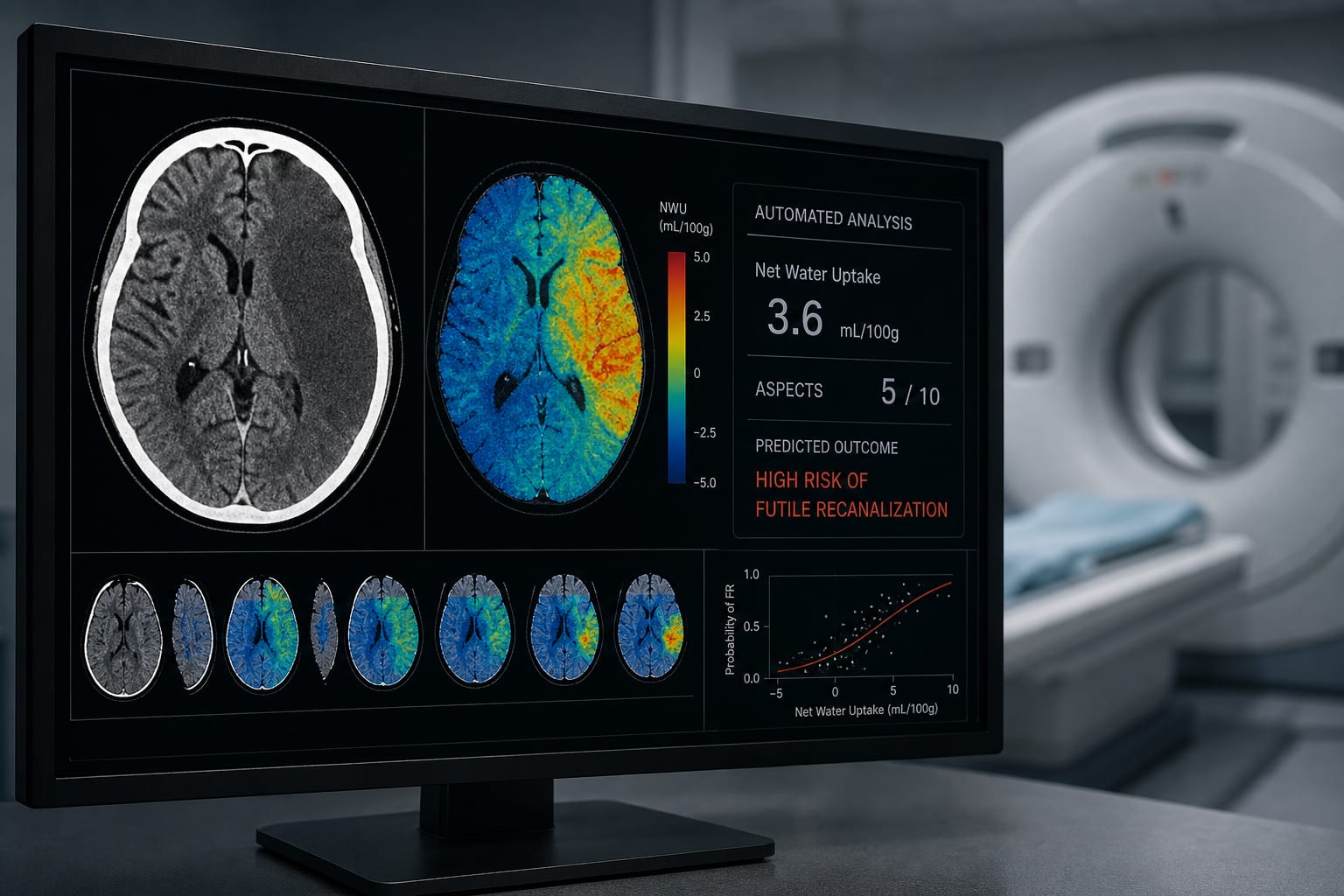
Automated Analysis of Net Water Uptake via Clinical Software Predicts Ineffective Recanalization in Acute Ischemic Stroke Cases
By
Abdallah Aburub
Oussama Dob
Mariana Gurschi
Yashar Aghazadeh
Jumana Jaber
Zaid Al-Tamimi
Zaid Samhan
Lars Timmermann
Christopher Nimsky
Peter Sporns
Gabriel Broocks
André Kemmling
July 8, 2026
Clinical Scorecard: Automated Analysis of Net Water Uptake via Clinical Software Predicts Ineffective Recanalization in Acute Ischemic Stroke Cases
At a Glance
Category Detail
Condition Acute Ischemic Stroke (AIS) Key Mechanisms Net water uptake (NWU) reflects tissue-level injury and predicts clinical outcomes in anterior-circulation large vessel occlusion (LVO) stroke. Target Population Patients with anterior circulation LVO treated with endovascular thrombectomy (EVT). Care Setting Tertiary care stroke center
Key Highlights
Automated NWU measurement on admission CT predicts futile recanalization (FR) in AIS. Higher NWU correlates with poor functional outcomes at 90 days post-treatment. A tiered NWU strategy may enhance early triage and prognostication. Guideline-Based Recommendations
Diagnosis
Use automated NWU measurement on admission CT to assess stroke severity. Management
Consider NWU thresholds (>11.5% as a risk flag, >17.5% for high specificity) for treatment decisions. Monitoring & Follow-up
Monitor NWU to evaluate potential for FR and adjust treatment strategies accordingly. Risks
Older age and higher NIHSS scores are associated with increased risk of FR. Patient & Prescribing Data
Patients presenting with anterior circulation LVO stroke.
Automated NWU can guide treatment decisions and prognostication in EVT.
Clinical Best Practices
Implement automated NWU quantification in acute stroke triage. Utilize NWU as a biomarker for assessing ischemic injury and predicting outcomes. Related Resources & Content