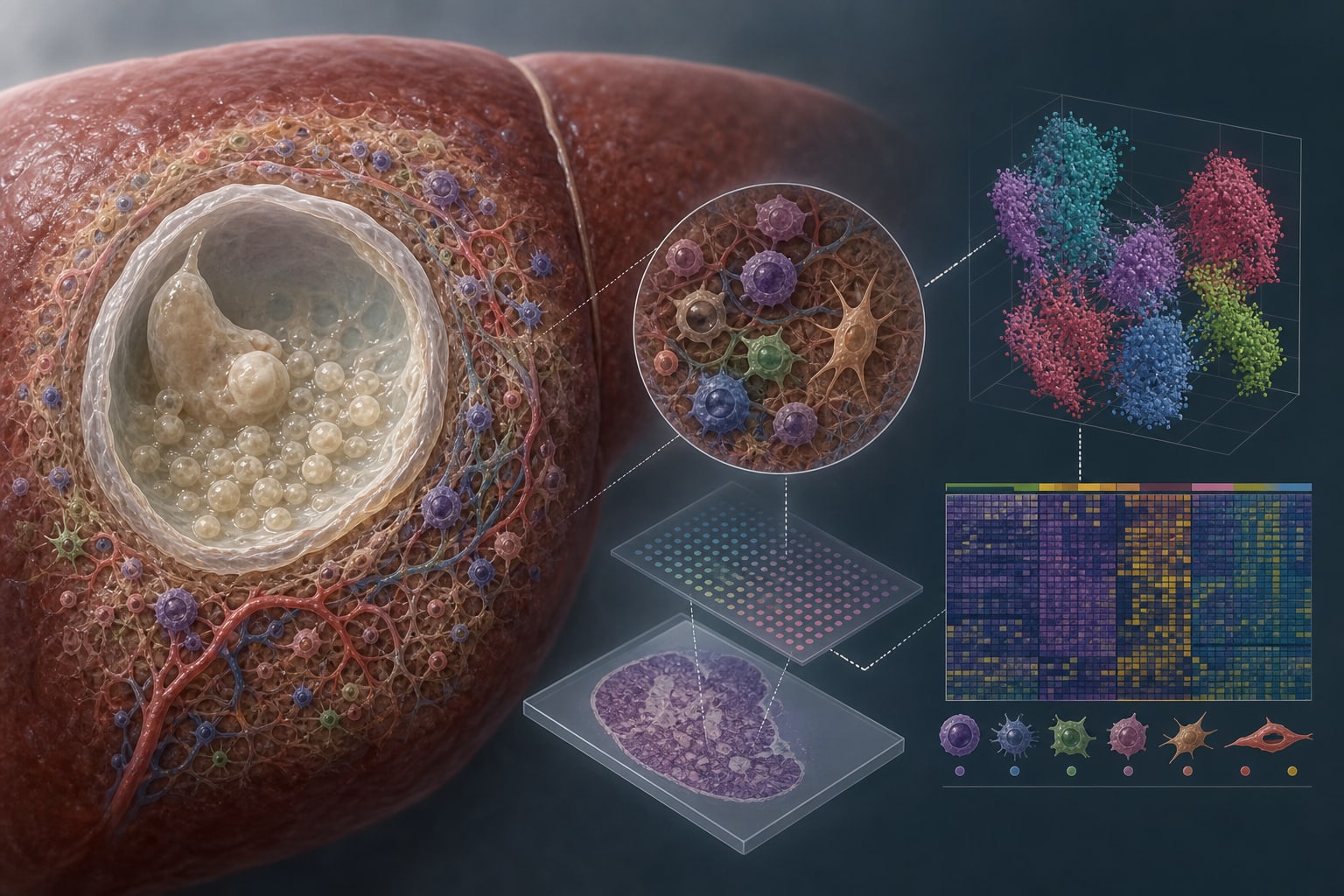
Omics landscapes of hepatic echinococcosis: bulk foundations, emerging single-cell studies, and analytical considerations
By
Qianwen Wang
Xiaopeng Wang
Honglin Yan
Jingping Yuan
June 15, 2026
Clinical Scorecard: Exploring the Omics Profiles in Hepatic Echinococcosis: Core Insights, Advancements in Single-Cell Research, and Key Analytical Factors
At a Glance
Category Detail
Condition Key Mechanisms Immunoregulation, angiogenesis, fibrovascular remodeling Target Population Care Setting
Key Highlights
Hepatic echinococcosis is caused by Echinococcus granulosus and Echinococcus multilocularis. Lesion progression involves a host-parasite stalemate with chronic persistence. Single-cell RNA sequencing and spatial transcriptomics provide insights into cellular interactions in lesions. Cystic echinococcosis and alveolar echinococcosis differ in growth patterns and clinical management. Clinical manifestations can include hepatomegaly, pain, and complications from cyst rupture. Guideline-Based Recommendations
Diagnosis
Imaging-based stage classification for cystic echinococcosis. Clinical evaluation of symptoms and imaging for alveolar echinococcosis. Management
Cystic echinococcosis may involve watch and wait, percutaneous interventions, surgery, or benzimidazoles. Alveolar echinococcosis often requires radical resection and prolonged antiparasitic therapy. Monitoring & Follow-up
Regular imaging and clinical assessment for changes in lesion size or symptoms. Risks
Cyst rupture may lead to hypersensitivity reactions or secondary echinococcosis. Patient & Prescribing Data
Individuals with hepatic echinococcosis, particularly in endemic regions.
Management strategies differ based on the type of echinococcosis and lesion stage.
Clinical Best Practices
Utilize single-cell and spatial transcriptomics for detailed profiling of lesions. Adopt a stage-aware and lesion-zone-aware approach for interpreting pathobiology. Integrate findings from bulk omics with single-cell analyses for comprehensive understanding. Related Resources & Content