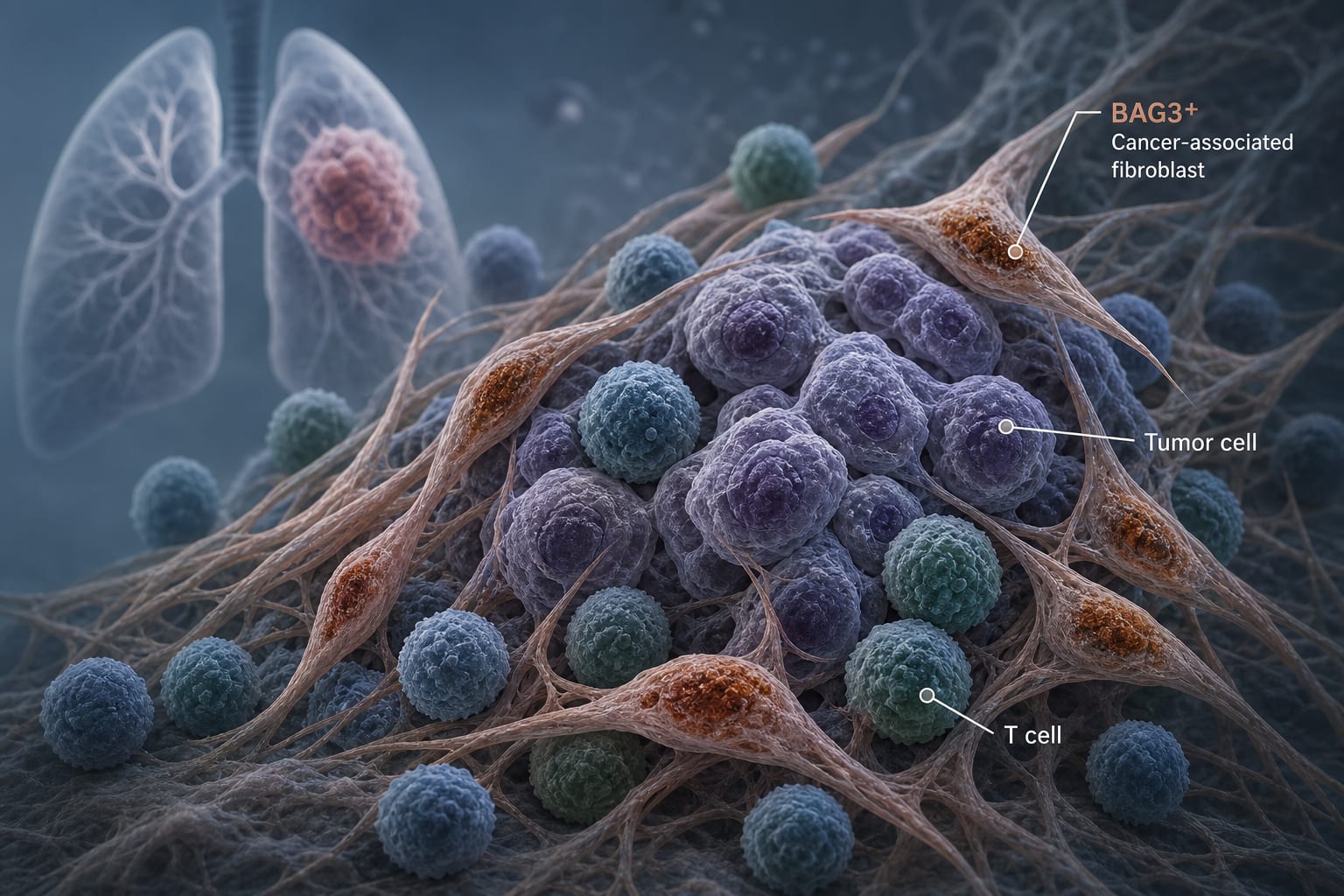
BAG3+ CAF-T cell neighborhood predicts resistance to neoadjuvant chemoimmunotherapy in NSCLC
-
By
-
Jing Sun
-
Zhengqi Cao
-
Yueping Jin
-
Anni Wang
-
Li Lu
-
Lixuan Chen
-
Wenhui Shi
-
Peiyi Xu
-
Yuxin Ouyang
-
Junjie Tang
-
Zhouwenli Meng
-
Ziming Li
-
July 7, 2026
-
Clinical Scorecard: BAG3+ CAF-T Cell Microenvironment as a Predictor of Neoadjuvant Chemoimmunotherapy Resistance in Non-Small Cell Lung Cancer
At a Glance
| Category | Detail |
|---|
| Condition | Non-Small Cell Lung Cancer (NSCLC) |
| Key Mechanisms | BAG3+ CAF-T Cell Neighborhood associated with treatment resistance |
| Target Population | Patients undergoing neoadjuvant chemoimmunotherapy (NCIT) |
| Care Setting | Oncology clinical practice |
Key Highlights
- Over 40% of NSCLC patients fail to achieve major pathological response (MPR) after NCIT.
- BAG3+ CAF-T Cell Neighborhood is significantly more abundant in non-responders (nMPR) compared to responders (MPR).
- The predictive value of BAG3+ CAF-T Cell Neighborhood outperformed other indicators in identifying non-response to NCIT.
- AUC values for BAG3+IFITM2+ CAFs and BAG3+CD8+ T cells indicate strong predictive potential.
- OS and DFS are significantly decreased in patients with high BAG3+ CAF-T Cell Neighborhood.
Guideline-Based Recommendations
Diagnosis
- Utilize single-cell RNA sequencing to identify biomarkers associated with treatment response.
Management
- Consider BAG3+ CAF-T Cell Neighborhood as a potential biomarker for predicting non-response to NCIT.
Monitoring & Follow-up
- Assess the abundance of BAG3+ CAF-T Cell Neighborhood in pre-treatment tissue samples.
Risks
- Patients with high levels of BAG3+ CAF-T Cell Neighborhood may have poorer survival outcomes.
Patient & Prescribing Data
Patients with resectable NSCLC undergoing NCIT.
Current biomarkers like PD-L1 and TMB have limited sensitivity and specificity in predicting NCIT response.
Clinical Best Practices
- Integrate BAG3+ CAF-T Cell Neighborhood assessment in pre-treatment evaluations.
- Utilize multiplex immunofluorescence for validation of predictive biomarkers.
Related Resources & Content