Disease-specific data augmentation enhances deep learning classification of age-related macular degeneration, diabetic retinopathy, and glaucoma
By
Carl Halladay Abraham
Emmanuel Kwasi Abu
Paul Owusu
Thomas Osei Mensah
Ebenezer Botchway
Philip Abakah Mensah
Albert Kofi Dadzie
Samuel Kyei
June 22, 2026
Clinical Scorecard: Augmentation of Disease-Specific Data Improves Deep Learning Accuracy in Classifying Age-Related Macular Degeneration, Diabetic Retinopathy, and Glaucoma
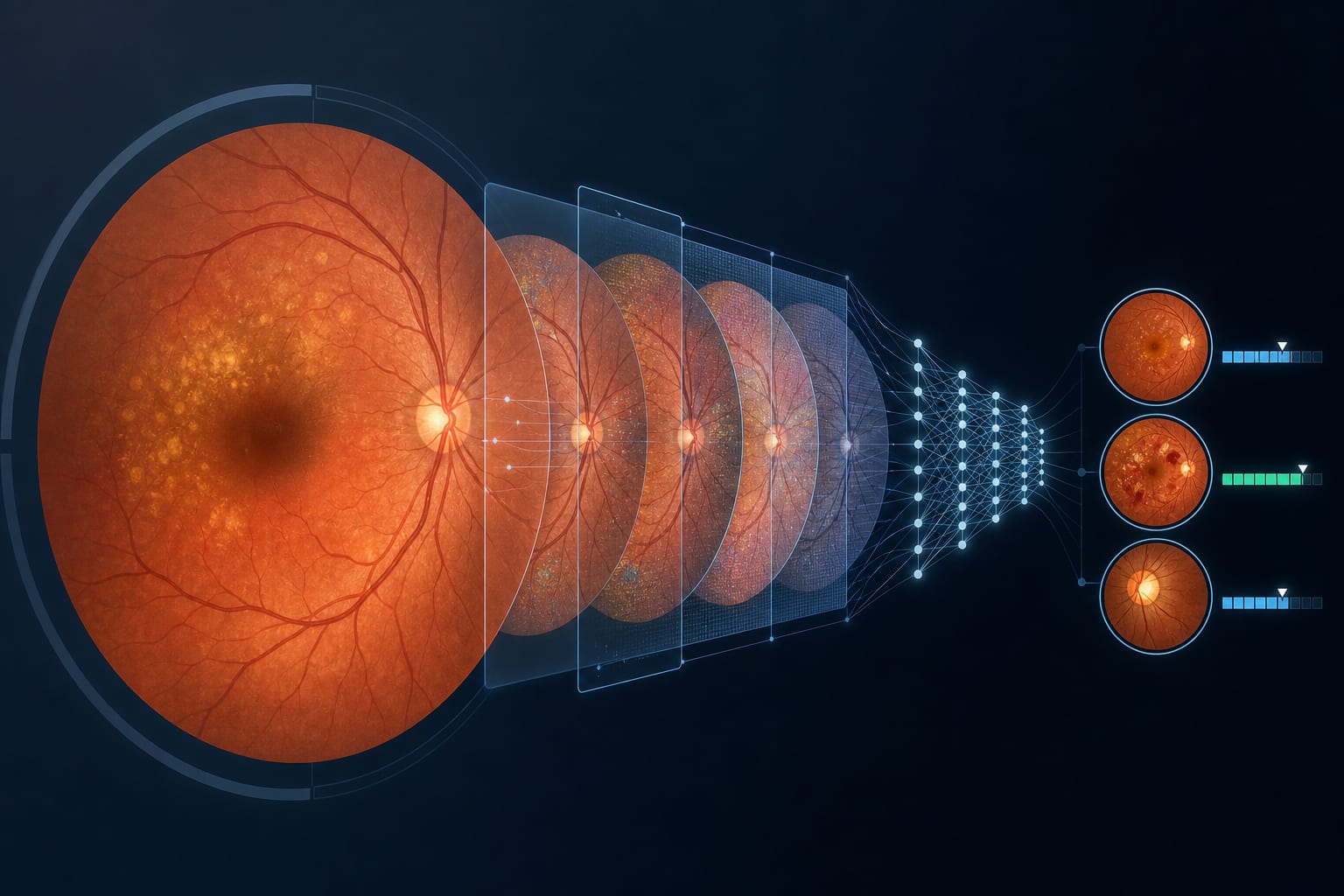
At a Glance
Category Detail
Condition Age-Related Macular Degeneration, Diabetic Retinopathy, Glaucoma
Key Mechanisms Deep Learning models for image classification and data augmentation techniques
Target Population Individuals at risk of irreversible blindness due to retinal diseases
Care Setting Clinical environments utilizing retinal imaging systems
Key Highlights
Glaucoma, AMD, and DR are leading causes of irreversible blindness. Deep Learning models can achieve diagnostic accuracy comparable to experienced clinicians. Data augmentation techniques can enhance model performance by expanding training datasets. Disease-specific augmentations may yield better classification results than generic ones. The study evaluates the impact of various augmentation techniques on deep learning performance.
Guideline-Based Recommendations
Diagnosis
Utilize high-resolution retinal imaging systems for accurate diagnosis.
Management
Implement AI tools to support diagnostic decision-making in retinal diseases.
Monitoring & Follow-up
Monitor model performance on validation sets to prevent overfitting.
Risks
Data scarcity may limit the development of robust deep learning models.
Patient & Prescribing Data
Patients with age-related macular degeneration, diabetic retinopathy, or glaucoma.
AI diagnostic systems can improve accuracy in identifying retinal diseases.
Clinical Best Practices
Employ disease-specific data augmentations to enhance model training. Ensure balanced representation of disease categories in training datasets. Regularly evaluate model performance using standardized validation sets.
Related Resources & Content