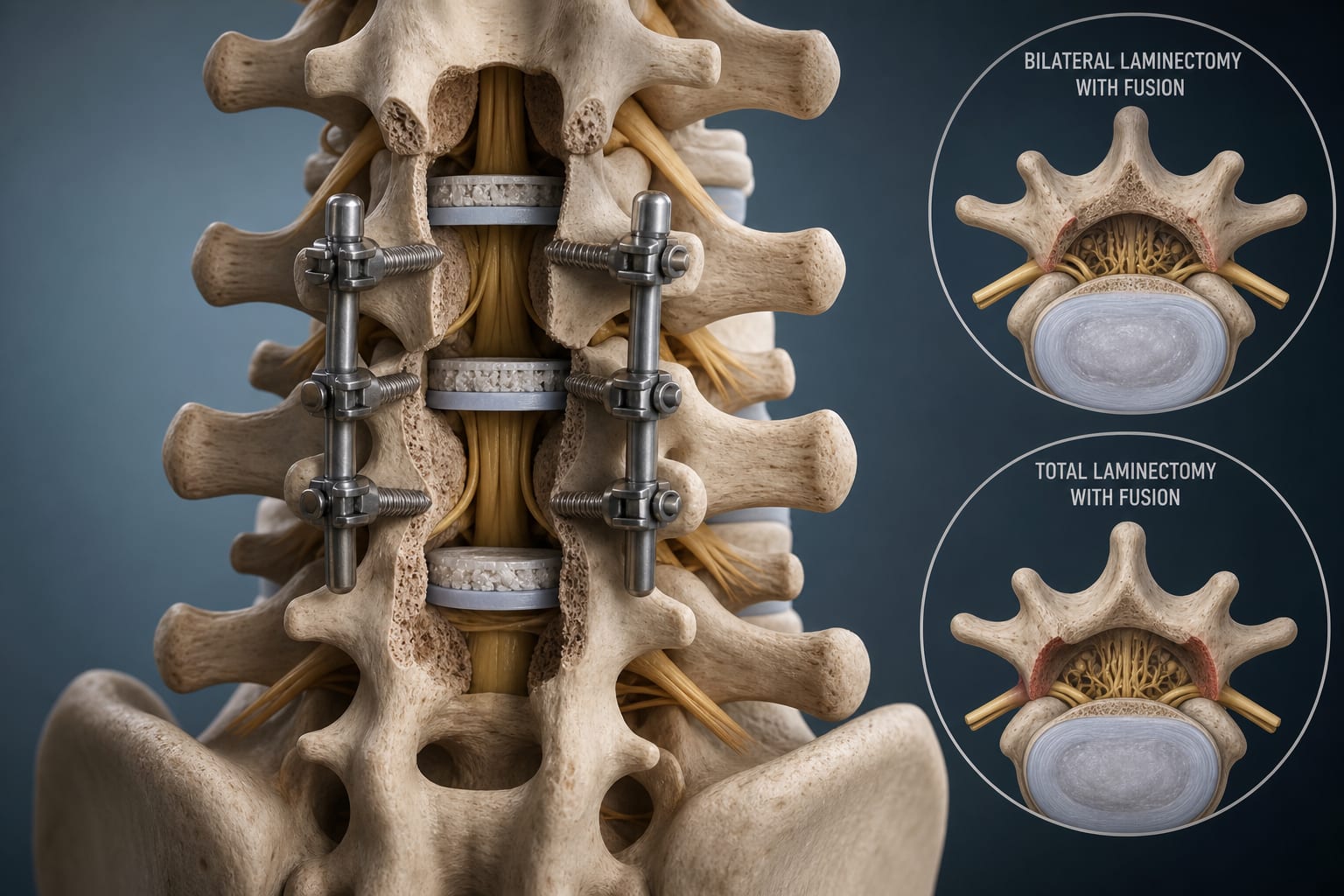
Clinical Scorecard: Comparative Efficacy of Bilateral Laminectomy with Fusion versus Total Laminectomy with Fusion in Patients with Two-Level Lumbar Spinal Stenosis
At a Glance
Category
Detail
Condition
Two-Level Lumbar Spinal Stenosis
Key Mechanisms
Degenerative changes leading to spinal canal narrowing and nerve root compression.
Target Population
Patients aged ≥18 years with two-level lumbar spinal stenosis who failed conservative treatment.
Care Setting
Single-center hospital study
Key Highlights
BLF group showed significantly reduced hospital stay and blood loss compared to TLF group.
Patients in the BLF group had better improvement in ODI, VAS, and JOA scores.
MacNab criteria excellent/good rates were 95% for BLF and 91% for TLF.
Fewer complications reported in the BLF group compared to the TLF group.
Guideline-Based Recommendations
Diagnosis
Diagnosis based on clinical symptoms, physical examination, MRI, and failure of conservative treatment.
Management
Surgical treatment indicated for patients with failed conservative therapy.
Monitoring & Follow-up
Follow-up assessments of clinical outcomes using VAS, ODI, and JOA scores.
Risks
Potential complications include nerve root irritation and spinal epidural tear.
Patient & Prescribing Data
124 patients with two-level lumbar spinal stenosis.
BLF may provide better clinical outcomes than TLF.
Clinical Best Practices
Consider BLF for patients with two-level lumbar spinal stenosis to improve recovery and reduce complications.