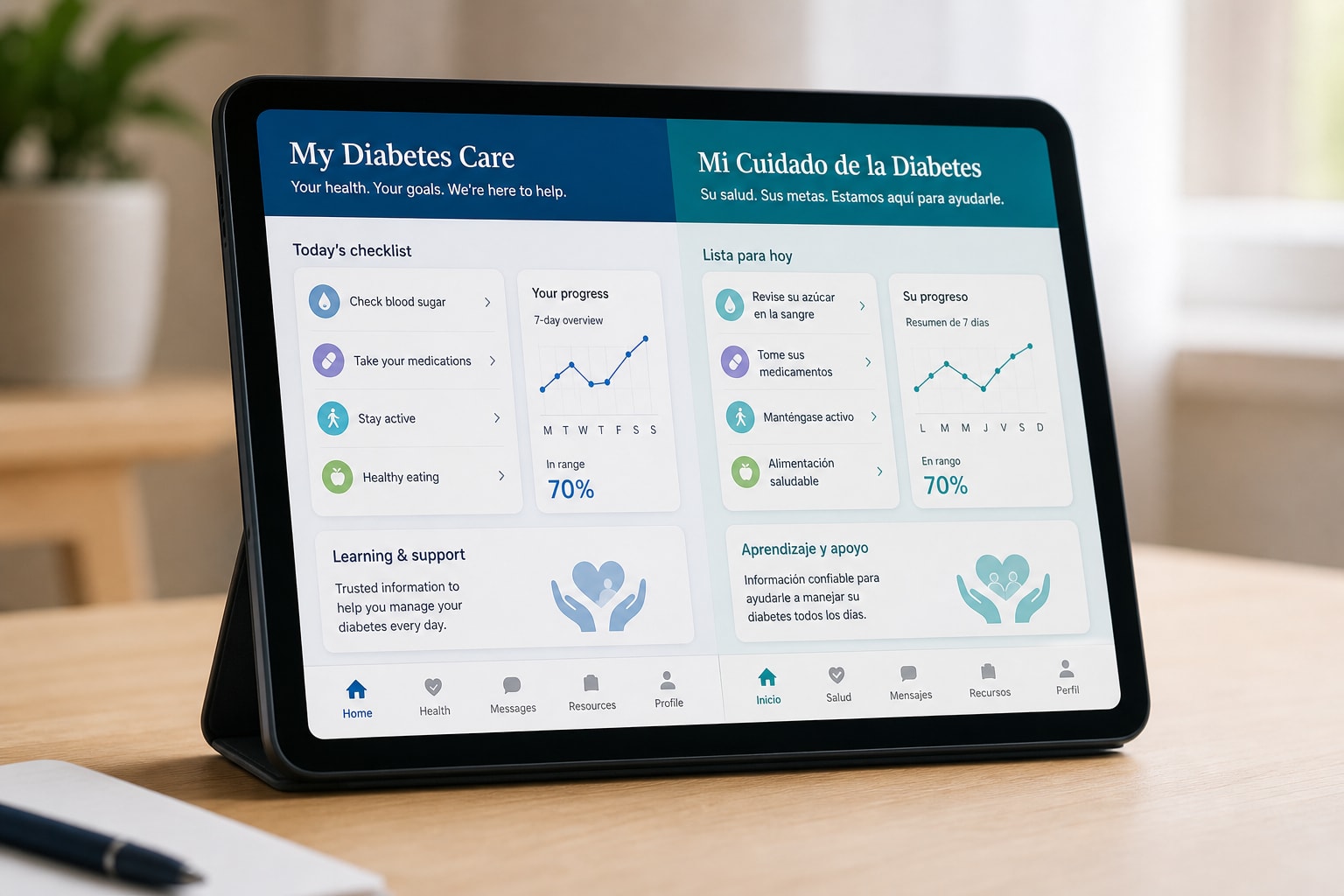
Developing an expanded version of My Diabetes Care in English and Spanish: A design and formative usability study
By
Elsa B. Rodriguez–Baron
Jorge A. Rodriguez
Lipika Samal
Shilo Anders
Russell Beebe
Carrie Reale
Tom Elasy
Amber J. Hackstadt
Zhihong Yu
Lindsay Mayberry
Lyndsay A. Nelson
S. Trent Rosenbloom
Adam Wright
Audriana Nigg
William Martinez
May 29, 2026
Clinical Scorecard: Creating an Enhanced Bilingual Edition of My Diabetes Care: A Design and Usability Assessment
At a Glance
Category Detail
Condition Diabetes self-management Key Mechanisms Patient portals to support diabetes self-management and improve health literacy. Target Population Patients with type 2 diabetes, particularly Spanish-speaking individuals. Care Setting Vanderbilt University Medical Center, Nashville, TN.
Key Highlights
Development of My Diabetes Care (MDC) to enhance diabetes self-management. Focus on culturally tailored, multilingual interventions for non-English speaking populations. Incorporation of additional health metrics such as urine microalbumin and BMI. Utilization of user-centered Design Sprint methodology for interface design. Formative usability testing conducted to refine the prototype. Guideline-Based Recommendations
Diagnosis
Confirm type 2 diabetes through self-report and electronic health records. Management
Implement culturally tailored interventions to improve diabetes education. Monitoring & Follow-up
Use patient portals to track diabetes health metrics and facilitate self-management. Risks
Address barriers such as limited health literacy and language barriers. Patient & Prescribing Data
Adults aged 18-75 with type 2 diabetes.
Focus on improving access to diabetes management resources for Spanish-speaking patients.
Clinical Best Practices
Engage patients in the design process to ensure usability and relevance. Incorporate feedback from diverse patient populations to enhance intervention effectiveness. Utilize integrated patient portals for better patient engagement in self-management. Related Resources & Content