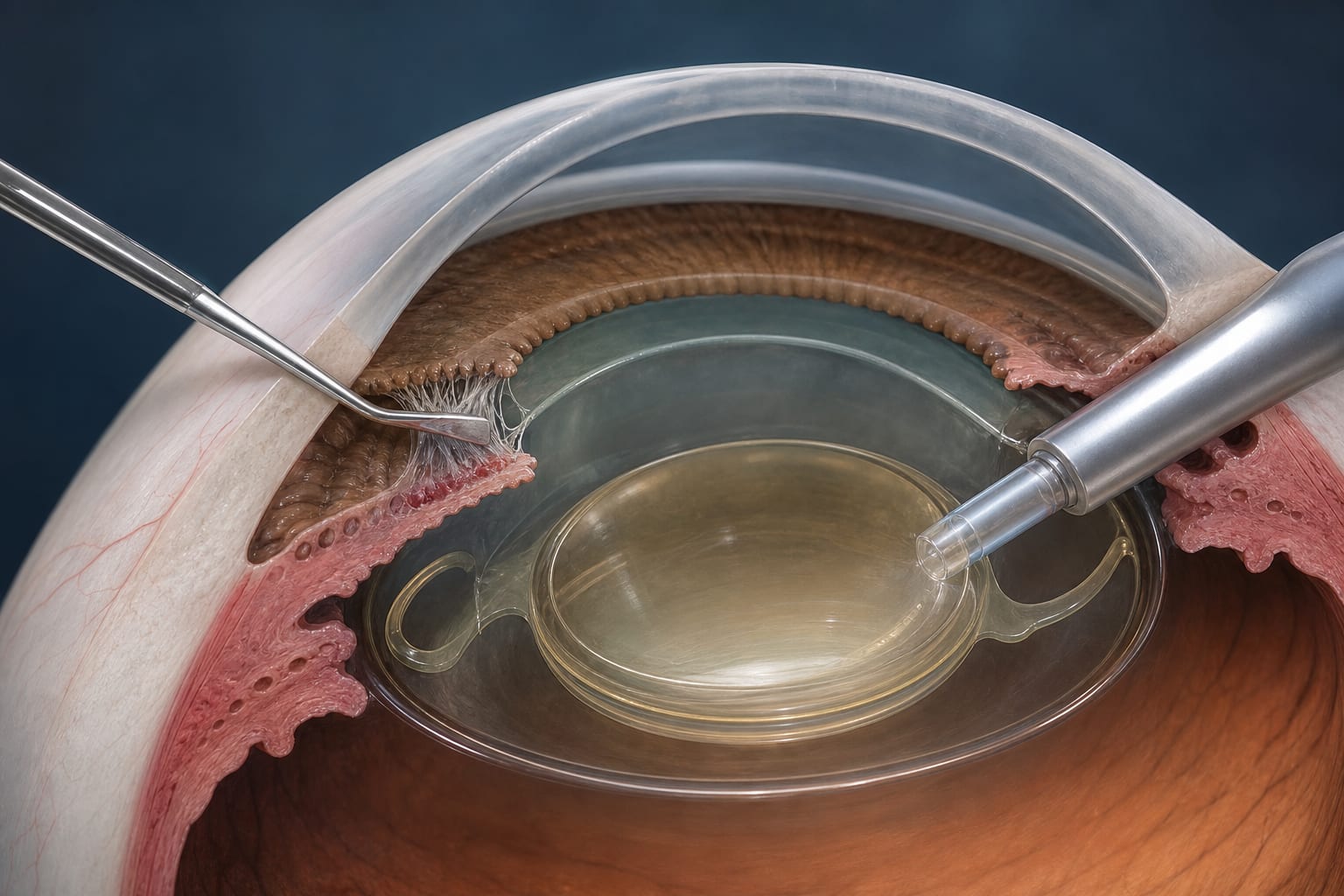
Comparison of Stability Between Panoptix and AT Lisa Trifocal Intraocular Lenses with Distinct Haptic Designs Utilizing the iTrace System - Scorecard - MDSpire
Clinical Scorecard: Comparison of Stability Between Panoptix and AT Lisa Trifocal Intraocular Lenses with Distinct Haptic Designs Utilizing the iTrace System
At a Glance
Category
Detail
Condition
Cataract with corneal astigmatism requiring trifocal toric intraocular lens implantation
Key Mechanisms
Rotational stability of trifocal toric IOLs influenced by haptic design (C-loop vs. plate) and material (hydrophobic vs. hydrophilic acrylic) affecting postoperative visual outcomes
Target Population
Patients over 50 years old with regular corneal astigmatism >0.80 D, mesopic pupil 3.0–5.5 mm, seeking spectacle independence
Trifocal toric IOLs correct distance, intermediate, and near vision simultaneously, addressing presbyopia and astigmatism.
Rotational instability of toric IOLs can cause residual astigmatism and visual disturbances such as halos and reduced contrast sensitivity.
The iTrace system provides objective, efficient postoperative assessment of toric IOL rotational alignment.
Guideline-Based Recommendations
Diagnosis
Perform comprehensive preoperative ophthalmological examination including visual acuity, intraocular pressure, slit lamp, and fundus exam.
Assess corneal topography and biometry to quantify astigmatism and ocular biometrics.
Use iTrace or equivalent objective measurement tools for postoperative toric IOL alignment evaluation.
Management
Select trifocal toric IOL type based on patient biometric parameters and surgeon-patient discussion of lens characteristics.
Consider haptic design and material properties when choosing IOL to optimize rotational stability.
Aim for spectacle independence by minimizing residual astigmatism through precise IOL alignment.
Monitoring & Follow-up
Conduct postoperative assessments using iTrace system to monitor IOL rotational stability.
Evaluate for visual disturbances such as halos or reduced contrast sensitivity that may indicate IOL rotation.
Regular follow-up to detect and manage any IOL misalignment or residual refractive error.
Risks
Rotational instability leading to residual astigmatism and decreased visual quality.
Potential visual disturbances including halos and reduced contrast sensitivity with IOL misalignment.
Limitations in detecting subtle rotational differences due to variability in measurement and sample size.
Patient & Prescribing Data
Patients over 50 years with regular corneal astigmatism >0.80 D desiring spectacle independence
Both PanOptix (C-loop, hydrophobic acrylic) and AT Lisa (plate haptic, hydrophilic acrylic) trifocal toric IOLs are commonly used; selection should consider rotational stability influenced by haptic design and material.
Clinical Best Practices
Use objective measurement systems like iTrace for accurate postoperative assessment of toric IOL rotation.
Discuss with patients the advantages and disadvantages of different trifocal toric IOL designs prior to surgery.
Exclude patients with irregular astigmatism, ocular comorbidities, or prior ocular surgeries to optimize outcomes.
Perform power analysis to ensure adequate sample size for detecting clinically meaningful differences in IOL rotation in studies.