Rapid phagosome formation drives parasite control in subclinical Leishmania braziliensis infection
By
Caic Figueiredo
Alan Rocha dos Santos
Camila Pimentel
Maurício T. Nascimento
Fabio Peixoto
Vítor Oliveira
Olivia Bacellar
Lucas P. Carvalho
Edgar M. Carvalho
Thiago M. Cardoso
June 5, 2026
Clinical Scorecard: Accelerated Formation of Phagosomes Enhances Control of Parasites in Asymptomatic Leishmania braziliensis Infections
At a Glance
Category Detail
Condition Cutaneous leishmaniasis (CL) caused by Leishmania braziliensis Key Mechanisms Phagosome formation and intracellular parasite control by macrophages Target Population Individuals with subclinical (SC) L. braziliensis infection Care Setting Endemic areas of L. braziliensis transmission
Key Highlights
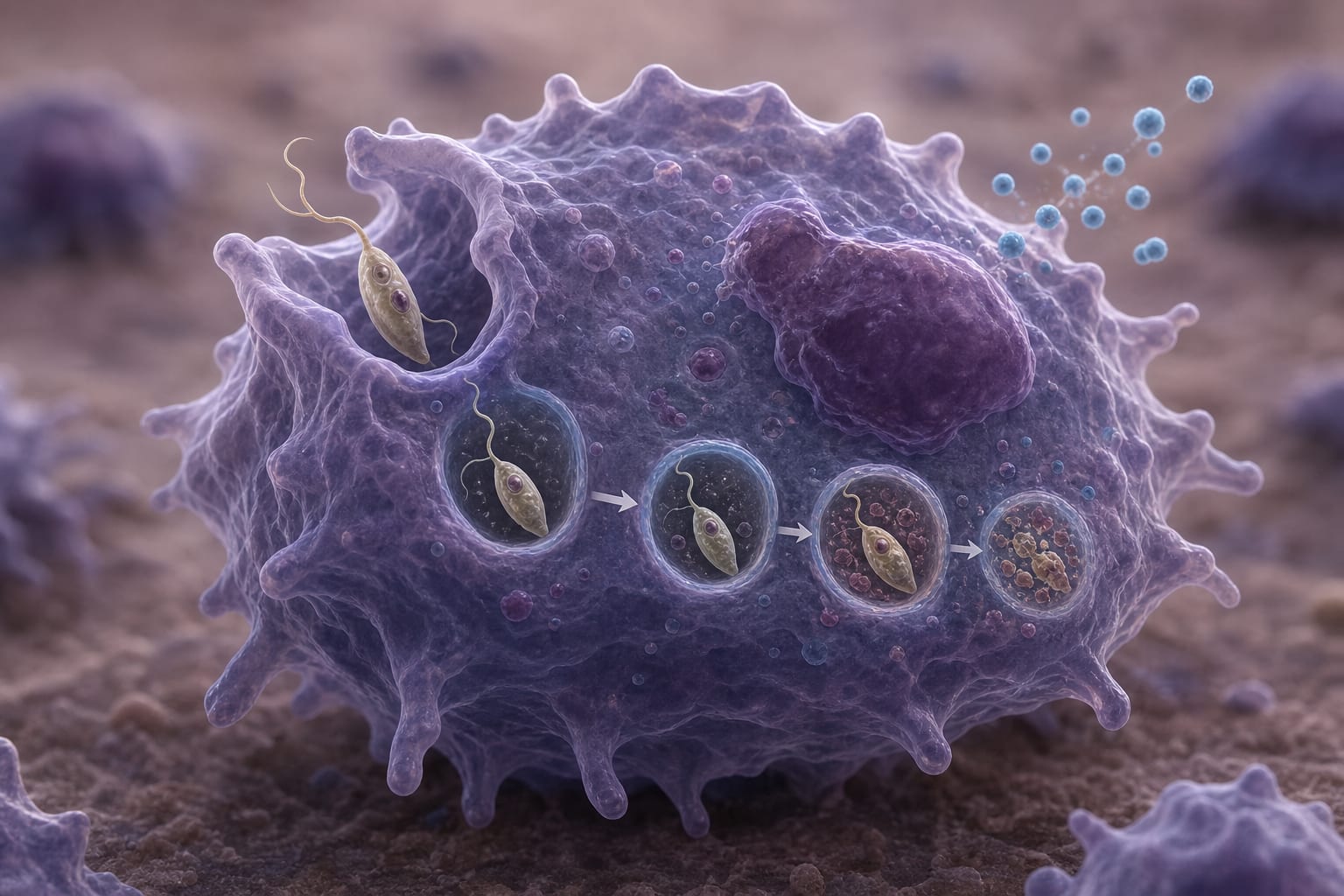
SC macrophages exhibit quicker phagosome formation compared to CL macrophages. Effective control of L. braziliensis infection observed in SC individuals. Lower levels of IFN-γ and TNF-α produced by SC individuals compared to CL subjects. SC individuals do not develop clinical leishmaniasis despite positive Leishmania skin test. Macrophages from SC individuals maintain effective parasite killing despite lower oxidative burst. Guideline-Based Recommendations
Diagnosis
Positive Leishmania skin test (LST) and/or IFN-γ production upon exposure to soluble Leishmania antigen (SLA) for SC individuals. Management
Monitor SC individuals for potential development of CL while recognizing their effective control of infection. Monitoring & Follow-up
Evaluate levels of pro-inflammatory cytokines in PBMCs from SC and CL subjects. Risks
Risk of developing CL in individuals with SC infection remains, necessitating ongoing surveillance. Patient & Prescribing Data
Individuals with subclinical L. braziliensis infection
SC individuals control infection without developing pathology.
Clinical Best Practices
Encourage monitoring of immune responses in SC individuals. Consider the role of macrophage function in the management of leishmaniasis. Utilize flow cytometry to assess phagosome formation and parasite control. Related Resources & Content