Management Strategies for Hydrocephalus in Pediatric Medulloblastoma: A Retrospective Cohort Analysis
-
By
-
Yunwei Ou
-
Yiqiao Xu
-
Jingzhe Yuan
-
Haoqi Zeng
-
Chunde Li
-
Jian Gong
-
September 8, 2026
Clinical Scorecard: Management Strategies for Hydrocephalus in Pediatric Medulloblastoma: A Retrospective Cohort Analysis
At a Glance
| Category | Detail |
|---|
| Condition | Hydrocephalus in Pediatric Medulloblastoma |
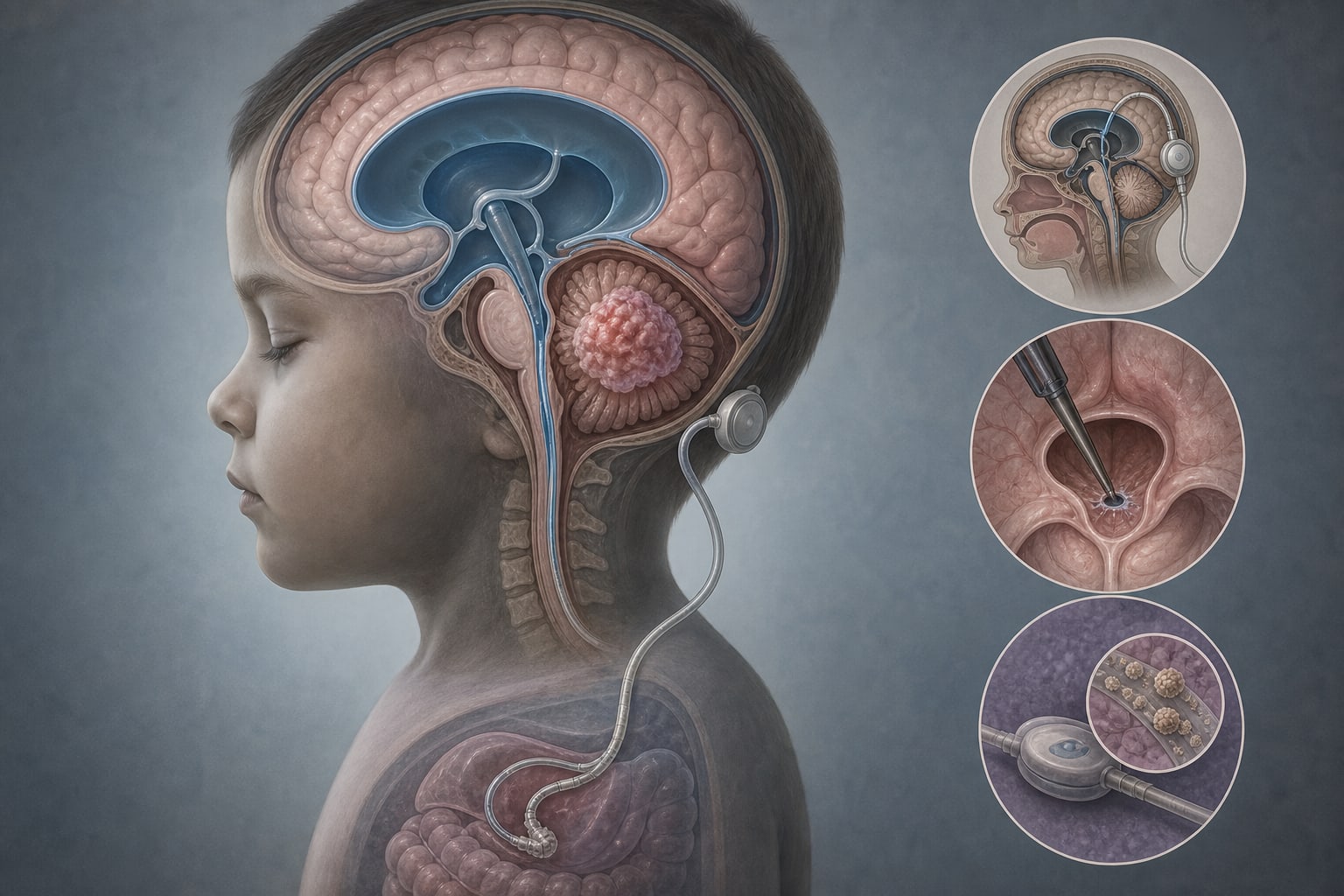
| Key Mechanisms | Management pathways include VP shunting, upfront resection, and endoscopic third ventriculostomy (ETV). |
| Target Population | Pediatric patients with medulloblastoma and preoperative hydrocephalus. |
| Care Setting | Single-center retrospective cohort study. |
Key Highlights
- ETV showed lower infection frequency compared to VP shunting (10.0% vs 24.0%).
- Recurrent hydrocephalus occurred in 10.0% of ETV patients and 8.0% of VP-shunt patients.
- Postoperative infection affected 24.2% of VP shunt patients and 22.1% of upfront resection patients.
- The study utilized propensity score matching for treatment comparisons.
- Larger prospective studies are needed for validation.
Guideline-Based Recommendations
Diagnosis
- Assess for preoperative hydrocephalus in pediatric patients with medulloblastoma.
Management
- Consider VP shunting, upfront resection, or ETV based on individual patient anatomy and clinical scenario.
Monitoring & Follow-up
- Follow-up for at least 6 months post-surgery to monitor for infection and hydrocephalus recurrence.
Risks
- Postoperative infection and recurrent hydrocephalus are potential complications of each management pathway.
Patient & Prescribing Data
Children under 18 years with histologically confirmed medulloblastoma and preoperative hydrocephalus.
Management pathway selection is based on clinical assessment and neurosurgical team decision.
Clinical Best Practices
- Utilize propensity score matching to compare treatment outcomes.
- Consider individual anatomical factors when selecting a management pathway.
- Monitor for complications postoperatively, particularly infection and hydrocephalus recurrence.
Related Resources & Content