A stepwise decannulation pathway for patients with prolonged disorders of consciousness after brain injury: a retrospective feasibility study - Scorecard - MDSpire

A stepwise decannulation pathway for patients with prolonged disorders of consciousness after brain injury: a retrospective feasibility study

  • By

  • Jinjin Huang

  • Long Chen

  • Chang Liu

  • Xinyuan Xue

  • Keling Cheng

  • Aziza Abdulaziz Abdulwahid

  • Jun Ni

  • Zhiyong Wang

  • June 8, 2026

  • 0 min

Share

Clinical Scorecard: A Gradual Decannulation Approach for Individuals with Prolonged Disorders of Consciousness Following Brain Injury: A Retrospective Feasibility Assessment

At a Glance

CategoryDetail
ConditionProlonged Disorders of Consciousness (pDoC) after brain injury
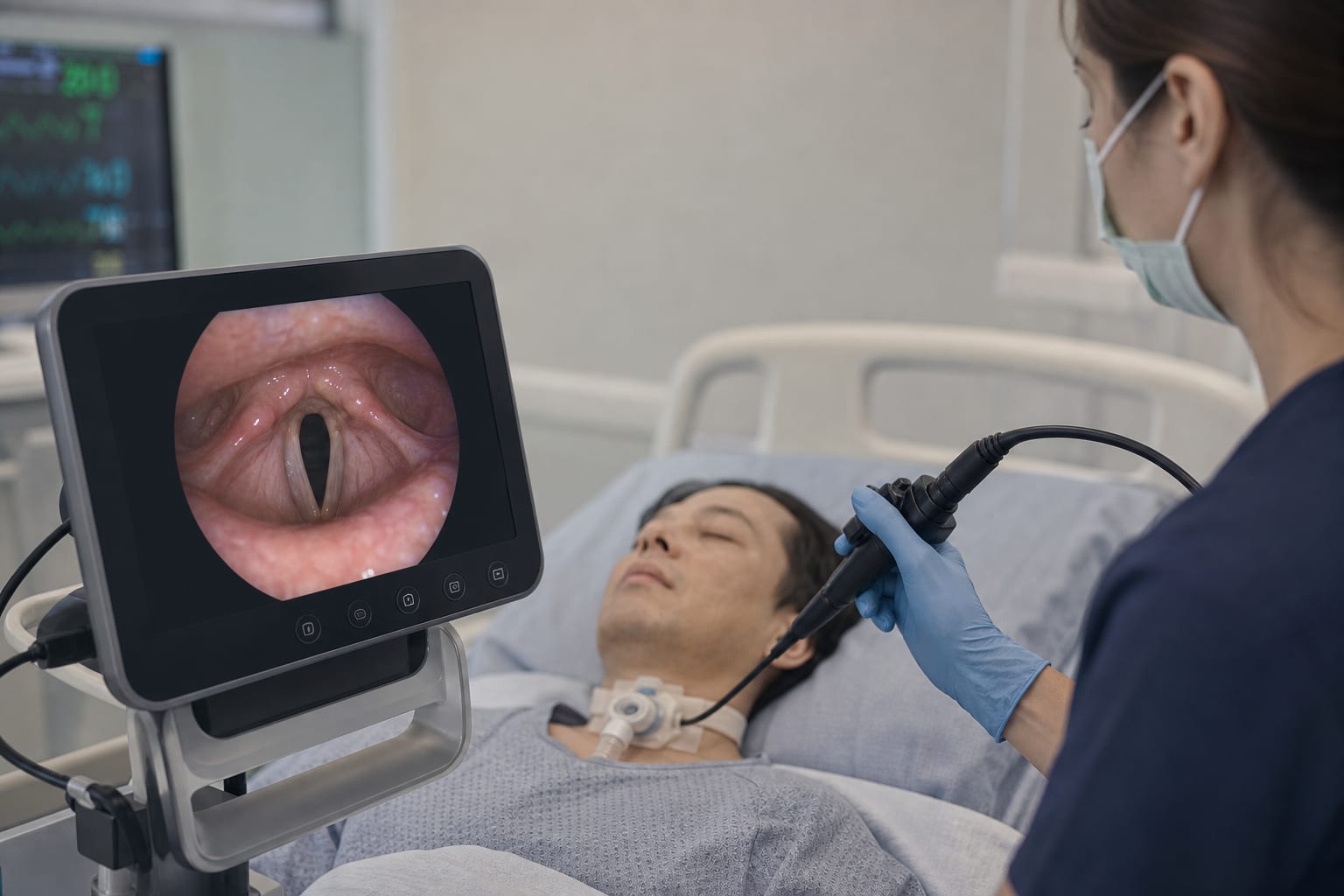
Key MechanismsStepwise decannulation pathway integrating flexible laryngoscopy, Murray Secretion Scale (MSS), and Semi-quantitative Cough Strength Score (SCSS)
Target PopulationPatients with pDoC persisting for ≥28 days after brain injury
Care SettingRehabilitation center

Key Highlights

  • 57.4% decannulation rate among 61 patients
  • No reintubation or ICU transfer within 48 hours post-decannulation
  • Mean time to decannulation was 19.8 days
  • Airway lesions found in 88.5% of patients
  • Main barriers included airway stenosis, uncontrolled secretion burden, and inadequate cough strength

Guideline-Based Recommendations

Diagnosis

  • Assessment of airway patency and secretion burden using MSS
  • Evaluation of airway protection using SCSS

Management

  • Implement a monitored 48-hour capping trial

Monitoring & Follow-up

  • Track reintubation rates and airway findings post-decannulation

Risks

  • Potential complications include pulmonary infections, airway stenosis, and secretion management difficulties

Patient & Prescribing Data

Tracheostomized patients with pDoC after brain injury

Decannulation pathway tailored for patients unable to perform voluntary cough tests or cooperate with swallowing evaluations

Clinical Best Practices

  • Utilize flexible laryngoscopy for airway assessment
  • Apply MSS and SCSS for evaluating decannulation readiness
  • Monitor patients closely during the capping trial

Related Resources & Content

Original Source(s)

Related Content