Development and validation of a machine learning model for predicting stroke-associated pneumonia in older patients with acute ischemic stroke - Scorecard - MDSpire
Advertisement
Development and validation of a machine learning model for predicting stroke-associated pneumonia in older patients with acute ischemic stroke
Clinical Scorecard: Creation and assessment of a machine learning algorithm for forecasting pneumonia linked to stroke in elderly individuals experiencing acute ischemic stroke
At a Glance
Category
Detail
Condition
Stroke-associated pneumonia (SAP)
Key Mechanisms
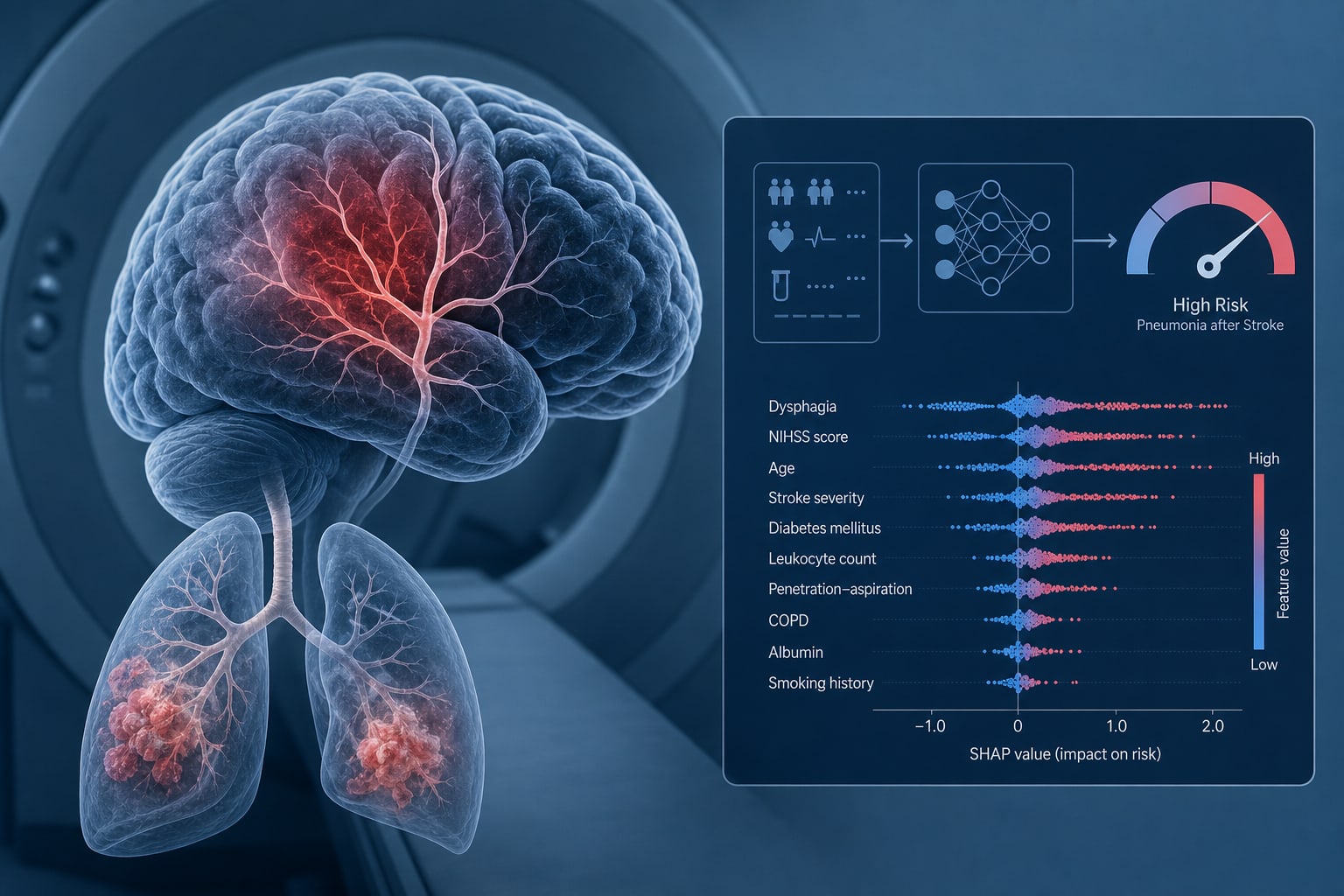
Machine learning model for predicting SAP risk using clinical and laboratory data
Target Population
Older patients (aged ≥65 years) with acute ischemic stroke (AIS)
Care Setting
Single-center study at Zhejiang Hospital, China
Key Highlights
SAP incidence was 18.79% among the studied population.
The SVM model achieved an accuracy of 0.773 and AUC of 0.794.
LASSO identified 12 predictive features for SAP risk.
An online platform was developed for clinical use to predict SAP risk.
SHAP analysis improved model interpretability by elucidating feature contributions.
Guideline-Based Recommendations
Diagnosis
Improved diagnostic criteria for SAP based on CDC guidelines.
Management
Early prophylactic management of SAP in high-risk patients.
Monitoring & Follow-up
Continuous evaluation of SAP risk post-stroke.
Risks
SAP is associated with adverse outcomes and prolonged hospital stays.
Patient & Prescribing Data
Patients aged ≥65 years with acute ischemic stroke.
Routine clinical and laboratory data can be used for risk prediction.
Clinical Best Practices
Utilize machine learning methods for analyzing high-dimensional data.
Incorporate predictive models into clinical decision-making for older AIS patients.