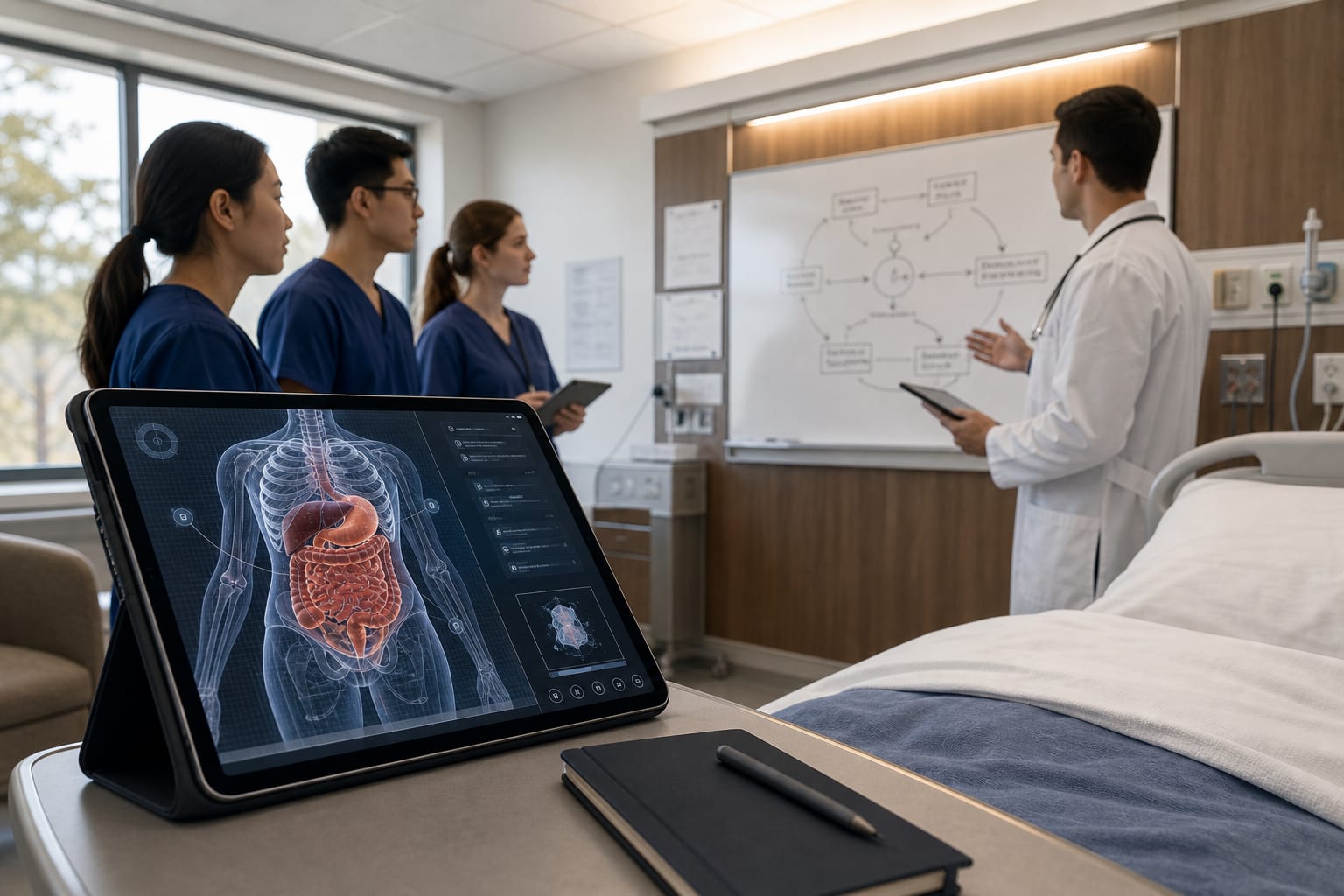
Transforming surgical ward rounds: constructivist pedagogy, structured models, and intelligent technologies
-
By
-
Linkun Zhong
-
Cong Zhou
-
Jianhang Miao
-
Jinghang Dong
-
Lili Luo
-
Chizhuai Liu
-
Yutong Li
-
July 7, 2026
-
Clinical Scorecard: Revolutionizing Surgical Ward Rounds: Engaging Learners through Constructivist Approaches, Structured Frameworks, and Smart Technologies
At a Glance
| Category | Detail |
|---|
| Condition | Surgical Education |
| Key Mechanisms | Constructivist learning theories, structured teaching models, intelligent technologies |
| Target Population | Surgical residents and learners |
| Care Setting | Surgical ward rounds |
Key Highlights
- Constructivist theories emphasize active engagement in learning.
- Structured models like SNAPPS and OMP enhance clinical reasoning and learner satisfaction.
- Generative AI tools can simulate consultant-level questioning for trainees.
- Immersive virtual reality (IVR) offers scalable training with potential long-term retention.
- Technologies should augment, not replace, human teaching.
Guideline-Based Recommendations
Diagnosis
Management
- Implement structured teaching models such as SNAPPS, OMP, and BID in surgical education.
Monitoring & Follow-up
Risks
- Concerns about accuracy, over-reliance, and algorithmic bias in intelligent technologies.
Patient & Prescribing Data
Not applicable; focuses on surgical education.
Utilization of structured frameworks and technologies to enhance learning outcomes.
Clinical Best Practices
- Design interactions to promote active clinical reasoning among learners.
- Use generative AI for pre-round preparation and post-round consolidation.
- Incorporate IVR for skills training in low-stakes environments.
Related Resources & Content