Development and validation of a 24-h predictive model for hypertriglyceridemic moderately severe acute pancreatitis: a single-center retrospective study - Scorecard - MDSpire
Advertisement
Development and validation of a 24-h predictive model for hypertriglyceridemic moderately severe acute pancreatitis: a single-center retrospective study
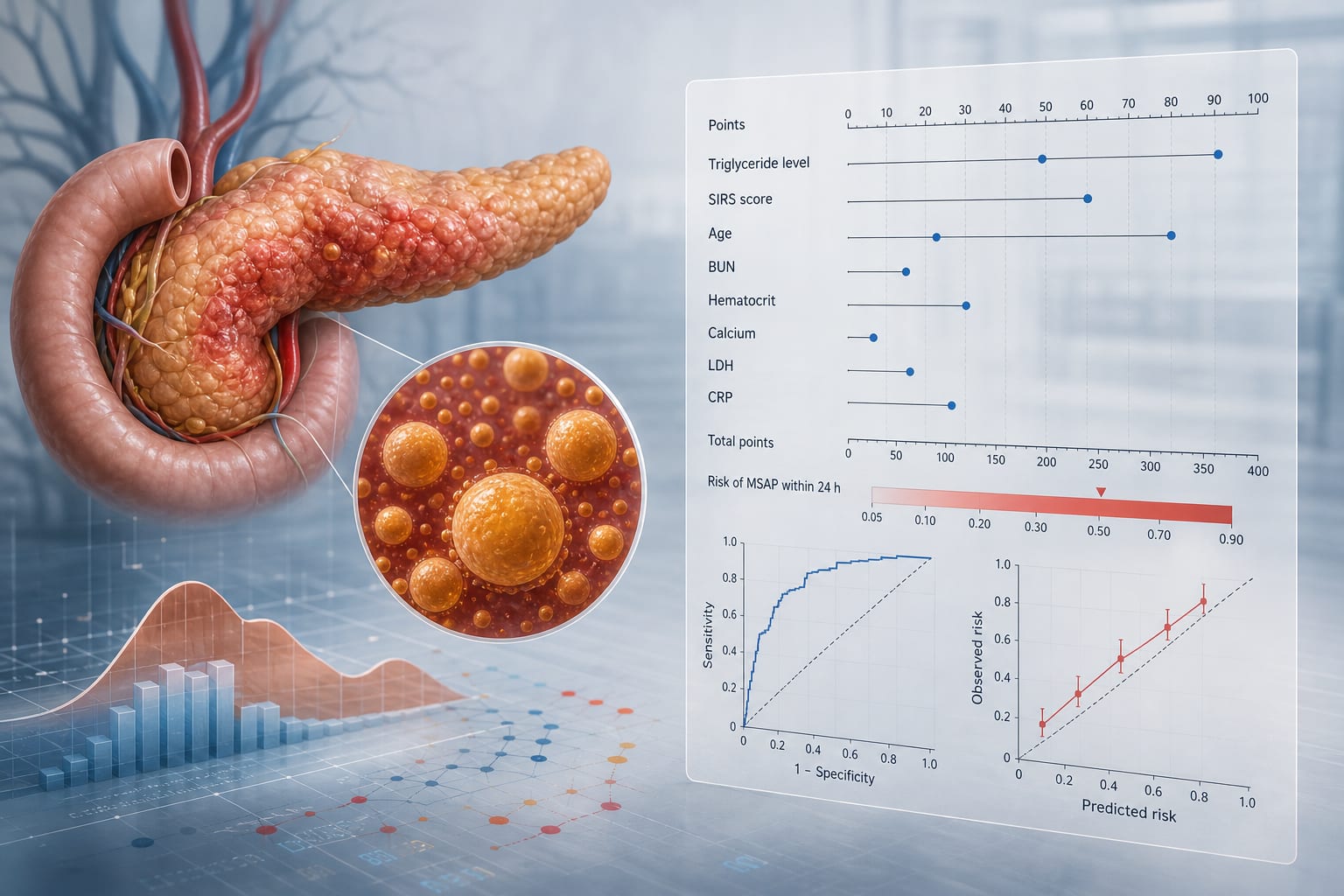
Clinical Scorecard: Creation and assessment of a 24-hour risk prediction model for moderately severe acute pancreatitis due to hypertriglyceridemia: a retrospective study from a single center
At a Glance
Category
Detail
Condition
Moderately Severe Acute Pancreatitis (MSAP) due to Hypertriglyceridemia
Key Mechanisms
Systemic inflammatory response syndrome (SIRS) and elevated triglyceride levels
Target Population
Patients with hypertriglyceridemia-induced acute pancreatitis
Care Setting
Single-center retrospective study
Key Highlights
Developed a risk prediction model for MSAP within 24 hours of admission
Identified SIRS and elevated triglyceride levels as independent risk factors
Model demonstrated an AUC of 0.909 in the validation cohort
Sensitivity of 86.2% and specificity of 90.9% for the prediction model
Comparison with the BISAP score showed superior performance
Guideline-Based Recommendations
Diagnosis
Diagnosis of acute pancreatitis requires characteristic abdominal pain, elevated serum amylase/lipase, and imaging findings.
Management
Early identification of patients at high risk of progressing to MSAP for timely clinical intervention.
Monitoring & Follow-up
Monitor triglyceride levels and SIRS criteria within the first 24 hours after admission.
Risks
Patients with HTG-AP have a higher risk of organ failure and local complications.
Patient & Prescribing Data
146 patients with hypertriglyceridemia-induced acute pancreatitis
A 24-hour triglyceride level below 18.41 mmol/L indicates a lower risk of progression to MSAP.
Clinical Best Practices
Utilize the developed prediction model for early risk stratification in HTG-AP patients.
Incorporate SIRS and triglyceride levels in clinical assessments.