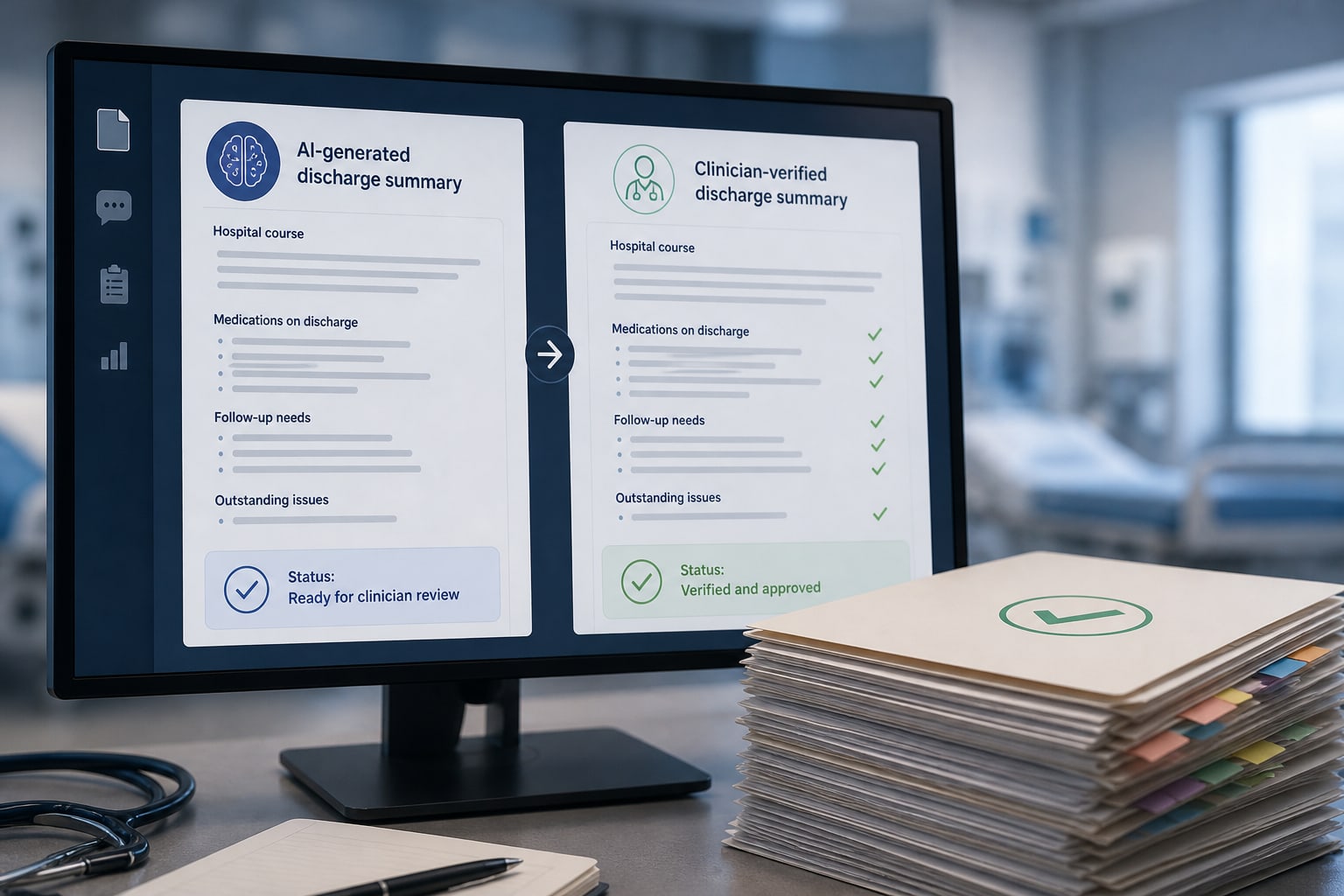
AI-Written Hospital Discharge Summaries and the Challenge of Verification
-
By
-
Melanie F. Molina
-
November 17, 2026
Clinical Scorecard: AI-Written Hospital Discharge Summaries and the Challenge of Verification
At a Glance
| Category | Detail |
|---|---|
| Condition | AI-assisted hospital discharge summarization and clinician verification |
| Key Mechanisms | Large language models synthesize clinical records into discharge-summary drafts; performance depends on source documents, prompts, models, processing pipelines, output templates, clinical populations, and evaluation standards. |
| Target Population | Hospitalized patients transitioning from inpatient care, including patients with lengthy or fragmented records. |
| Care Setting | Hospital discharge workflows; evidence also includes a virtual emergency-department EHR assessment of emergency discharge-note writing. |
Key Highlights
- In a study of 1294 admissions at 5 London hospitals, residents more often approved GPT-4o mini–generated summaries without or with only minor edits than clinician-authored summaries (adjusted probabilities, 92.2% vs 70.0%).
- Reviewers identified omitted key information in 23.5% of AI-generated summaries; 50% required no edits.
- In a separate assessment of 100 UCSF hospitalizations, LLM-generated hospital-course narratives had more errors than physician-authored narratives (2.91 vs 1.82 per summary), predominantly omissions and inaccuracies.
- In a 50-case virtual EHR assessment, an LLM assistant reduced median emergency discharge-note writing time from 69.5 to 32.0 seconds.
Guideline-Based Recommendations
Diagnosis
- Assess the final signed summary against what occurred, what remains uncertain, and what must happen next; the EHR is not a gold standard because it may be incomplete, duplicative, or internally inconsistent.
Management
- Evaluate the complete AI summarization system, including source documents, prompt, model, processing pipeline, output template, clinical population, and evaluation standard.
- Consider EHR-integrated functionality connected to pertinent data, linked to source material, and presented within clinicians’ existing workflow.
- Manage the model, prompt, data pipeline, and interface as a versioned clinical intervention.
Monitoring & Follow-up
- Evaluate the signed final summary, clinician verification and editing work, and downstream users’ ability to act on the result.
- Track omissions, inaccuracies, hallucinations, and other safety feedback; the article reports these outcomes in cited studies but does not specify a monitoring schedule.
Risks
- Fluent prose does not establish that a handoff is safe; reported errors included omissions and inaccuracies.
- Clinician review may not be dependable when performed amid interruptions and competing clinical demands.
- Broader, more complex source records can make verification harder; provenance identifies a statement’s origin but does not establish its accuracy.
- Replacing a model does not address incomplete source data or make verification effortless.
Patient & Prescribing Data
Patients discharged after hospitalization; the cited studies included 1294 admissions at 5 London hospitals and 100 hospitalizations at UCSF.
The article concerns documentation workflows rather than a patient treatment or prescribing regimen. It reports AI-generated discharge-summary drafts and clinician review, with omissions and inaccuracies remaining relevant concerns.
Clinical Best Practices
- Treat AI-generated summaries as drafts requiring verification, not as independently validated handoffs.
- Check whether the summary accurately conveys events, uncertainty, and required follow-up actions.
- Design evaluation around the full clinician-AI workflow and the final signed summary, not model output alone.
- Account for the difficulty of reviewing lengthy, complex, and fragmented records under real clinical workload conditions.
- Assess system performance when models, prompts, data pipelines, or interfaces change.
Related Resources & Content
Based on findings from:
AI-Generated Discharge Summaries—The Verification Paradox
Melanie F. Molina. Jama Network Open, 2026.
https://jamanetwork.com/journals/jamanetworkopen/fullarticle/2856762
This content is an AI-generated, fully rewritten summary based on a published scholarly article. It does not reproduce the original text and is not a substitute for the original publication. Readers are encouraged to consult the source for full context, data, and methodology.