Dynamic urinary proteomics integrates single-cell and spatial transcriptomics to reveal tumour microenvironment and predict immunotherapy response in biliary tract cancer - Scorecard - MDSpire

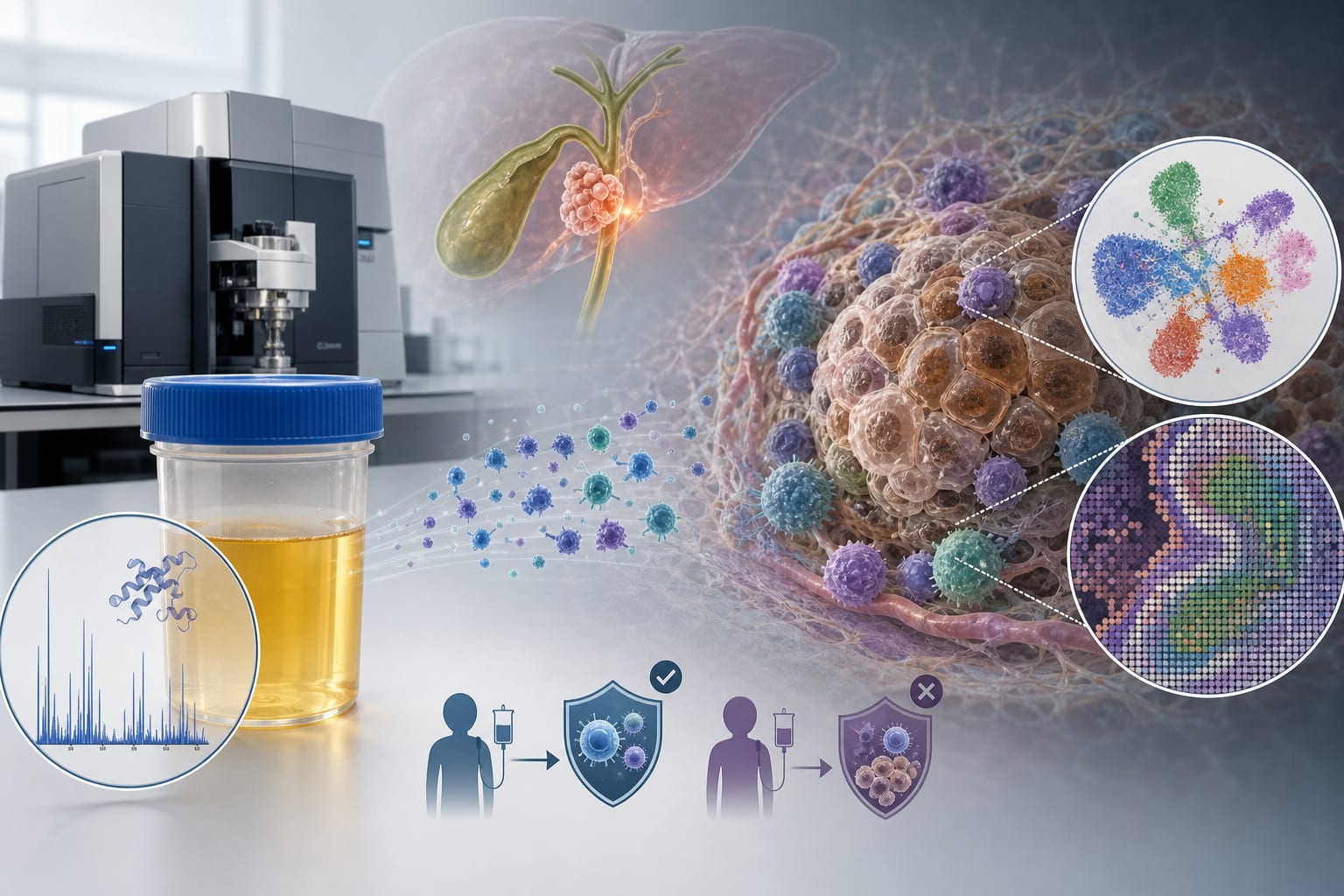
Dynamic urinary proteomics integrates single-cell and spatial transcriptomics to reveal tumour microenvironment and predict immunotherapy response in biliary tract cancer

  • By

  • Shanshan Wang

  • Zhengguang Guo

  • Boyu Sun

  • Kai Liu

  • Jiashuo Chao

  • Ziyu Xun

  • Yunchao Wang

  • Zibo Xu

  • Ziyue Huang

  • Hao Wang

  • Yang Tan

  • Nan Zhang

  • Mingjian Piao

  • Longhao Zhang

  • Chengjie Li

  • Shuofeng Li

  • Jiongyuan Li

  • Haidan Sun

  • Feng Qi

  • Aiwei Wang

  • XiaoBo Yang

  • Chengpei Zhu

  • Hanping Wang

  • Wei Sun

  • Haitao Zhao

  • July 1, 2026

  • 0 min

Share

Clinical Scorecard: Integrative Analysis of Urinary Proteomics with Single-Cell and Spatial Transcriptomics Uncovers Tumor Microenvironment Insights and Predicts Immunotherapy Outcomes in Biliary Tract Cancer

At a Glance

CategoryDetail
ConditionBiliary Tract Cancer
Key MechanismsUrinary proteomics for predicting immune checkpoint inhibitor responsiveness and capturing tumor microenvironment dynamics.
Target PopulationPatients with biliary tract cancer receiving immune checkpoint inhibitors.
Care SettingClinical oncology and immunotherapy settings.

Key Highlights

  • Urinary proteomics offers a non-invasive method for predicting ICI responsiveness.
  • Protein tyrosine phosphatase non-receptor 13 identified as a promising biomarker.
  • Study provides insights into tumor microenvironment dynamics.
  • Mass spectrometry-based proteomics enables comprehensive biomarker validation.
  • Urinary proteomics may facilitate timely therapeutic adjustments.

Guideline-Based Recommendations

Diagnosis

  • Utilize urinary proteomics for early prediction of ICI responsiveness.

Management

  • Incorporate urinary biomarker panels in treatment decision-making for BTC patients.

Monitoring & Follow-up

  • Employ urinary proteomics for longitudinal monitoring of treatment efficacy.

Risks

  • Consider limitations of tissue-based biomarkers such as invasiveness and sampling bias.

Patient & Prescribing Data

Patients diagnosed with advanced biliary tract cancer.

First-line therapy involves immune checkpoint inhibitors, with a need for effective biomarkers.

Clinical Best Practices

  • Adopt non-invasive urinary proteomics in clinical trials for immunotherapy.
  • Utilize machine learning approaches for biomarker development.
  • Integrate single-cell and spatial transcriptomics for comprehensive tumor analysis.

Related Resources & Content

Original Source(s)

Related Content