Lower serum 25-hydroxyvitamin D levels predict higher risk of DSPN in type 2 diabetes, and exhibit a non-linear association with the severity of DSPN - Scorecard - MDSpire
Advertisement
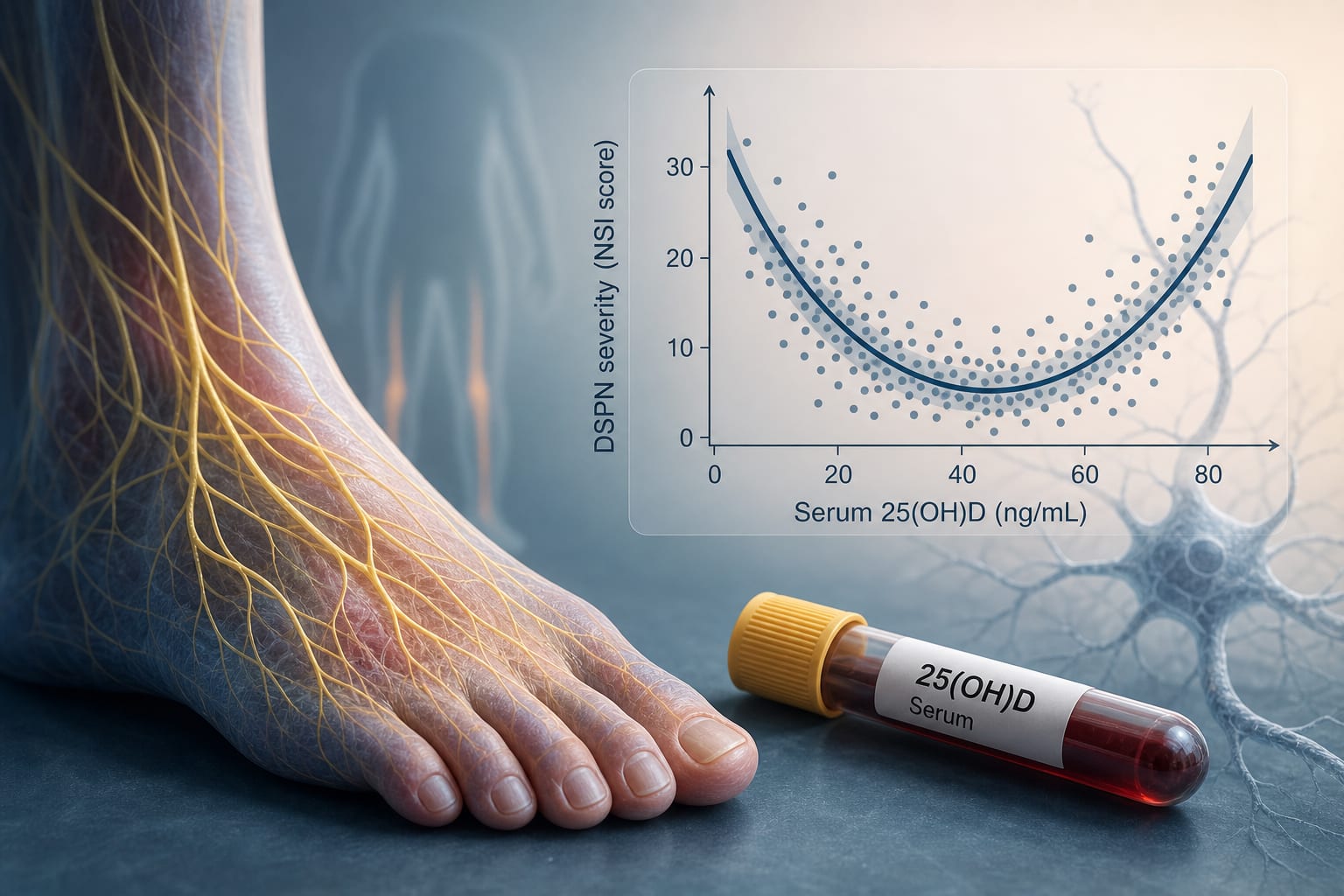
Lower serum 25-hydroxyvitamin D levels predict higher risk of DSPN in type 2 diabetes, and exhibit a non-linear association with the severity of DSPN
Clinical Scorecard: Reduced serum 25-hydroxyvitamin D concentrations are associated with an increased likelihood of distal symmetric polyneuropathy in individuals with type 2 diabetes, demonstrating a non-linear relationship with the condition's severity.
At a Glance
Category
Detail
Condition
Distal Symmetric Polyneuropathy (DSPN)
Key Mechanisms
Inverse association with serum 25-hydroxyvitamin D levels.
Target Population
Adults with type 2 diabetes mellitus (T2DM).
Care Setting
Multicenter clinical study.
Key Highlights
Lower serum 25(OH)D levels are significantly associated with DSPN.
A nonlinear relationship exists between 25(OH)D levels and DSPN severity.
A threshold of 26.1 ng/mL for 25(OH)D is identified for increased severity of DSPN.
Standardized neurological examinations are recommended for DSPN screening.
DSPN affects over half of patients with T2DM.
Guideline-Based Recommendations
Diagnosis
Utilize a standardized five-item neurological examination for DSPN screening.
Combine with the Michigan Neuropathy Screening Instrument (MNSI) for severity assessment.
Management
Monitoring & Follow-up
Risks
Increased risk of diabetic foot ulcers and lower-limb amputation with advanced DSPN.
Patient & Prescribing Data
Adults with type 2 diabetes mellitus (T2DM).
Serum 25(OH)D levels may serve as an indicator for screening DSPN risk.
Clinical Best Practices
Early screening for DSPN is crucial to prevent progression.
Monitor serum 25(OH)D levels in patients with T2DM.