Next-generation CAR-T engineering for colorectal cancer: integrating targets, tumor microenvironment barriers, and emerging strategies
-
By
-
Yajuan Yang
-
Zongyue Gao
-
Ping Song
-
Chao Wang
-
Kai Wang
-
Zuowu Xi
-
Ruirui Jing
-
June 23, 2026
-
Clinical Scorecard: Advancements in CAR-T Cell Engineering for Colorectal Cancer: Addressing Target Diversity, Tumor Microenvironment Challenges, and Innovative Approaches
At a Glance
| Category | Detail |
|---|
| Condition | Colorectal Cancer (CRC) |
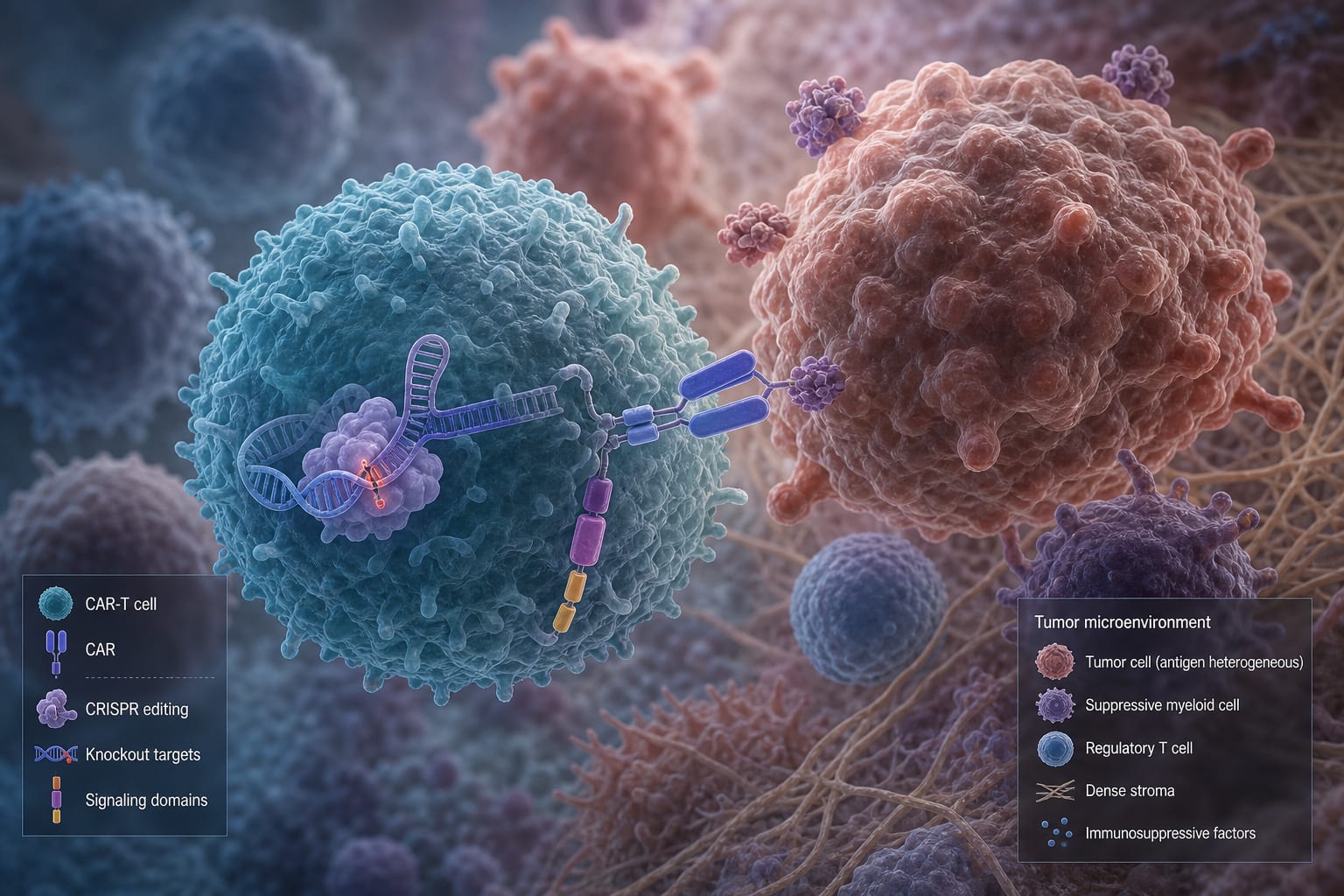
| Key Mechanisms | Chimeric antigen receptor (CAR)-T cell therapy targeting CRC-specific antigens and overcoming tumor microenvironment challenges. |
| Target Population | Patients with advanced colorectal cancer, particularly those with microsatellite-stable (MSS) subtype. |
| Care Setting | Clinical applications of CAR-T cell therapy in oncology. |
Key Highlights
- CAR-T therapy faces barriers including antigen heterogeneity and off-tumor toxicity.
- Next-generation engineering strategies include novel targets and architectural innovations.
- CRISPR-based editing is utilized for enhancing CAR-T cell efficacy and safety.
- The immunosuppressive tumor microenvironment limits CAR-T persistence.
- Future directions include molecular typing-guided interventions and interdisciplinary collaboration.
Guideline-Based Recommendations
Diagnosis
- Identify CRC subtype, focusing on microsatellite stability.
Management
- Utilize next-generation CAR-T therapies targeting CRC-specific antigens.
Monitoring & Follow-up
- Assess tumor response and monitor for off-tumor toxicity.
Risks
- Consider risks of cytokine release syndrome and dose-limiting colitis.
Patient & Prescribing Data
Advanced-stage colorectal cancer patients, particularly those with MSS subtype.
Clinical evidence shows objective responses and disease stabilization in subsets of patients.
Clinical Best Practices
- Implement logic-gated circuits for tumor-specific recognition.
- Incorporate CRISPR-based functional genomics for CAR-T optimization.
- Focus on safety profiles of novel CRC-associated targets.
Related Resources & Content