Masked Hypertension Phenotypes and Cardiac Structure and Function in the Prehypertensive Population - Scorecard - MDSpire
Coming Soon: Introducing MDSpire News. Learn more
Conexiant’s news site is now MDSpire News. Learn more

Cardiac Structure and Function Across Masked Hypertension Phenotypes in People With Prehypertension

  • By

  • Ruirui Geng

  • Jie Chen

  • Yuelin Wu

  • Junna Li

  • Mengmeng Liu

  • Hui Jia

  • Zhiwei Li

  • Juan Cong

  • Hualing Liu

  • Meiling Wang

  • Shuai Jiang

  • Yiming Wu

  • Weili Zhang

  • AMEC-Pre Study Group

  • Yu Chen

  • Rongmei Liu

  • Qiuping Zhao

  • Junfang Wang

  • Ruifa Wang

  • Wenjing Liu

  • Yan Zhang

  • Jingwen Xiao

  • Minbin Zhuo

  • Xin Fang

  • Shu Zhang

  • Bowen Zhang

  • Xiaoshu Chen

  • Lijuan Pan

  • Jiajia Yan

  • Zhijuan Li

  • Laijing Du

  • Wei Liu

  • Bin Wang

  • Xiuming Chen

  • Hong Hou

  • Xiuhong Duan

  • Yan Feng

  • November 19, 2026

Share

Clinical Scorecard: Cardiac Structure and Function Across Masked Hypertension Phenotypes in People With Prehypertension

At a Glance

CategoryDetail
ConditionMasked hypertension phenotypes and left ventricular changes in adults with prehypertension (office BP 120–139/80–89 mm Hg).
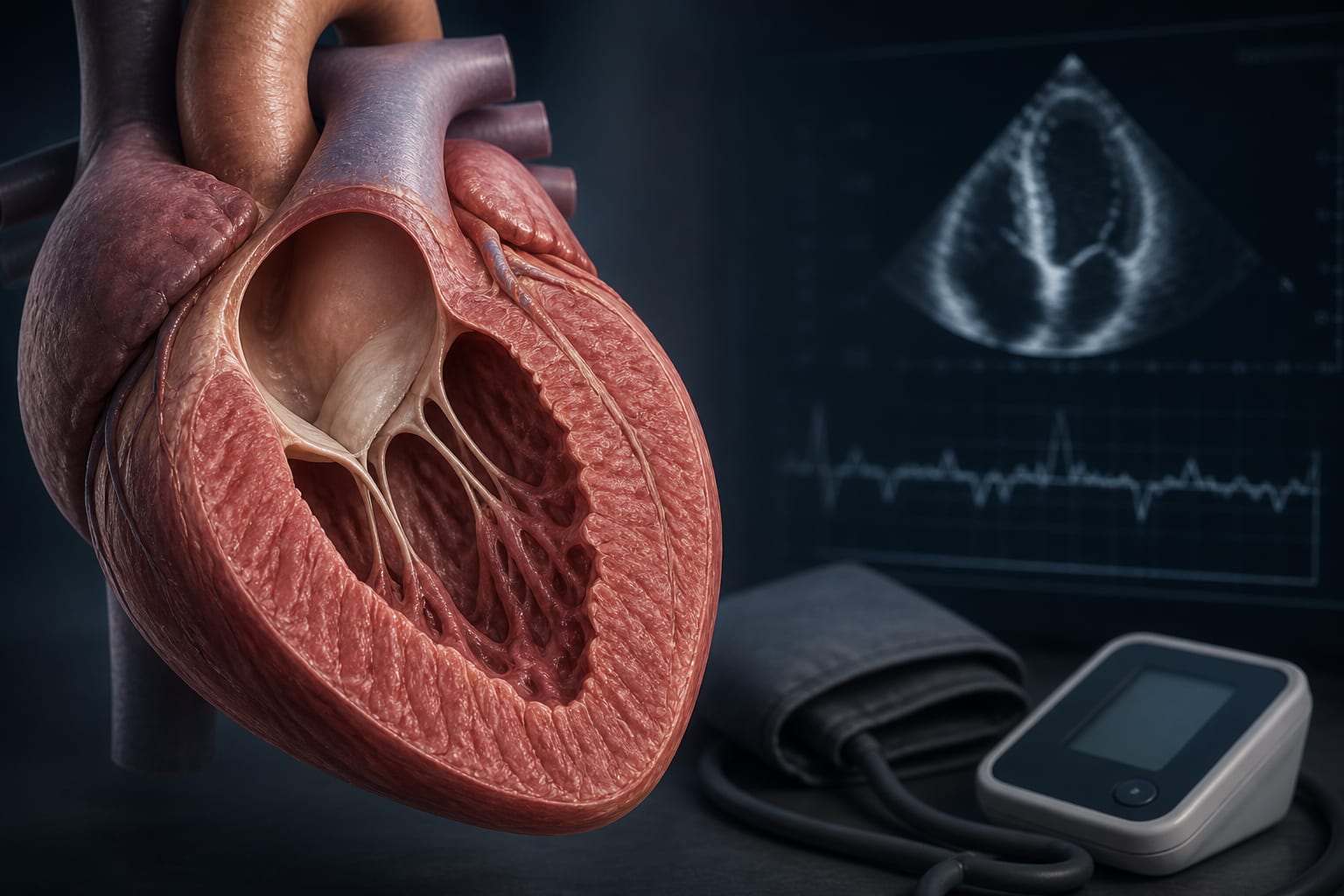
Key MechanismsMasked hypertension was associated with adverse left ventricular remodeling, impaired diastolic function, and higher odds of left ventricular hypertrophy (LVH) than normotension.
Target PopulationAdults aged 35–80 years with office BP of 120–139/80–89 mm Hg at three screening visits and no antihypertensive medication use in the preceding 3 months.
Care SettingCommunity-based cohort across health care facilities in China; ambulatory blood pressure monitoring (ABPM) was assessed at baseline and echocardiography at 1-year follow-up.

Key Highlights

  • Among 6,858 participants, 3,369 (49.1%) had masked hypertension.
  • Masked hypertension phenotypes were associated with greater odds of LVH than normotension.
  • The strongest reported associations were for isolated daytime hypertension (OR 3.66; 95% CI 2.27–5.88) and day-night sustained hypertension (OR 3.49; 95% CI 2.60–4.69).
  • Isolated nocturnal hypertension was also associated with LVH (OR 1.81; 95% CI 1.31–2.49).
  • The authors state that office BP alone may underestimate risk and support greater ABPM use in people with prehypertension, consistent with cited guidelines.

Guideline-Based Recommendations

Diagnosis

  • The study defined masked hypertension as office BP below 140/90 mm Hg with ambulatory BP at or above any of these thresholds: 24-hour 130/80 mm Hg, daytime 135/85 mm Hg, or nighttime 120/70 mm Hg.

Management

  • The authors support greater use of ABPM in people with prehypertension, consistent with cited guideline recommendations.

Monitoring & Follow-up

  • The study used baseline 24-hour ABPM and echocardiography at 1-year follow-up; it did not establish a clinical monitoring schedule.

Risks

  • Masked hypertension was associated with LVH, adverse left ventricular remodeling, and impaired diastolic function.
  • A single 24-hour ABPM recording may not represent long-term BP patterns; intraindividual variability may cause phenotype misclassification.

Patient & Prescribing Data

Community-based Chinese cohort; 6,858 adults with prehypertension were included in the reported analysis. Mean age was 54.1 years, and 38.5% were male.

Participants had not used antihypertensive medication during the 3 months before enrollment. The study evaluated associations and did not report treatment effects or prescribing recommendations.

Clinical Best Practices

  • Consider ABPM when assessing adults with prehypertension; the authors note that office BP alone may underestimate risk.
  • Interpret phenotype-specific LVH associations in light of the cross-sectional analysis, which cannot establish causality.
  • Interpret the isolated daytime hypertension result cautiously because that subgroup was relatively small.
  • Recognize that nocturnal BP phenotypes may be affected by unmeasured factors, including obstructive sleep apnea and psychological stress.

Related Resources & Content

    Original Source(s)

    Related Content