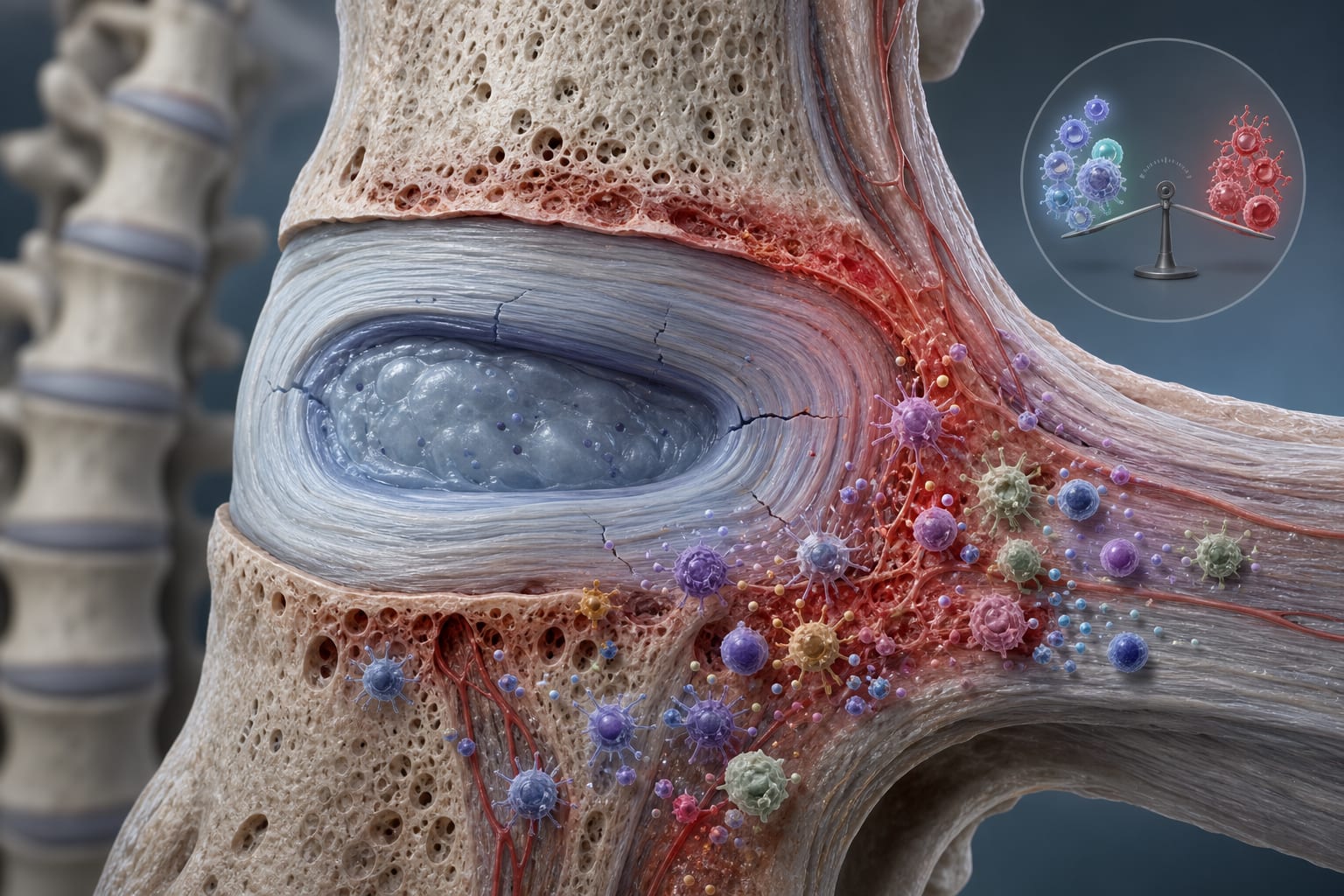
Restoring immune homeostasis in the spinal microenvironment: targeting mechano-inflammation and immunometabolic reprogramming
-
By
-
Zhichao Chen
-
Junfeng Zeng
-
Zhiwei Zhang
-
Zhi Zheng
-
June 19, 2026
-
Clinical Scorecard: Reestablishing Immune Balance in the Spinal Microenvironment: Focusing on Mechano-Inflammation and Immunometabolic Reprogramming
At a Glance
| Category | Detail |
|---|
| Condition | Chronic inflammatory diseases of the spine |
| Key Mechanisms | Mechano-inflammatory coupling and metabolic reprogramming in the spinal microenvironment |
| Target Population | Adults with axial spondyloarthritis (axSpA) and intervertebral disc degeneration (IDD) |
| Care Setting | Clinical management of chronic inflammatory spinal disorders |
Key Highlights
- axSpA and IDD share microenvironmental features despite distinct etiologies
- Current therapies improve symptoms but have limited effects on structural deterioration
- Mechanical loading and hypoxia drive immune cell reprogramming in the spine
- Targeting metabolic checkpoints may offer new therapeutic strategies
- The spine functions as an 'immune organ' with unique anatomical constraints
Guideline-Based Recommendations
Diagnosis
- Use ASAS criteria for diagnosing axSpA
Management
- Consider biologic DMARDs targeting TNF and IL-17A for axSpA
Monitoring & Follow-up
- Monitor for inadequate response and structural progression despite treatment
Risks
- Residual structural progression and limited drug persistence in some patients
Patient & Prescribing Data
Adults with axSpA and IDD
Current treatments focus on symptom relief and may partially slow progression
Clinical Best Practices
- Recognize the unique immune dynamics of the spinal microenvironment
- Explore upstream modulation of the microenvironment rather than solely targeting cytokines
- Implement a multidisciplinary approach to manage chronic spinal inflammatory diseases
Related Resources & Content