Clinical Scorecard: Combining Anisotropic Heat Transfer and Transformer Encoding within Convolutional Neural Networks for the Classification of Skin Cancer
At a Glance
Category
Detail
Condition
Key Mechanisms
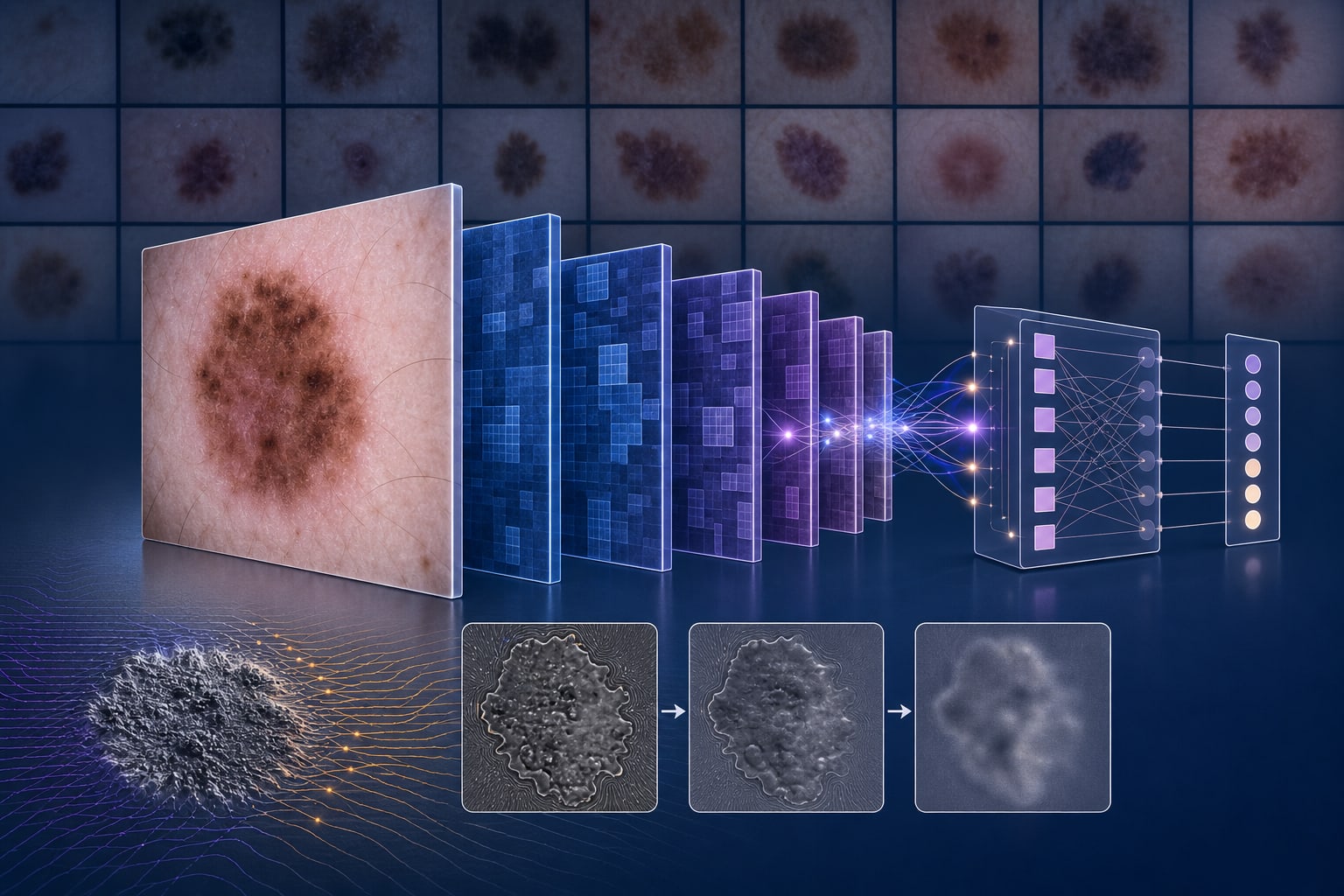
Integration of Advanced Heat Flow Layer with DenseNet121 and transformer encoder layers for image processing and classification.
Target Population
Care Setting
Key Highlights
Utilizes the HAM10000 dataset for model evaluation.
Employs anisotropic diffusion for edge-preserving image smoothing.
Integrates Ensemble Learning to enhance predictive performance.
Adapts Vision Transformers for handling spatial dimensionality in skin lesion images.
Guideline-Based Recommendations
Diagnosis
Utilize advanced computational approaches for accurate classification and early detection of skin cancer.
Management
Implement Ensemble Learning to combine outputs from multiple models.
Monitoring & Follow-up
Evaluate model performance using comprehensive datasets like HAM10000.
Risks
Mitigate risks of individual model biases in deep learning-based medical image analysis.
Patient & Prescribing Data
Diverse demographics represented in the HAM10000 dataset.
Enhanced diagnostic capabilities through advanced deep learning techniques.
Clinical Best Practices
Incorporate anisotropic diffusion techniques in image preprocessing.
Leverage deep learning architectures like DenseNet121 for feature extraction.
Utilize transformer models to capture long-range dependencies in image data.