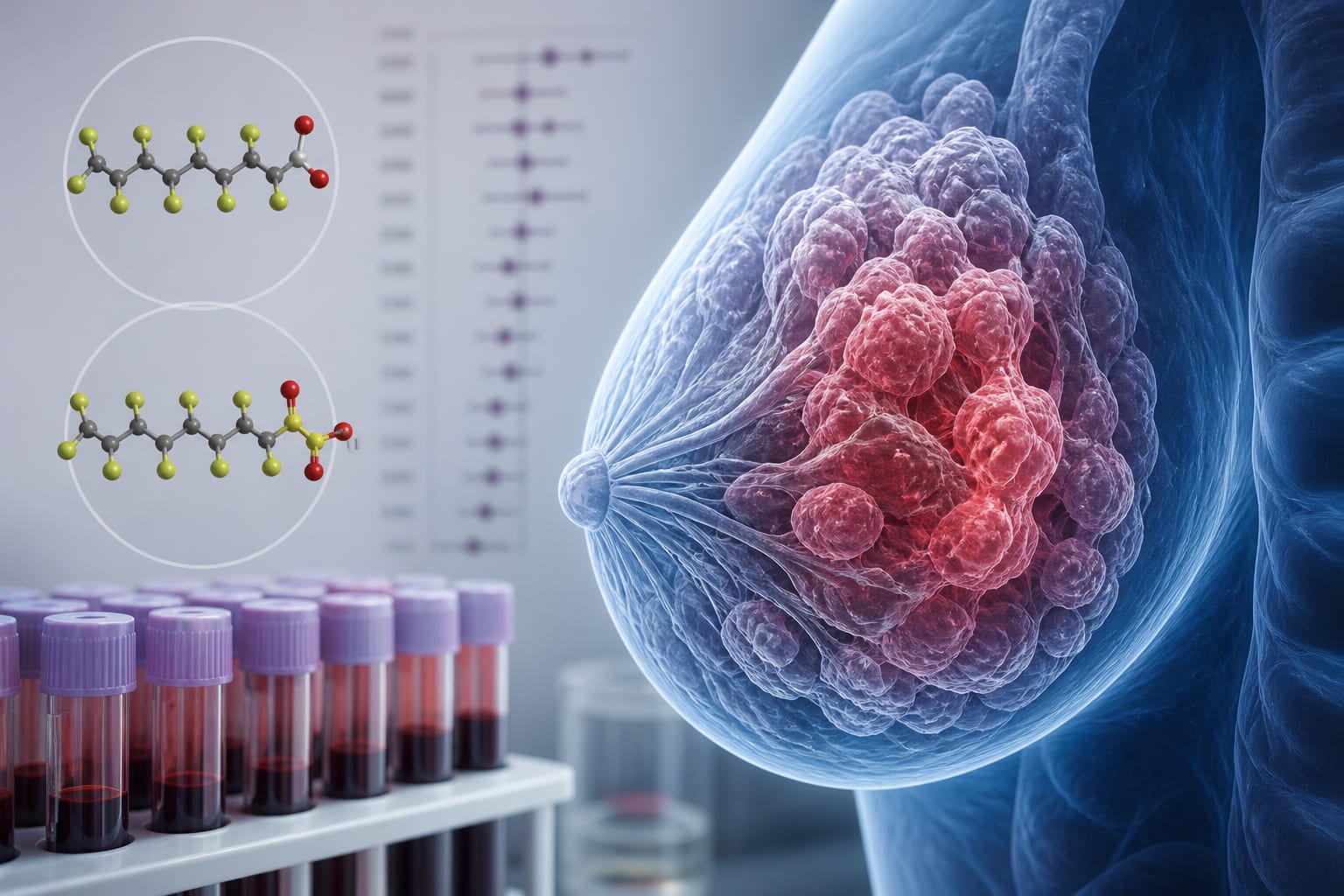
NIH Analysis Links Two “Forever Chemicals” to Increased Risk of Aggressive Breast Cancer
-
By
-
Assistant Secretary for Public Affairs (ASPA)
-
November 5, 2026
Clinical Scorecard: NIH Analysis Links PFOA and PFOS to Increased Risk of ER-Negative Breast Cancer
At a Glance
| Category | Detail |
|---|---|
| Condition | Clinical topic addressed by the source article: NIH Analysis Links Two “Forever Chemicals” to Increased Risk of Aggressive Breast Cancer |
| Key Mechanisms | The authors proposed that PFAS could influence cancer risk through non-hormonal mechanisms, including altered gene activity or immune-system changes; these mechanisms were not examined. |
| Target Population | Population described in the source article. |
| Care Setting | Care setting described in the source article. |
Key Highlights
- Higher PFOA and PFOS concentrations were associated with increased ER-negative breast cancer incidence, but no clear association was observed with overall breast cancer risk.
- Compared with women in the lowest PFOA concentration group, those in the highest group had a 67% higher rate of ER-negative breast cancer; the corresponding difference for PFOS was 93%.
- These percentages describe relative differences between groups, not an individual woman’s probability of developing breast cancer.
- The analysis quantified 17 PFAS in blood samples collected before diagnosis and included a meta-analysis of previous research.
- The authors call for further research on populations with greater PFAS exposure and on newer PFAS replacement chemicals.
Guideline-Based Recommendations
Diagnosis
Management
Monitoring & Follow-up
Risks
- Higher blood concentrations of PFOA and PFOS were associated with increased ER-negative breast cancer incidence; the study did not establish causation.
- No clear association was observed between either chemical and overall breast cancer risk.
- The proposed non-hormonal mechanisms were not examined in this study.
Patient & Prescribing Data
The Sister Study enrolled 50,884 U.S. and Puerto Rico residents aged 35–74 who had no breast cancer diagnosis at enrollment and had a full or half-sister previously diagnosed with breast cancer. The PFAS analysis included 1,609 subsequent breast cancer cases and 2,269 comparison participants.
The article reports no treatment or prescribing recommendations. The authors state that PFAS exposure is potentially modifiable and that people can take measures to reduce exposure; they also call for further research.
Clinical Best Practices
- The study reports 67% and 93% higher rates between concentration groups; these are relative differences, not individual absolute risk.
- The study found an association with ER-negative breast cancer but no clear association with overall breast cancer risk.
- The authors proposed gene-activity or immune-system mechanisms, but these were not examined in the study.
- The authors call for further research on populations with greater PFAS exposure and on breast cancer risk associated with newer PFAS replacements.
Related Resources & Content
Based on findings from:
Two ‘forever chemicals’ associated with higher risk of aggressive breast cancer in NIH analysis
Assistant Secretary for Public Affairs (ASPA). United States Department Of Health And Human Services, 2026.
https://www.hhs.gov/press-room/nih-study-pfas-forever-chemicals-aggressive-breast-cancer-risk.html
This content is an AI-generated, fully rewritten summary based on a published scholarly article. It does not reproduce the original text and is not a substitute for the original publication. Readers are encouraged to consult the source for full context, data, and methodology.