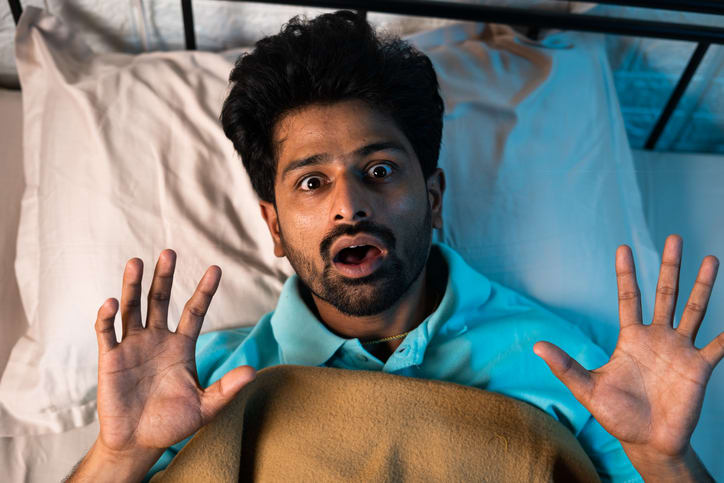
Clinical Scorecard: Poorer sleep and anxiety associated with frequent hypnic jerks in survey
At a Glance
Category
Detail
Condition
Clinical topic addressed by the source article: Anxiety, poor sleep linked to hypnic jerks
Key Mechanisms
Participants reported motor, sensory, emotional, cognitive, and autonomic experiences with sleep starts. In adjusted analyses, poorer sleep quality, stronger dysfunctional sleep-related beliefs, and higher anxiety symptoms were independently associated with greater episode frequency; the cross-sectional study cannot establish causality.
Target Population
Patients or participants described in the source article.
Care Setting
Care setting described in the source article.
Key Highlights
In this survey, participants reporting weekly sleep starts had poorer sleep quality and greater insomnia severity than the comparison group.
Poorer sleep quality, stronger dysfunctional sleep-related beliefs, and higher anxiety symptoms were independently associated with more frequent episodes; the study cannot establish causality.
Muscle jerks or twitches were reported by 87.5% of the weekly-episode group; dream-like experiences and sensations of falling or losing stability were also common.
Daytime sleepiness did not differ significantly between groups, and depressive symptoms were not independently associated with episode frequency in adjusted analyses.
The study relied on retrospective self-report, obtained no objective sleep measurements, and could not reliably distinguish sleep starts from related sleep-onset phenomena.
Guideline-Based Recommendations
Diagnosis
The study defined weekly sleep starts as sudden awakenings at sleep onset plus at least one additional symptom; this threshold was established post hoc.
The authors noted that the survey could not reliably distinguish sleep starts from related phenomena, including exploding head syndrome and hypnagogic hallucinations.
Management
Monitoring & Follow-up
Risks
Cross-sectional data and retrospective self-report prevent conclusions about causality or the temporal relationship between sleep starts and psychological characteristics.
Study-specific questions about sleep-start experiences had not undergone formal psychometric validation.
Patient & Prescribing Data
The article reports no treatment or prescribing evaluation. Participants retrospectively associated stress, emotional tension, and mental burden with more frequent episodes; relaxation was perceived as reducing episode frequency.
Clinical Best Practices
Interpret the reported associations as observational; the study does not establish that anxiety or poor sleep causes sleep starts, or vice versa.
Consider the study's limitations when interpreting its findings: no objective sleep measurements were obtained, and related sleep-onset phenomena could not be reliably distinguished.
Increases in apnea-hypopnea events were greatest among patients with an elevated baseline index, while evidence supporting mouth taping remained preliminary.