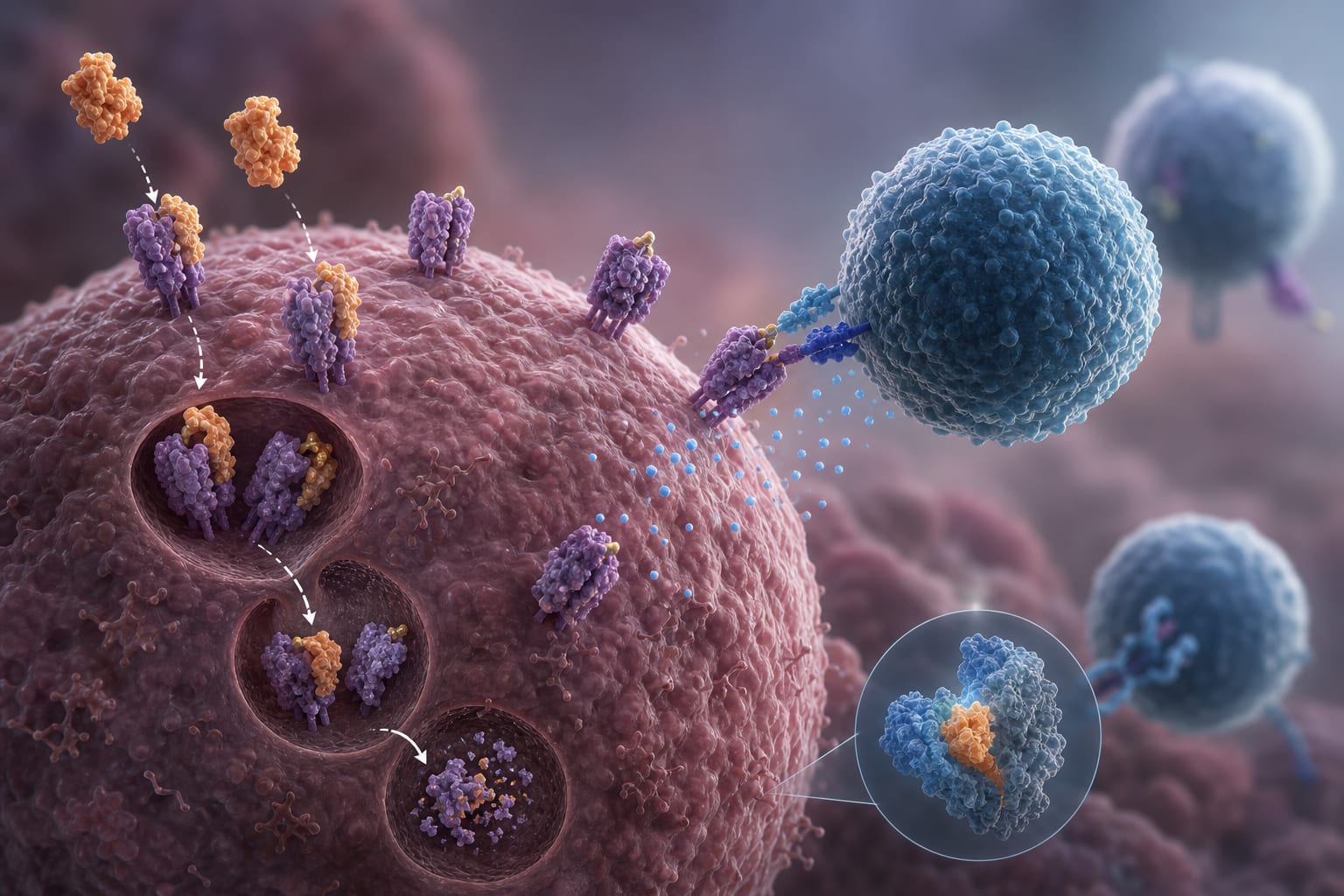
HHLA2 as an emerging immune checkpoint in lung cancer: linking EGFR signaling, macrophage polarization, and CD8+ T-cell metabolic suppression
-
By
-
Juan Wang
-
Kang Wang
-
Zhenhong Hu
-
Xueting Hu
-
May 25, 2026
-
Clinical Scorecard: HHLA2: A Novel Immune Checkpoint in Lung Cancer Associated with EGFR Pathway, Macrophage Polarization, and CD8+ T-Cell Metabolism
At a Glance
| Category | Detail |
|---|
| Condition | Lung Cancer |
| Key Mechanisms | HHLA2 enhances EGFR/MAPK/ERK signaling, promotes macrophage M2 polarization, and suppresses CD8+ T-cell metabolism. |
| Target Population | Patients with EGFR-mutant lung cancer. |
| Care Setting | Oncology, specifically in the context of lung cancer treatment. |
Key Highlights
- HHLA2 is enriched in EGFR-mutant lung cancer and functions as a genotype-associated immune checkpoint.
- HHLA2 promotes tumor progression by enhancing EGFR signaling and driving IL-10–dependent macrophage M2 polarization.
- The HHLA2–KIR3DL3 axis suppresses CD8+ T-cell glutamine metabolism, representing a metabolic immune checkpoint with therapeutic potential.
Guideline-Based Recommendations
Diagnosis
- Evaluate HHLA2 expression in lung cancer tissues to assess its association with EGFR mutational status.
Management
- Consider targeting the HHLA2–KIR3DL3 axis in combination with EGFR tyrosine kinase inhibitors for EGFR-mutant lung cancer.
Monitoring & Follow-up
- Monitor HHLA2 expression as a potential biomarker for treatment response and disease progression.
Risks
- Lower HHLA2 expression is associated with improved response to neoadjuvant immunotherapy.
Patient & Prescribing Data
Patients with EGFR-mutant lung cancer and potentially those with small cell lung cancer.
HHLA2 expression correlates with tumor size, clinical stage, and overall survival in small cell lung cancer.
Clinical Best Practices
- Incorporate HHLA2 assessment in the evaluation of lung cancer patients, especially those with EGFR mutations.
- Utilize HHLA2 as a predictive biomarker for immunotherapy response.
Related Resources & Content