Advanced magnetic resonance neurography for preoperative facial nerve assessment and surgical planning in parotid tumors: a review of current evidence and surgical translation - Scorecard - MDSpire
Advertisement
Advanced magnetic resonance neurography for preoperative facial nerve assessment and surgical planning in parotid tumors: a review of current evidence and surgical translation
Clinical Scorecard: Utilizing Advanced Magnetic Resonance Neurography for Preoperative Evaluation of Facial Nerve and Surgical Strategy in Parotid Tumor Cases: A Review of Current Evidence and Clinical Applications
At a Glance
Category
Detail
Condition
Parotid tumors
Key Mechanisms
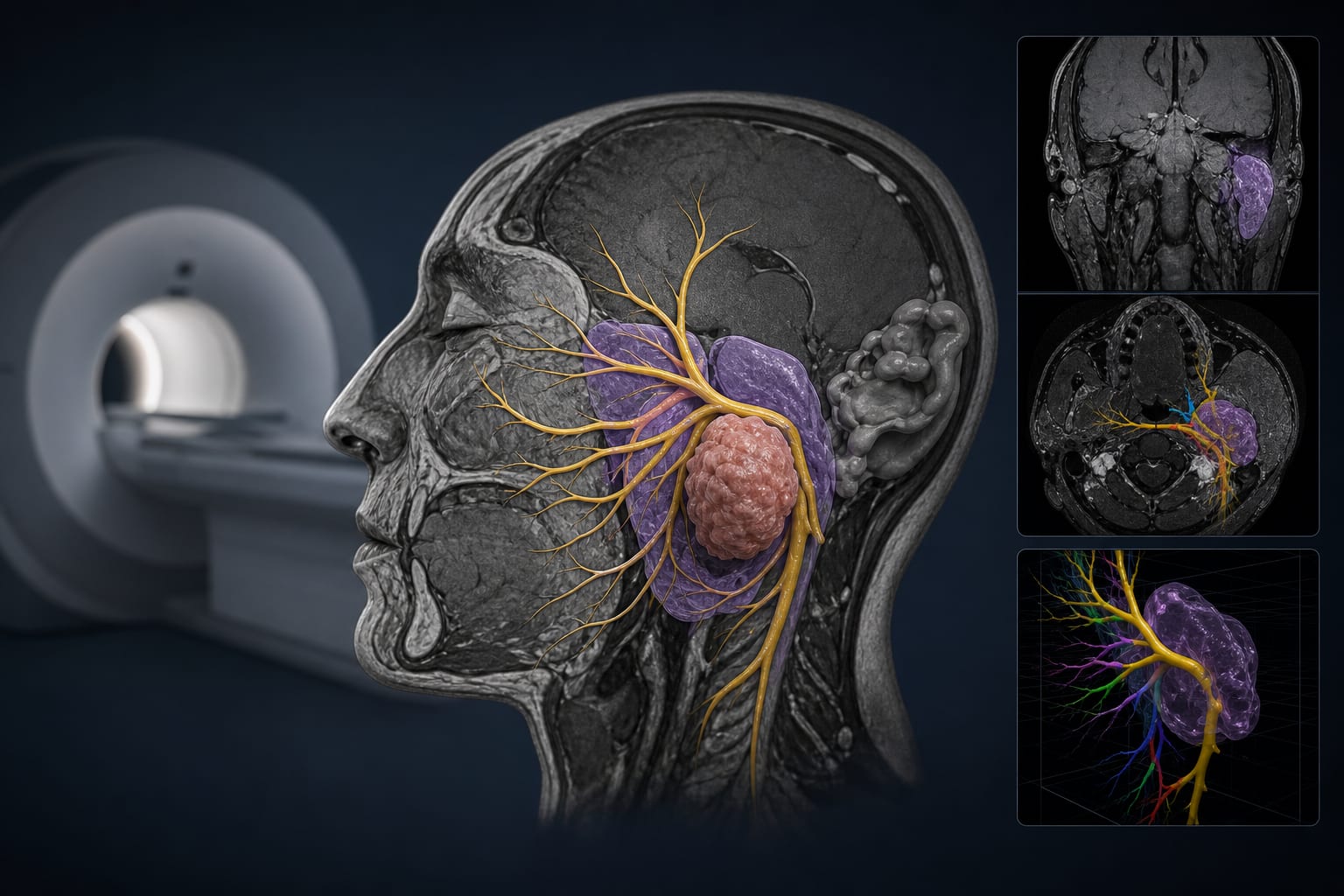
Advanced magnetic resonance neurography (MRN) and 3D modeling for facial nerve assessment
Target Population
Patients with primary or recurrent parotid neoplasms
Care Setting
Surgical planning and preoperative evaluation
Key Highlights
Advanced MRN provides reliable visualization of the facial nerve trunk and primary bifurcation.
Quantitative imaging and radiomic profiles may aid in peritumoral risk stratification.
Integration of imaging findings with 3D models may facilitate targeted surgical approaches.
Facial nerve palsy rates post-surgery range from 1.2% to 7.9% for permanent and 10% to 77% for transient weakness.
Advanced imaging serves as adjunctive tools but cannot replace intraoperative judgment.
Guideline-Based Recommendations
Diagnosis
Utilize high-resolution MRI sequences for facial nerve assessment.
Management
Consider advanced imaging techniques to inform surgical planning.
Monitoring & Follow-up
Employ continuous neuromonitoring during surgery to assess nerve integrity.
Risks
Permanent nerve paralysis risk can increase up to 50% in complex cases.
Patient & Prescribing Data
Patients undergoing parotid surgery for tumors, particularly those with deep-lobe tumors or advanced cancers.
Advanced MRN can enhance preoperative planning but should be used alongside established surgical protocols.
Clinical Best Practices
Combine quantitative imaging data with 3D models for improved surgical decision-making.
Maintain meticulous surgical technique to optimize functional outcomes.