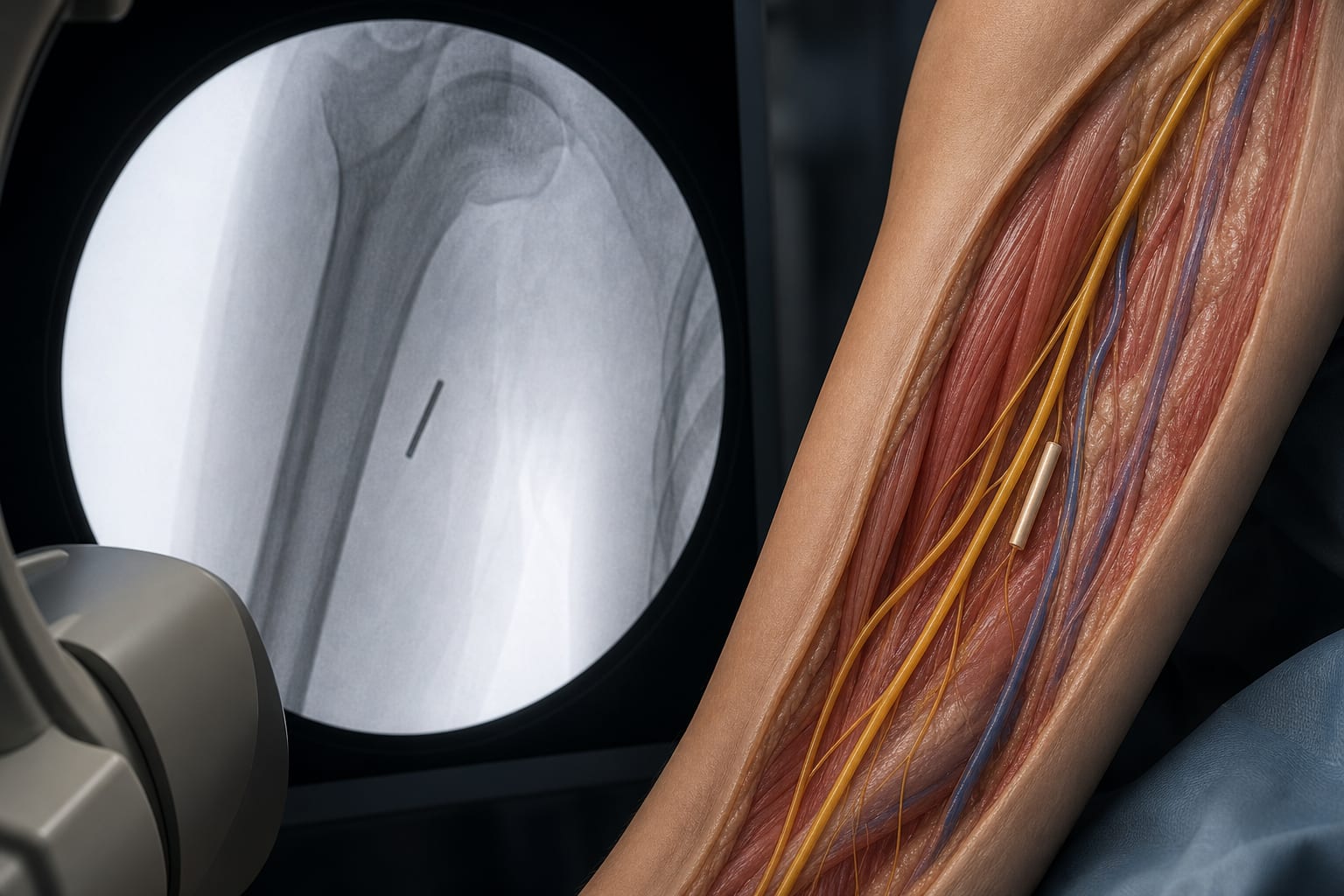
Ultrasound-Assisted Extraction of a Non-Palpable Etonogestrel Implant Adhering to the Ulnar Nerve: A Case Study
-
By
-
Changsung Han
-
Chungwon Lee
-
May 29, 2026
Clinical Scorecard: Ultrasound-Assisted Extraction of a Non-Palpable Etonogestrel Implant Adhering to the Ulnar Nerve: A Case Study
At a Glance
| Category | Detail |
|---|
| Condition | |
| Key Mechanisms | |
| Target Population | Women aged 18-45 with etonogestrel implants experiencing complications |
| Care Setting | |
Key Highlights
- Etonogestrel implants can migrate and become non-palpable, complicating removal.
- Fluoroscopy guidance was successfully used after unsuccessful ultrasound attempts.
- The implant was located adjacent to the ulnar nerve, posing a risk for nerve injury.
- Patient reported resolution of transient tingling sensation post-procedure.
- Accurate localization and specialist referral are critical for safe removal.
- Imaging techniques are essential for localization of non-palpable implants.
Guideline-Based Recommendations
Diagnosis
- Use imaging techniques for localization of non-palpable implants, such as ultrasound or fluoroscopy.
Management
- Consider fluoroscopy guidance for removal of deeply placed or migrated implants.
Monitoring & Follow-up
- Continuous neurological monitoring during surgical procedures near critical structures.
Risks
- Potential for neuropathy, vascular injury, and other complications from migration.
Patient & Prescribing Data
Women with a history of etonogestrel implant placement and complications.
Fluoroscopy-guided removal is effective when conventional methods fail.
Clinical Best Practices
- Avoid epinephrine in local anesthesia to prevent ischemia near neurovascular structures, as it can constrict blood vessels and reduce blood flow.
- Utilize hydrodissection cautiously to protect adjacent nerves during dissection.
- Employ intermittent fluoroscopy to minimize radiation exposure during procedures.
Related Resources & Content