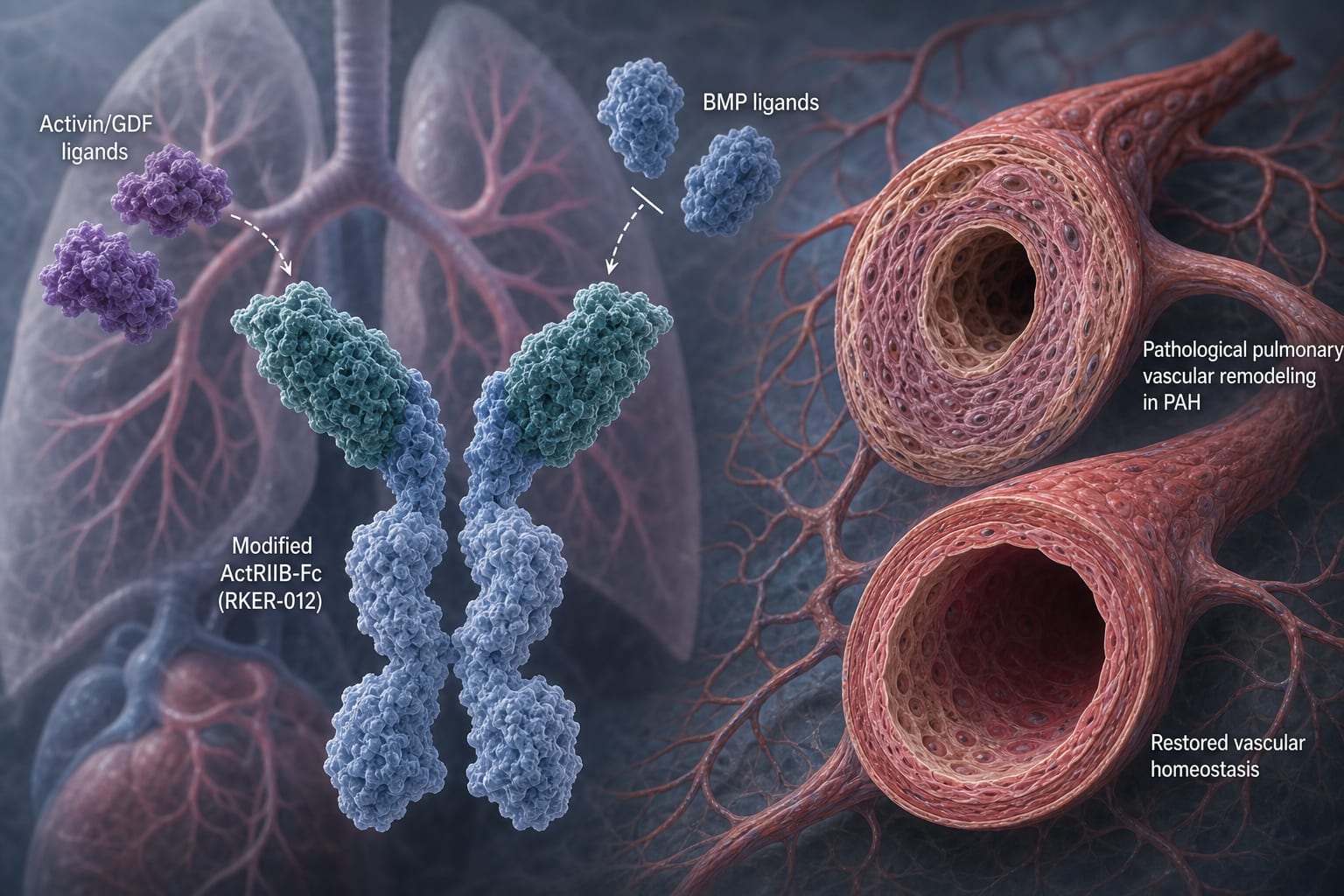
RKER-012, a modified ActRIIB-Fc ligand trap with BMP sparing properties, attenuates pathological features of experimental pulmonary arterial hypertension - Scorecard - MDSpire
Advertisement
RKER-012, a modified ActRIIB-Fc ligand trap with BMP sparing properties, attenuates pathological features of experimental pulmonary arterial hypertension
Clinical Scorecard: RKER-012: A Modified ActRIIB-Fc Ligand Trap That Preserves BMP Function and Reduces Pathological Changes in Experimental Pulmonary Arterial Hypertension
At a Glance
Category
Detail
Condition
Pulmonary Arterial Hypertension (PAH)
Key Mechanisms
Overactive activin/GDF signaling and BMP signaling imbalance contribute to vascular remodeling and RV failure.
Target Population
Patients with pulmonary arterial hypertension and related cardiovascular conditions.
Care Setting
Clinical research and experimental models.
Key Highlights
KER-012/RKER-012 preserves BMP function while targeting activin/GDF signaling.
Unlike sotatercept, KER-012/RKER-012 does not induce erythrocytosis or thrombocytopenia.
The modified ligand trap could reduce risks of hyperviscosity syndrome and bleeding.
KER-012/RKER-012 demonstrated potential in improving pulmonary vascular remodeling.
Clinical trials are underway to assess KER-012's effects in at-risk populations.
Guideline-Based Recommendations
Diagnosis
Evaluate pulmonary artery pressure and RV function in suspected PAH cases.
Management
Consider targeting activin/GDF signaling in PAH treatment strategies.
Monitoring & Follow-up
Monitor for signs of thrombocytopenia and erythrocytosis in patients receiving activin receptor ligand traps.
Risks
Be aware of potential hyperviscosity syndrome and bleeding risks associated with certain treatments.
Patient & Prescribing Data
Individuals with pulmonary arterial hypertension, particularly those with heritable forms.
Modified ligand traps like KER-012 may offer therapeutic advantages by minimizing adverse effects.
Clinical Best Practices
Utilize BMP-sparing strategies in the management of PAH.
Incorporate monitoring protocols for hematologic changes in patients treated with activin receptor inhibitors.
by R. Keith Babbs, Jeanne Ishimwe, Chris Materna, ffolliott M. Fisher, Tandicka Nurse, Cynthia Pinkus, Pritesh Jain, Kevin Dagbay, Rosa Grenha, Tyler Daman, Claire C. Tseng, Emily A. Ledoux, Evan Lema, Alana Gudelsky, Francis Wolenski, Harveen D. Natarajan, Lorena Lerner, Jennifer L. Lachey, Jasbir Seehra, Sachindra R. Joshi