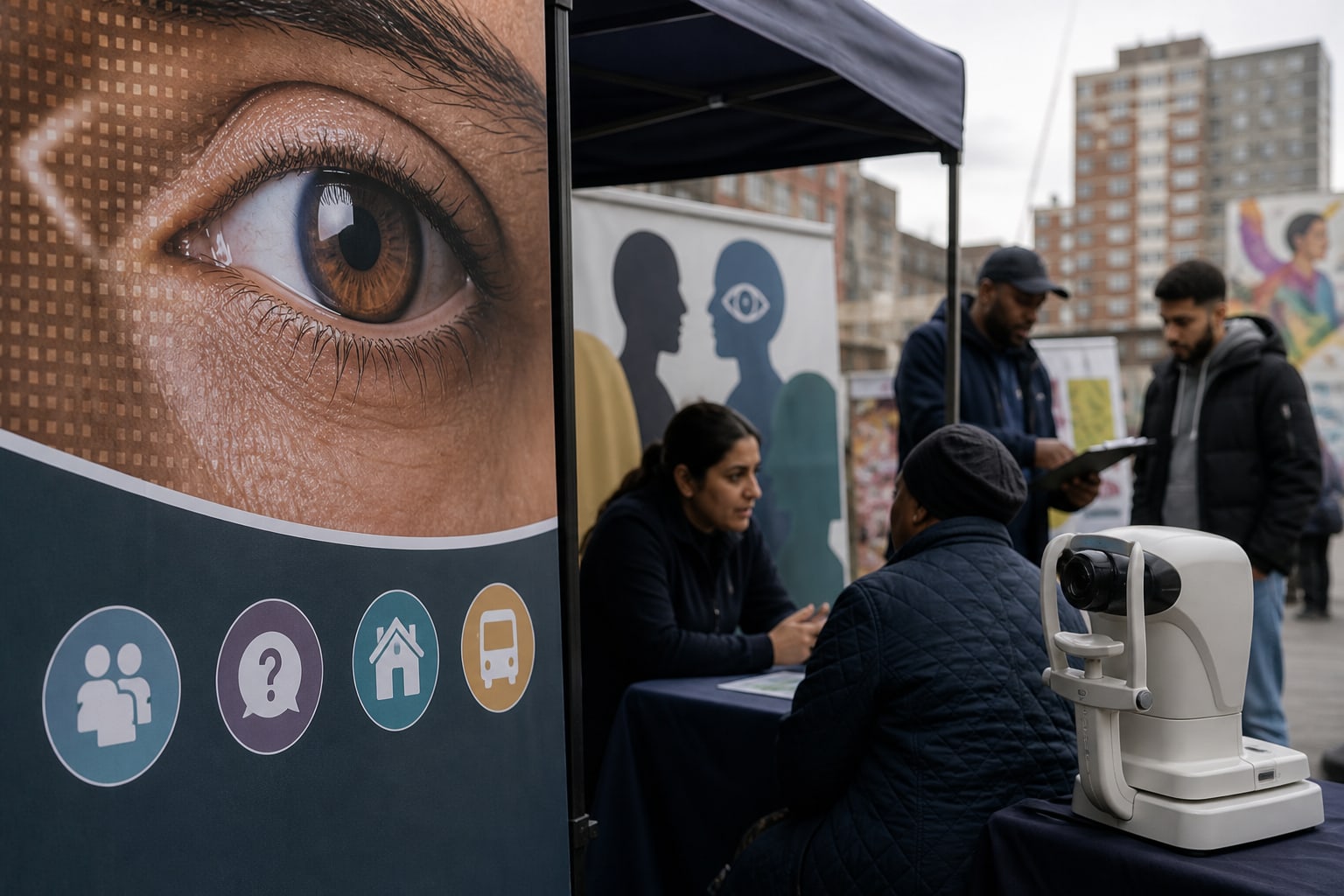
Community Event Assessment of Glaucoma Awareness and Obstacles to Eye Testing in an Urban Deprived Area
-
By
-
Thomas JM Weatherby
-
Neeru Amrita Vallabh
-
November 7, 2026
Clinical Scorecard: Community Event Assessment of Glaucoma Awareness and Obstacles to Eye Testing in an Urban Deprived Area
At a Glance
| Category | Detail |
|---|---|
| Condition | Glaucoma awareness and perceived barriers to eye testing in a deprived urban community |
| Key Mechanisms | Case finding for primary open-angle glaucoma is difficult because available diagnostic tests have low positive predictive value in the general population, where disease prevalence is low. |
| Target Population | Twenty-three consecutive attendees at a community glaucoma awareness event in a diverse urban community. |
| Care Setting | Community centre in a neighbourhood in the most deprived decile overall and the most deprived 1% for health and disability deprivation. |
Key Highlights
- In this cohort, 87% had heard of glaucoma and 57% demonstrated good understanding.
- Forty percent believed vision changes occur early in glaucoma; some participants said they would defer eye testing until symptoms developed.
- Thirty-nine percent reported that their eye pressure had never been measured.
- Forty-three percent reported relatives with glaucoma, so selection bias cannot be excluded.
- Participants commonly said that further information about the importance of eye tests would encourage more regular attendance.
Guideline-Based Recommendations
Diagnosis
- The article reports that available tests for primary open-angle glaucoma have low positive predictive value for case finding in the general population.
Management
- The authors recommend that community initiatives provide actionable information: glaucoma can be asymptomatic, eye pressure measurement forms part of routine optometric assessment, and regular sight testing remains important without visual symptoms.
Monitoring & Follow-up
- The authors recommend communicating the importance of regular sight testing, including when visual symptoms are absent.
Risks
- The article reports higher glaucoma prevalence in socioeconomically deprived populations and links greater neighbourhood deprivation with delayed presentation, more severe disease at presentation, and poorer outcomes.
- NHS General Ophthalmic Service sight test claim data indicate that people in the most deprived areas are five times less likely to attend NHS sight tests.
Patient & Prescribing Data
Twenty-three consecutive attendees at a community glaucoma awareness event in a deprived urban area; 43% reported relatives with glaucoma.
The article reports no prescribing data. It cites previous findings that understanding blindness risk and confidence in treatment effectiveness improve compliance.
Clinical Best Practices
- The authors recommend tailoring community awareness interventions to the community’s existing level of understanding.
- The authors recommend explaining that glaucoma can be asymptomatic and that eye pressure measurement forms part of routine optometric assessment.
- The authors recommend providing actionable information on the importance of regular sight testing, including in the absence of visual symptoms.
- The authors recommend addressing misconceptions that vision changes occur early in glaucoma and that testing can wait until symptoms develop.
Related Resources & Content
Based on findings from:
Glaucoma awareness and barriers to eye testing at a community event in a deprived urban setting
Thomas JM Weatherby, Neeru Amrita Vallabh. Eye, 2026.
https://www.nature.com/articles/s41433-026-04941-z
This content is an AI-generated, fully rewritten summary based on a published scholarly article. It does not reproduce the original text and is not a substitute for the original publication. Readers are encouraged to consult the source for full context, data, and methodology.