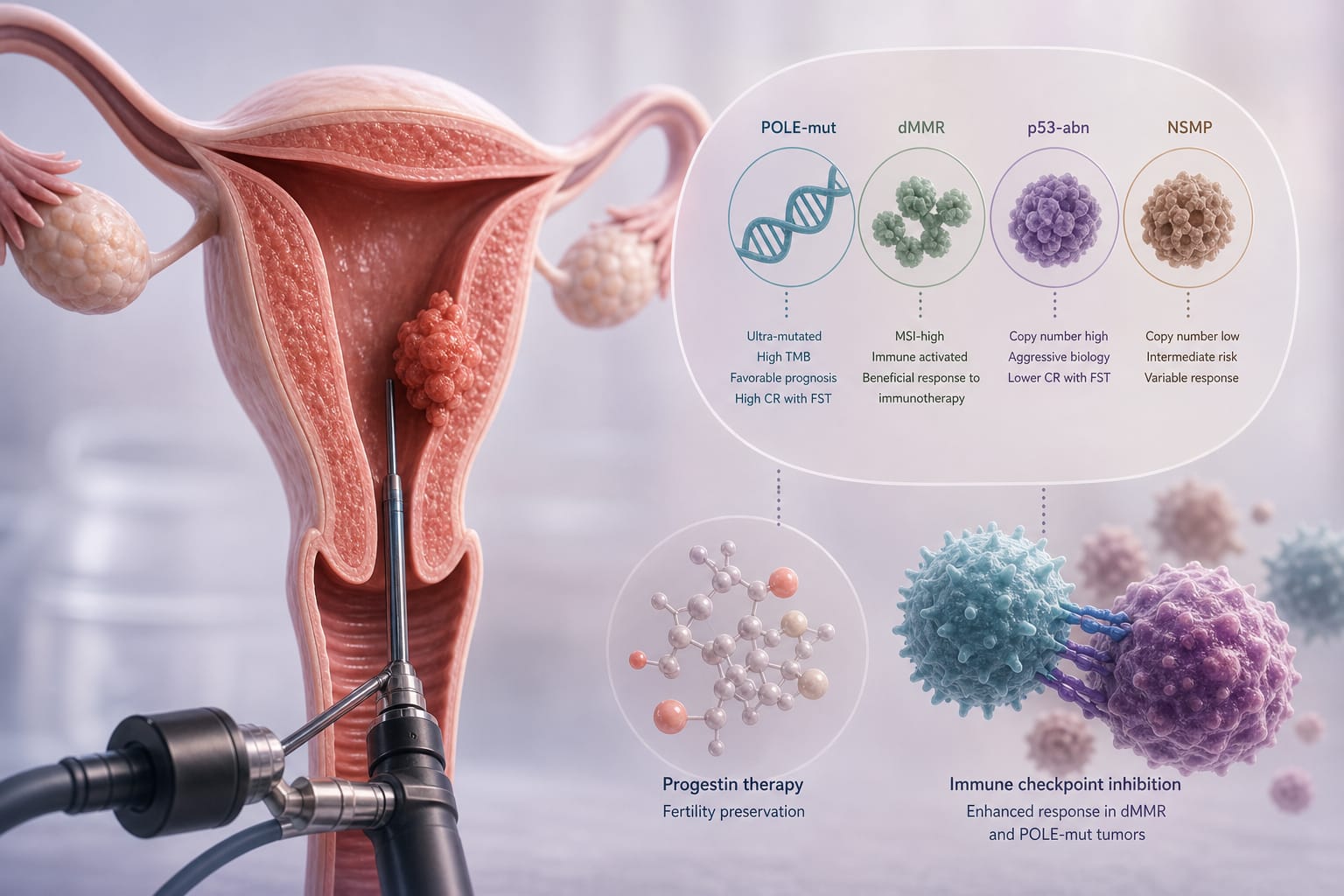
Molecular Subtyping and Immunotherapy in Fertility-Preserving Approaches for Endometrial Cancer: Challenges and Prospects
-
By
-
Jing Li
-
Shixiang Dong
-
Dongdong Hu
-
Wen Feng
-
July 9, 2026
Clinical Scorecard: Molecular Subtyping and Immunotherapy in Fertility-Preserving Approaches for Endometrial Cancer: Challenges and Prospects
At a Glance
| Category | Detail |
|---|
| Condition | Endometrial Cancer |
| Key Mechanisms | Molecular classification, progestin therapy, immune checkpoint inhibitors |
| Target Population | Young women with endometrial cancer desiring fertility preservation |
| Care Setting | Oncology and reproductive health |
Key Highlights
- Endometrial cancer incidence is rising, with approximately 417,000 new cases in 2020.
- Fertility-sparing treatment (FST) is available for select patients to preserve fertility.
- Molecular subtypes significantly influence prognosis and treatment response.
- POLE mutations are associated with higher complete remission rates.
- Immune checkpoint inhibitors may enhance outcomes in fertility-sparing treatment.
Guideline-Based Recommendations
Diagnosis
- Use hysteroscopic resection for accurate pathological diagnosis.
Management
- First-line FST includes LNG-IUS; progestins like MPA and MA are alternatives.
Monitoring & Follow-up
- Patients must be informed of the need for total hysterectomy if FST fails.
Risks
- Patients with P53abn are not eligible for fertility-sparing therapy due to poor prognosis.
Patient & Prescribing Data
Women with well-differentiated endometrioid adenocarcinoma, grade 1, FIGO stage IA.
High-dose progestin regimens (160-320 mg for MA, 400-600 mg for MPA) yield superior outcomes.
Clinical Best Practices
- Ensure multidisciplinary team guidance for FST.
- Discuss risks of persistence or recurrence in patients with Lynch syndrome.
Related Resources & Content